
Animal Adaptations Worksheet
How Animals Adapt
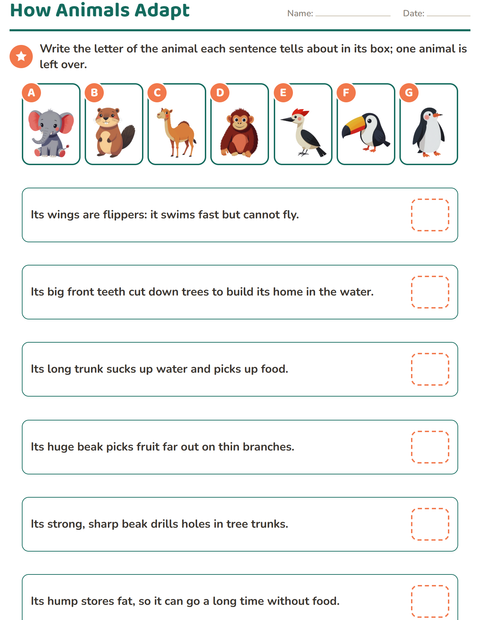
Seven animal pictures across the top of this 2nd grade page carry the letters A to G: an elephant, a beaver, a camel, a monkey, a woodpecker, a toucan and a penguin. Six sentences below each end in an empty box, and the child writes the letter of the animal the sentence tells about. The sentences describe a body part and what it does: wings that are flippers, so it swims fast but cannot fly; big front teeth that cut down trees to build a home in the water; a long trunk that sucks up water and picks up food; a huge beak that picks fruit far out on thin branches; a strong, sharp beak that drills holes in tree trunks; and a hump that stores fat, so it can go a long time without food.
An adaptation is a body part that fits the way an animal lives, and every sentence here pairs the part with its job. That is the move second grade science asks for when children compare how animals are suited to their surroundings. There are two beaks in the list, one for fruit and one for drilling, so children have to read to the end of the sentence rather than stop at the word beak. There is also one animal too many, and the instruction says so: the monkey has no sentence.
One sheet, six letters. Read the instruction aloud so children know from the start that one animal is left over. The penguin sentence is a good one to discuss, because a bird that cannot fly surprises many children. A good extension is to write the missing monkey sentence together, about its long arms or its gripping hands. The habitat report face comes next in the family, where children write about a whole habitat themselves.
What's inside
- 7 pictures
- Answer key included
- Print as PDF or play online — free, no sign-up
Updated September 24, 2026
More worksheets to try
Made with the Animal Adaptations Worksheets maker
Worksheet-maker page coming soon.