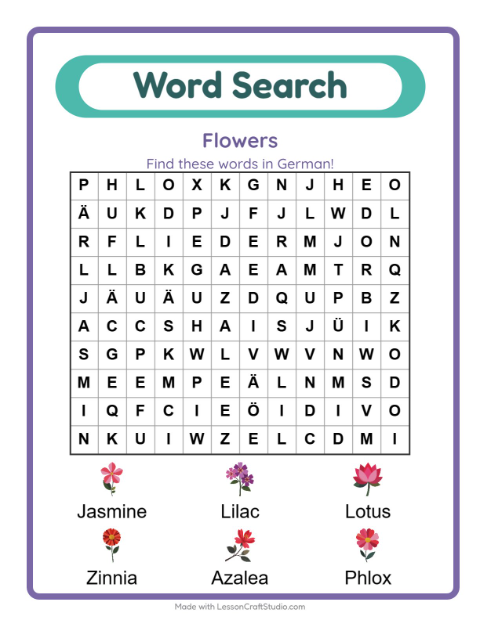
Learn German: picture word search
Flower names in German that a reader will half-recognise
Four of these six will look almost familiar to an English reader. PHLOX and LOTUS are spelled exactly as we spell them, JASMIN drops the final E of jasmine, and AZALEE ends in a second E where azalea ends in A. Only FLIEDER, which is lilac, and ZINNIE, which is zinnia, must be learned outright. That makes a gentle sheet for a child a few weeks into German.
Near-cousins like these are worth pointing out, because they show a child that a new language is not entirely new territory. But the small differences are exactly what gets lost in a grid: anyone hunting for jasmine will not find JASMIN, and a child looking for zinnia will pass over ZINNIE without a flicker. Ask them to read the printed word letter by letter before the scanning begins.
The pictures carry the naming, so no adult needs to know one flower from another to help. Say each word once while you look at its picture — flieder starts like the English flee — and let the hunt start. It suits a spring afternoon, a garden week at school, or any point where a child's German is ready to move past the first handful of everyday things. Six words, one grid, and a pencil is the whole of the equipment list.
What's inside
- 6 exercises
- 6 words
- Answer key included
- Print as PDF or play online — free, no sign-up
Updated June 13, 2026
The 6 words in this worksheet
- Azalee
- Flieder
- Phlox
- Zinnie
- Jasmin
- Lotus