
Sun, Moon and Planets Worksheet
Why Do We Have Day and Night?
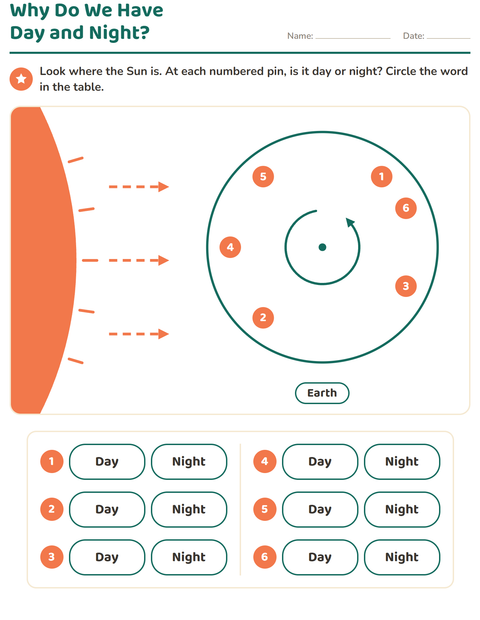
A large piece of the Sun glows at the left edge of this 2nd grade page, sending three dashed arrows of light to the right. Beside it is a big circle labeled Earth, with a curved arrow at its center showing that it spins, and six numbered pins placed around the inside of the circle. Below is a table with the numbers 1 to 6 and two chips for each, Day and Night. The child looks where the Sun is and circles day or night for each pin. On the sheet shown pins 2, 4 and 5 sit on the half facing the Sun, and pins 1, 3 and 6 on the far half.
Day and night happen because the Earth turns, so each place spends part of the time facing the Sun and part facing away. This page asks children to use that idea rather than recite it. The circle is not shaded, so the child has to decide which half is lit by looking at where the light comes from; that is the reasoning the page is built on. Pins 2 and 5 sit closer to the middle than the others, so ask children to draw a line down the circle first, splitting it into the half toward the Sun and the half away.
One sheet, six pins, six circles. The Earth is labeled but drawn without land, so it reads as a plain circle; hold up a globe and point to where it would sit. A globe and a lamp in a dark room make the idea visible in minutes: stick a paper figure on the globe and turn it slowly. The full explanation of the Earth's spin belongs to NGSS 5-ESS1-2, well above this grade, so here it is the simple idea only.
What's inside
- Answer key included
- Print as PDF or play online — free, no sign-up
Updated September 23, 2026
More worksheets to try
Made with the Sun, Moon and Planets Worksheets maker
Worksheet-maker page coming soon.