- Question 1: 9 - 5 blank.
- Question 2: 7 - 5 blank.
- Question 3: 20 - 10 blank.
- Question 4: 2 + 7 blank.
- Question 5: 15 - 8 blank.
- Question 6: 7 + 1 blank.
- Question 7: 3 + 2 blank.
- Question 8: 1 + 5 blank.
- Question 9: 14 - 11 blank.

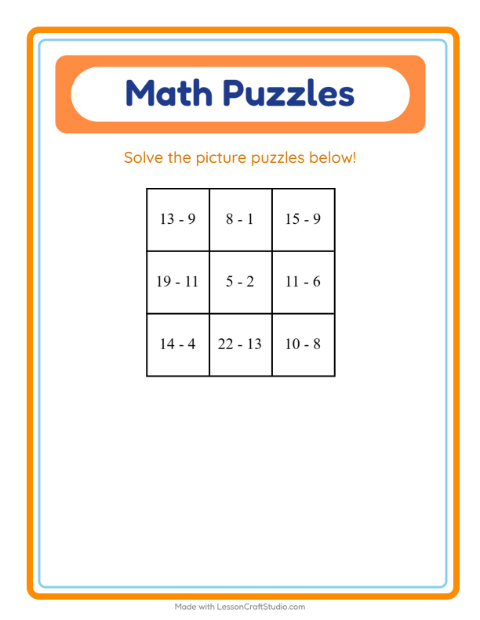
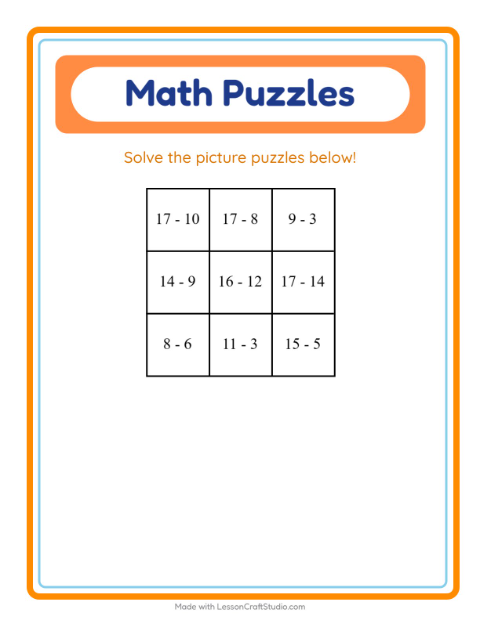
Addition and subtraction are mixed on the same sheet, so a child has to read the sign each time: 3 + 2, then 20 - 10. Switching between the two is a separate difficulty from the arithmetic itself.
The nine problems on this sheet: 9 - 5, 7 - 5, 20 - 10, 2 + 7, 15 - 8, 7 + 1, 3 + 2, 1 + 5, 14 - 11.
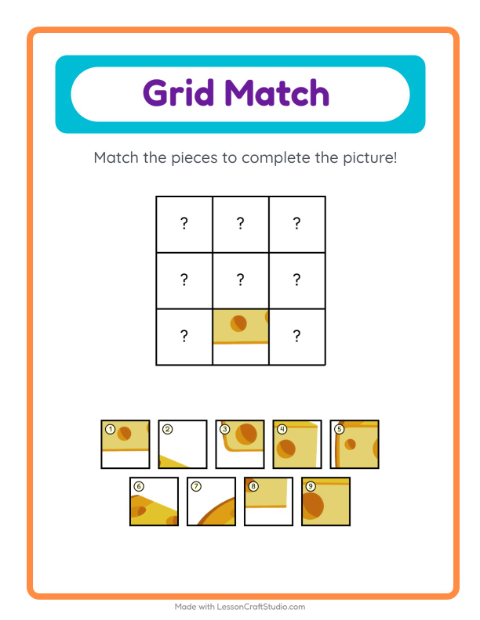
A wrong answer breaks the picture, so a child sees the mistake straight away and can fix it without waiting for an adult. It shows where they went wrong, not why. Every sheet uses the same nine answers, 2 to 10. Some children will match by piece shape instead of calculating — asking them to read two facts aloud settles it.
Best suited to a math center or station rotation, where a child needs to finish something without an adult and without anyone marking it. A complete picture is a five-metre glance-check across the room.
The answer key lists all nine results, which is the quickest way to check the level before printing. Note that crossing 10 only comes up in the subtraction here; adding over ten does not appear on this type of sheet. The completed picture shows a animals scene.