- Question 1: 1 + 4 blank.
- Question 2: 2 + 4 blank.
- Question 3: 3 + 4 blank.
- Question 4: 5 + 3 blank.
- Question 5: 7 + 3 blank.
- Question 6: 1 + 2 blank.
- Question 7: 1 + 1 blank.
- Question 8: 5 + 4 blank.
- Question 9: 1 + 3 blank.

Nine problems, none of them crossing 10 — 1 + 1 and 7 + 3 are typical. This is consolidation of adding rather than new ground. Filed under Grade 1, though everything here stays within 10 and nothing crosses it — most teachers will reach for it in Kindergarten or Year 1, or in Grade 1 as review.
The nine problems on this sheet: 1 + 4, 2 + 4, 3 + 4, 5 + 3, 7 + 3, 1 + 2, 1 + 1, 5 + 4, 1 + 3.
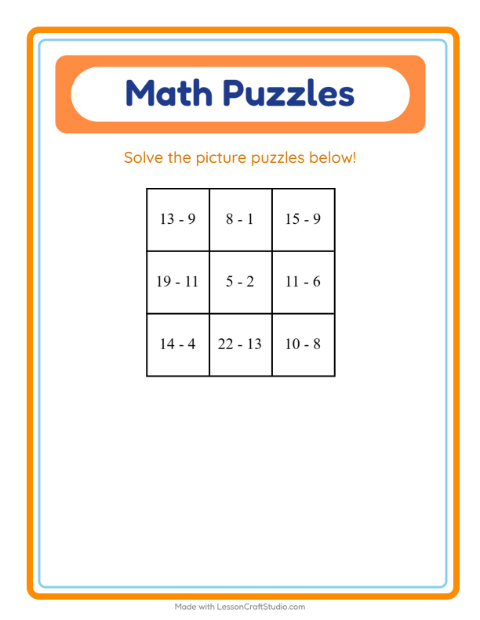
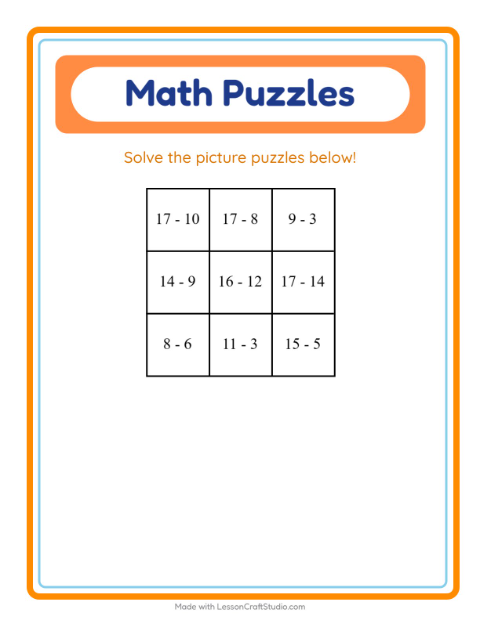
The picture is the check: it only completes when all nine answers are right. That is what makes the sheet work without an adult standing over it. Every sheet uses the same nine answers, 2 to 10. Some children will match by piece shape instead of calculating — asking them to read two facts aloud settles it.
Best suited to a math center or station rotation, where a child needs to finish something without an adult and without anyone marking it. A complete picture is a five-metre glance-check across the room.
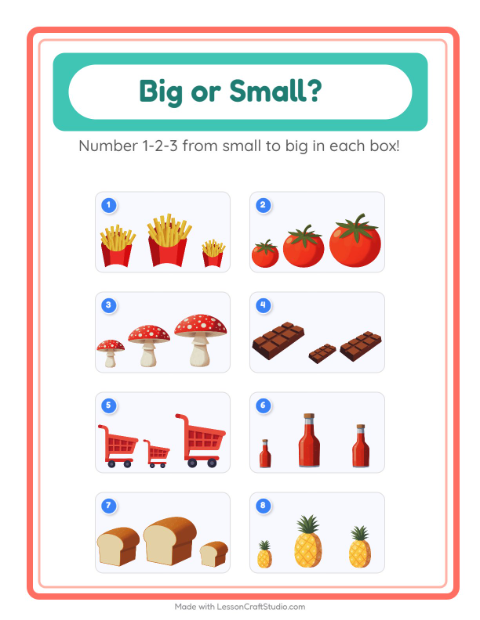
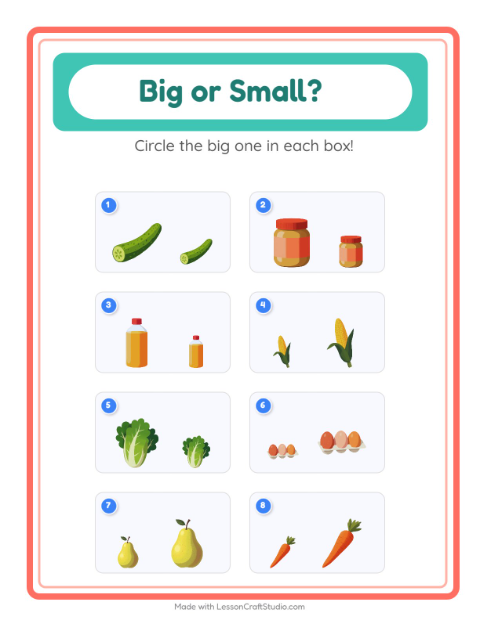
The answer key lists all nine results, which is the quickest way to check the level before printing. The completed picture shows a At the Supermarket scene.