- Question 1: 3 - 1 blank.
- Question 2: 18 - 12 blank.
- Question 3: 11 - 3 blank.
- Question 4: 16 - 13 blank.
- Question 5: 24 - 14 blank.
- Question 6: 14 - 7 blank.
- Question 7: 10 - 6 blank.
- Question 8: 22 - 13 blank.
- Question 9: 16 - 11 blank.

This sheet practises taking away with numbers up to 24. 3 of 9 problems cross 10, which is what makes one sheet harder than another at this stage. Filed under Grade 1, though the numbers here go above 20 — closer to Grade 2 or Year 3. In Grade 1 it suits children already secure within 20.
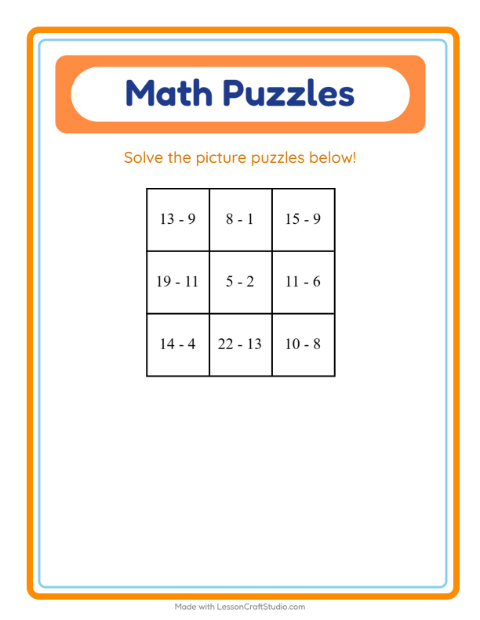
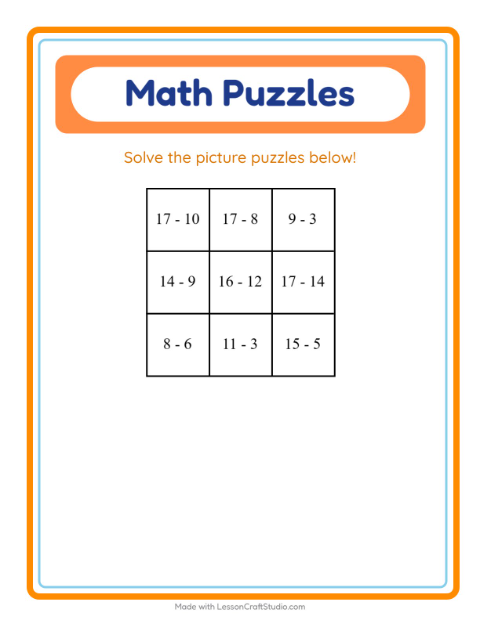
The nine problems on this sheet: 3 - 1, 18 - 12, 11 - 3, 16 - 13, 24 - 14, 14 - 7, 10 - 6, 22 - 13, 16 - 11.
A wrong answer breaks the picture, so a child sees the mistake straight away and can fix it without waiting for an adult. It shows where they went wrong, not why. The answers are always 2 to 10, one per piece, so ask children to solve all nine before placing any — otherwise the last few can be found by elimination.
Useful as cover or substitute work: the sheet corrects itself and the answer key is included, so an adult who does not know the class can run it.
The answer key lists all nine results, which is the quickest way to check the level before printing. Note that crossing 10 only comes up in the subtraction here; adding over ten does not appear on this type of sheet. The completed picture shows a classroom scene.