- Question 1: 1 + 1 blank.
- Question 2: 2 + 8 blank.
- Question 3: 8 + 1 blank.
- Question 4: 2 + 1 blank.
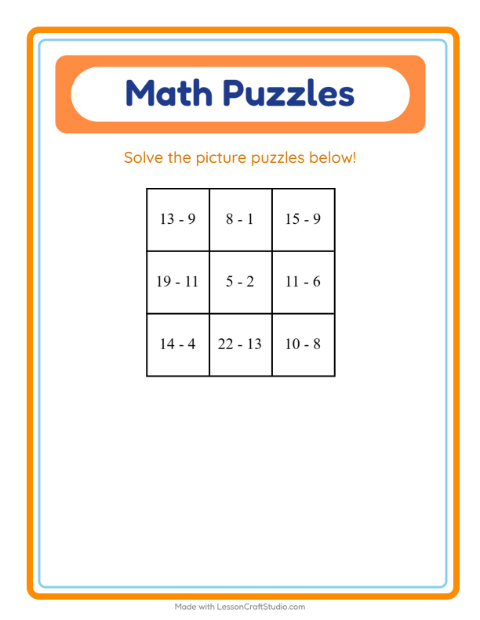
- Question 5: 19 - 11 blank.
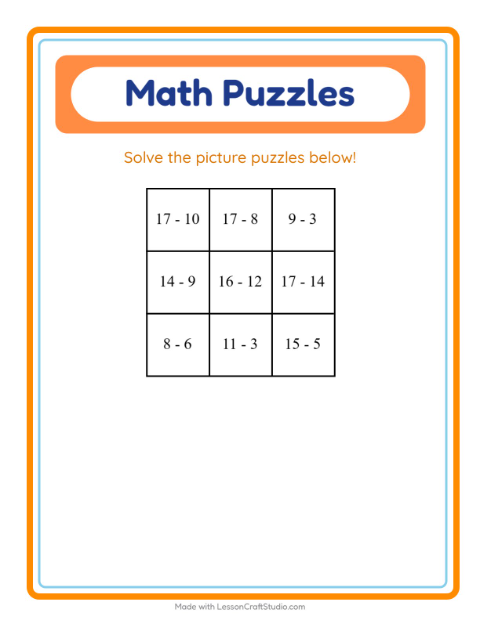
- Question 6: 17 - 10 blank.
- Question 7: 3 + 1 blank.
- Question 8: 4 + 1 blank.
- Question 9: 5 + 1 blank.

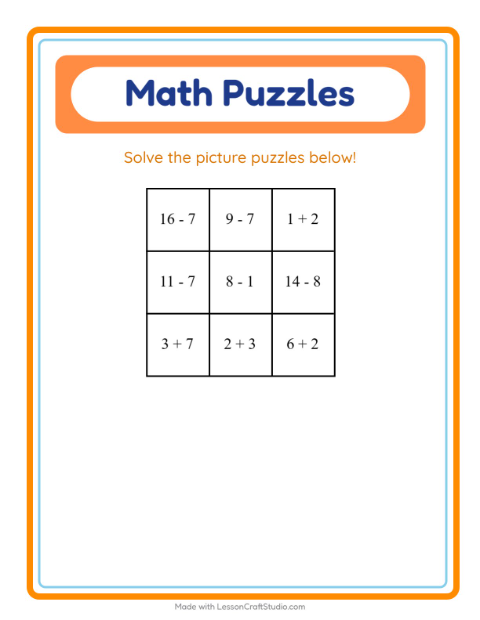
Addition and subtraction are mixed on the same sheet, so a child has to read the sign each time: 1 + 1, then 19 - 11. Switching between the two is a separate difficulty from the arithmetic itself.
The nine problems on this sheet: 1 + 1, 2 + 8, 8 + 1, 2 + 1, 19 - 11, 17 - 10, 3 + 1, 4 + 1, 5 + 1.
A wrong answer breaks the picture, so a child sees the mistake straight away and can fix it without waiting for an adult. It shows where they went wrong, not why. Because each answer from 2 to 10 appears exactly once, a child who has placed six pieces can deduce the rest. Having them write the answers first keeps it arithmetic.
Sent home, it works best after the strategy has been taught in class — a parent can support a method the child already knows, but will confidently teach a different one if they are guessing.
The answer key lists all nine results, which is the quickest way to check the level before printing. The completed picture shows a fruits scene.