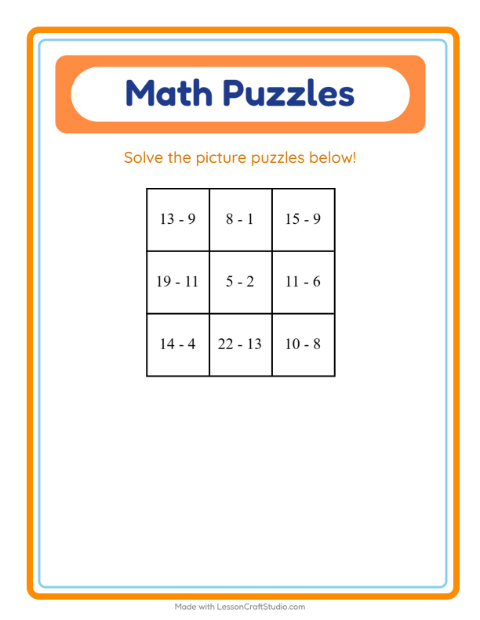
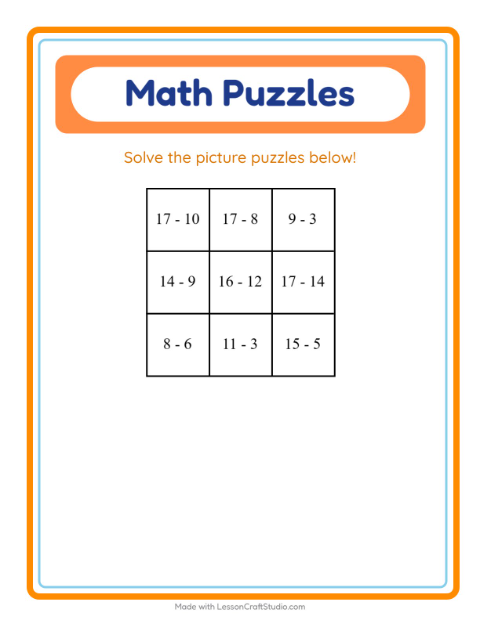
- Question 1: 10 - 6 blank.
- Question 2: 13 - 7 blank.
- Question 3: 15 - 13 blank.
- Question 4: 15 - 10 blank.
- Question 5: 19 - 12 blank.
- Question 6: 18 - 10 blank.
- Question 7: 23 - 14 blank.
- Question 8: 8 - 5 blank.
- Question 9: 21 - 11 blank.

Numbers on this sheet go up to 23, and 2 of 9 problems cross 10. That combination is what decides whether it fits your class this week. The catalog says Grade 1; the numbers say otherwise, reaching past 20. Treat it as Grade 2 work, or as a stretch for confident Grade 1 children.
The nine problems on this sheet: 10 - 6, 13 - 7, 15 - 13, 15 - 10, 19 - 12, 18 - 10, 23 - 14, 8 - 5, 21 - 11.
Because the sheet corrects itself, a child can fail privately and try again — which matters for children who are anxious about getting maths wrong. One mistake does leave the picture incomplete, so for children who find that discouraging it works better in pairs, or checked after every three pieces.
Nine problems is about five to ten minutes for a secure child, which fits early finishers and morning work. It practises something already taught rather than introducing anything new.
The answer key lists all nine results, which is the quickest way to check the level before printing. Note that crossing 10 only comes up in the subtraction here; adding over ten does not appear on this type of sheet. The completed picture shows a occupations scene.