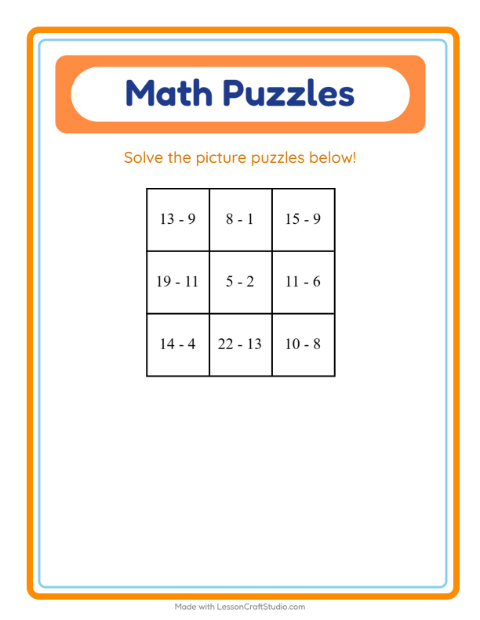
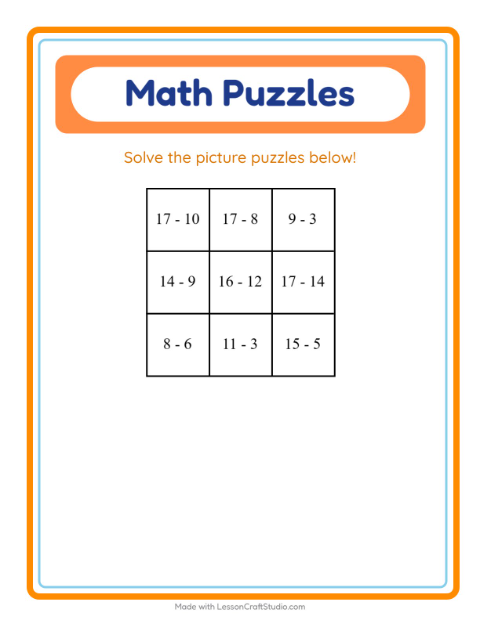
- Question 1: 1 + 2 blank.
- Question 2: 1 + 1 blank.
- Question 3: 3 + 3 blank.
- Question 4: 2 + 6 blank.
- Question 5: 1 + 4 blank.
- Question 6: 5 + 4 blank.
- Question 7: 3 + 1 blank.
- Question 8: 2 + 8 blank.
- Question 9: 3 + 4 blank.

Nine problems, none of them crossing 10 — 1 + 1 and 2 + 8 are typical. This is consolidation of adding rather than new ground. The catalog files this as Grade 1. The arithmetic on it is Kindergarten and Year 1 work, which also makes it useful for early-in-year revision higher up.
The nine problems on this sheet: 1 + 2, 1 + 1, 3 + 3, 2 + 6, 1 + 4, 5 + 4, 3 + 1, 2 + 8, 3 + 4.
The picture is the check: it only completes when all nine answers are right. That is what makes the sheet work without an adult standing over it. Every sheet uses the same nine answers, 2 to 10. Some children will match by piece shape instead of calculating — asking them to read two facts aloud settles it.
Nine problems is about five to ten minutes for a secure child, which fits early finishers and morning work. It practises something already taught rather than introducing anything new.
The answer key lists all nine results, which is the quickest way to check the level before printing. The completed picture shows a summer scene.