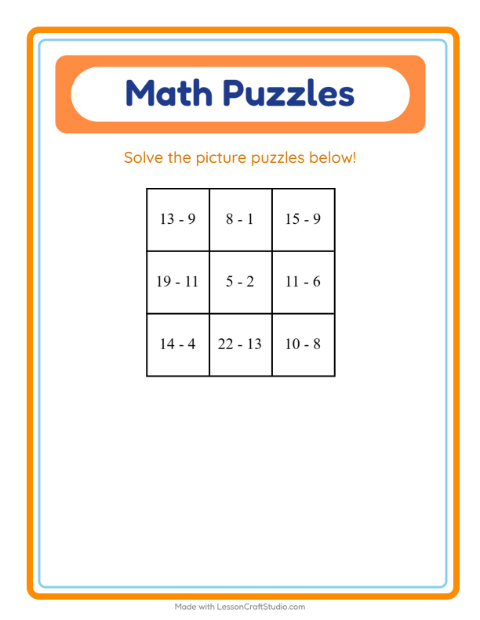
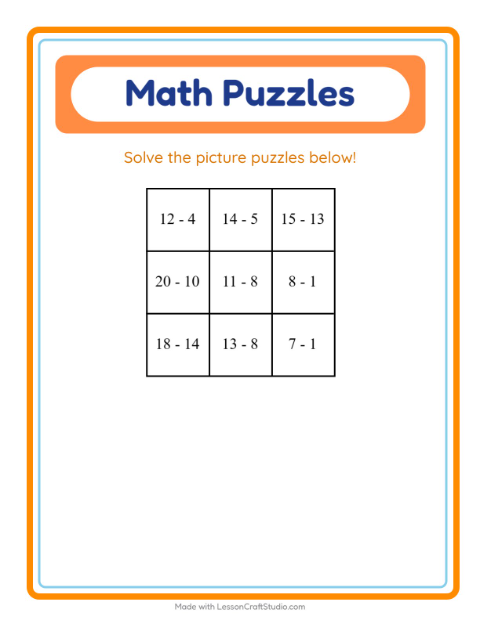
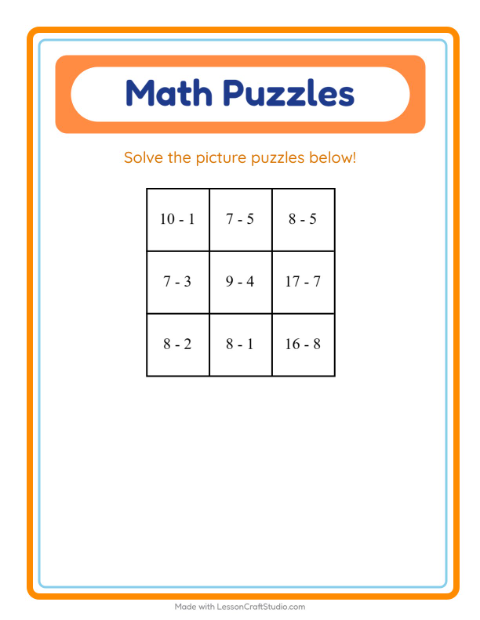
- Question 1: 13 - 11 blank.
- Question 2: 5 + 2 blank.
- Question 3: 13 - 3 blank.
- Question 4: 5 - 2 blank.
- Question 5: 4 + 5 blank.
- Question 6: 11 - 7 blank.
- Question 7: 1 + 5 blank.
- Question 8: 15 - 10 blank.
- Question 9: 21 - 13 blank.

Addition and subtraction are mixed on the same sheet, so a child has to read the sign each time: 5 + 2, then 21 - 13. Switching between the two is a separate difficulty from the arithmetic itself. The catalog says Grade 1; the numbers say otherwise, reaching past 20. Treat it as Grade 2 work, or as a stretch for confident Grade 1 children.
The nine problems on this sheet: 13 - 11, 5 + 2, 13 - 3, 5 - 2, 4 + 5, 11 - 7, 1 + 5, 15 - 10, 21 - 13.
No timer and no score — a child works at their own pace and the picture is the only judge. Every sheet uses the same nine answers, 2 to 10. Some children will match by piece shape instead of calculating — asking them to read two facts aloud settles it.
Useful as cover or substitute work: the sheet corrects itself and the answer key is included, so an adult who does not know the class can run it.
The answer key lists all nine results, which is the quickest way to check the level before printing. Note that crossing 10 only comes up in the subtraction here; adding over ten does not appear on this type of sheet. The completed picture shows a winter scene.