
Division with Remainders Worksheet
Exact or Not? Divisions With and Without a Remainder
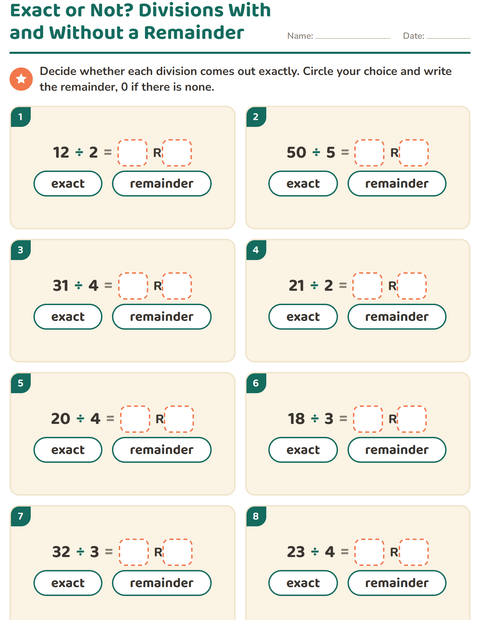
Eight cards on this 3rd grade page each carry one division — 12 ÷ 2, 50 ÷ 5, 31 ÷ 4, 21 ÷ 2, 20 ÷ 4, 18 ÷ 3, 32 ÷ 3, 23 ÷ 4 on the sheet shown — followed by two dashed boxes, the second marked R, and under them two pill-shaped chips reading exact and remainder. The child decides whether the division comes out exactly, circles the right chip, and then fills both boxes, writing 0 in the R box when nothing is left. Four of the eight are exact and four are not, and they are mixed, so the chip has to be earned card by card.
Deciding is the skill on this page, and it is the one the practice-rows page cannot test, because there every row has a remainder. Here 20 ÷ 4 sits next to 21 ÷ 2, and the child has to ask of each whether the dividend is in the table — is 31 a multiple of 4, is 18 a multiple of 3. Writing R 0 for the exact ones keeps the notation the same across the page and stops the idea that a remainder is something only some divisions have. Divisors stay inside 2 to 5 and every quotient stays at 10 or below.
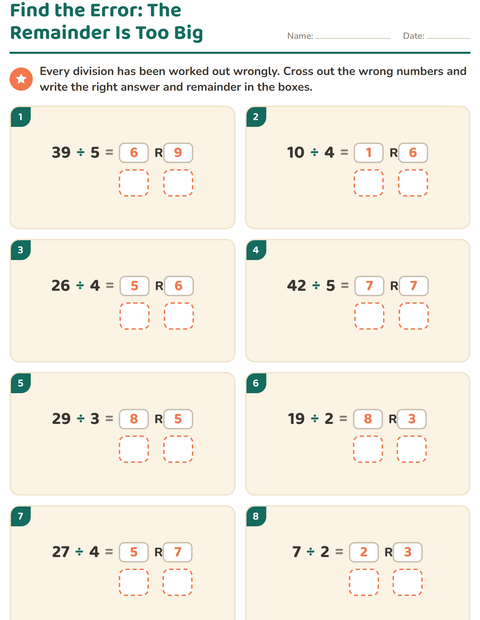
One sheet, eight decisions and sixteen boxes. This is the decision face of the division-with-remainders family, and the boundary is written into its title: half of these divisions come out exactly, and telling which is the task. Use it after the practice-rows page, and before the find-the-error page, where the child checks division that has already been done.
What's inside
- Answer key included
- Print as PDF or play online — free, no sign-up
Updated September 14, 2026
More worksheets to try
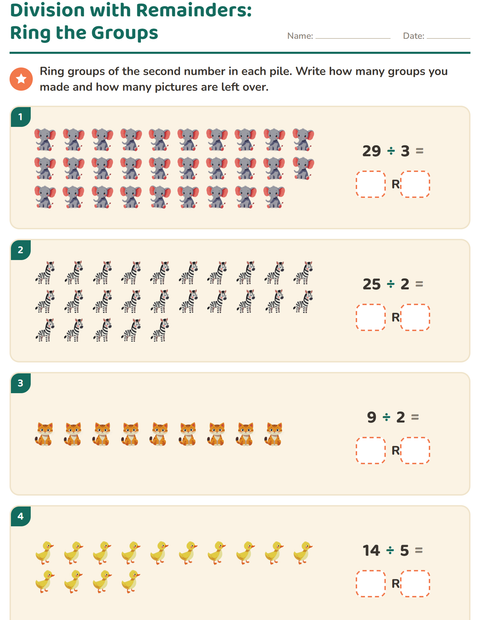
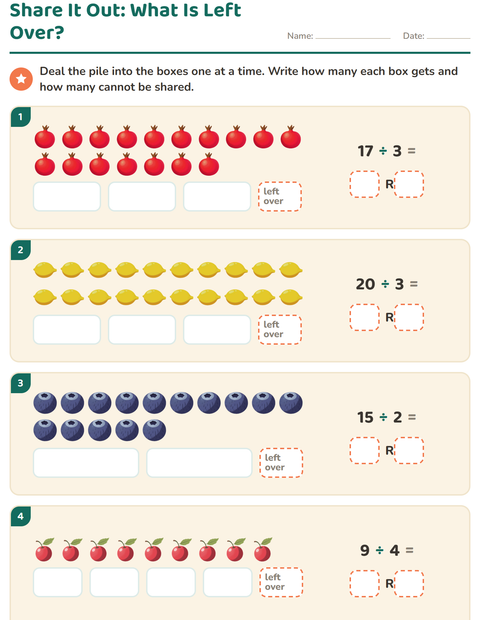
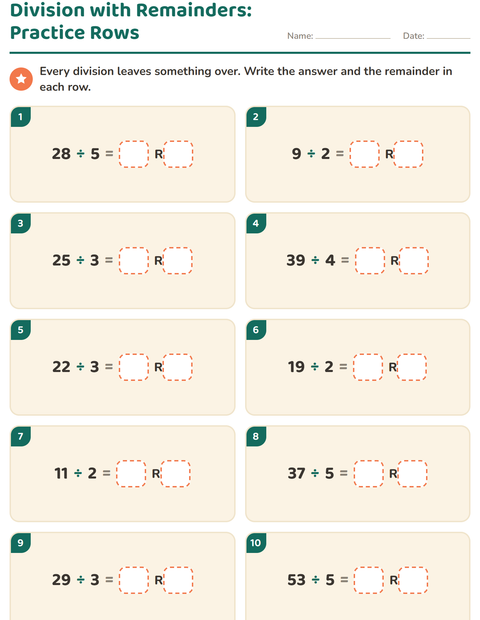
Math · grade 3
→
Made with the Division with Remainders Worksheets maker
Worksheet-maker page coming soon.