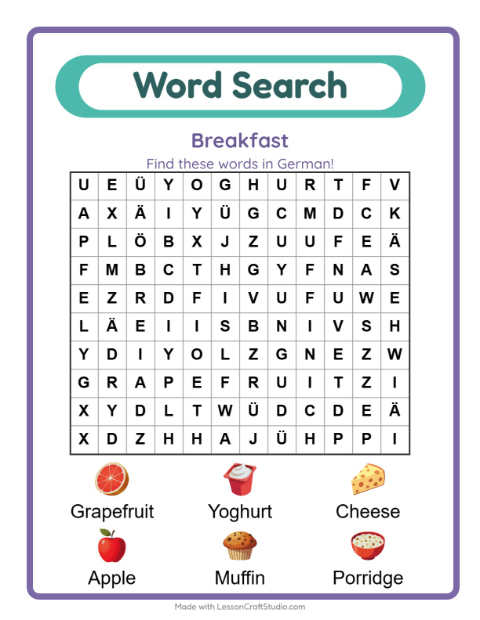
Learn German: picture word search
What is on the breakfast table, said in German
Six breakfast things are pictured, and their German names are hidden in the grid: porridge, yoghurt, a grapefruit, a muffin, cheese and an apple. Three of them barely change at all. YOGHURT, GRAPEFRUIT and MUFFIN are spelled close to what an English-speaking child expects, so those get circled quickly and the sheet starts well rather than stalling on the first line.
The other three do the real teaching. BREI is porridge and looks nothing like it. KÄSE carries an umlaut over the A, which changes the sound completely, so it is worth saying twice before searching. APFEL is near to apple but not identical, and children who half-remember it hunt for the English spelling and fail. Reading the printed word first prevents that particular quarter of an hour.
This is a good one to print and leave beside the actual breakfast, so a child can name what is in front of them. It also fills five minutes at the end of a language session. German gives every noun a capital first letter, so KÄSE and APFEL are written that way in an ordinary sentence too, not only inside a puzzle grid, which is a useful thing to mention while the pencil is still out and the word is still in front of them.
What's inside
- 6 exercises
- 6 words
- Answer key included
- Print as PDF or play online — free, no sign-up
Updated June 13, 2026
The 6 words in this worksheet
- Brei
- Yoghurt
- Grapefruit
- Muffin
- Käse
- Apfel