
Sun, Moon and Planets Worksheet
Giant and Rocky Planets
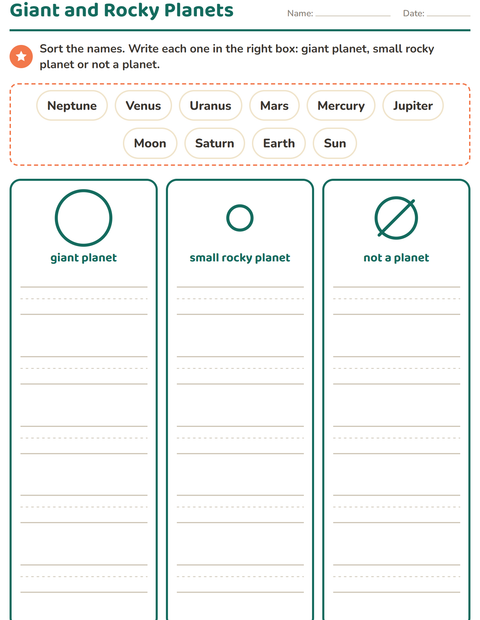
A bank of ten names sits at the top of this 3rd grade page: Neptune, Venus, Uranus, Mars, Mercury, Jupiter, Moon, Saturn, Earth and Sun on the sheet shown. Below are three tall sorting columns, each with five writing lines: giant planet, headed by a big circle; small rocky planet, headed by a small one; and not a planet, headed by a crossed-out circle. The child sorts the names and writes each one in the right column. Four go under giant, four under rocky and two under not a planet.
Sorting the planets into two kinds is how the solar system starts to make sense: four small rocky planets close to the Sun, four giant planets of gas and ice further out. The third column is where the thinking happens. The Sun and the Moon are the two bodies children most often call planets, and giving them their own column forces a decision about what a planet is. Every column has five lines, so the number of lines does not give the answer away.
One sheet, ten names, three columns. This page is above the kindergarten to grade 2 science range and fits a grade 3 space unit; there is no NGSS standard for sorting planets at this age. Do the planets in order face first, since knowing the order makes the split plain to see: the first four are rocky, the last four giant. A scale drawing on the playground in chalk is a memorable follow-up.
What's inside
- Answer key included
- Print as PDF or play online — free, no sign-up
Updated September 23, 2026
More worksheets to try
Made with the Sun, Moon and Planets Worksheets maker
Worksheet-maker page coming soon.