
Beginning, Middle, End Worksheet
Beginning, Middle and End of a Story
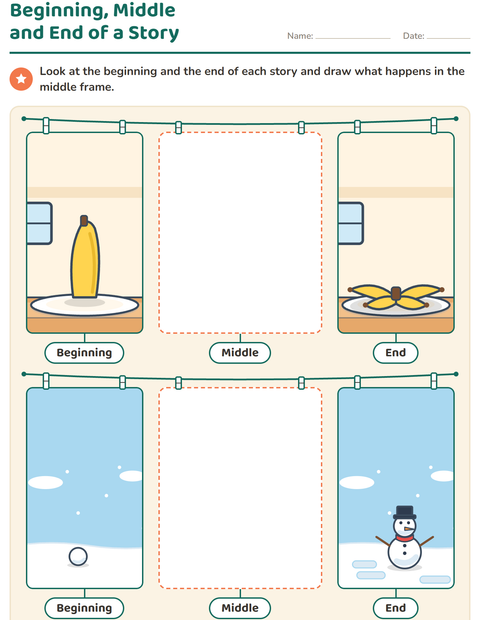
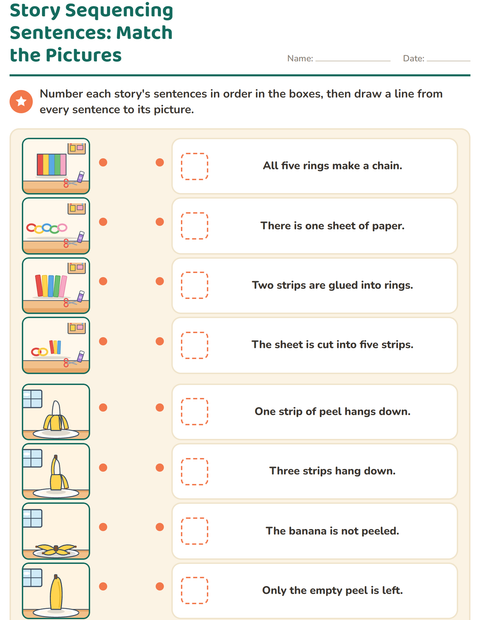
Two stories, and each is missing its heart. The frames on this 1st grade page are labeled Beginning, Middle and End, and only the outer two are drawn. On the sheet shown the first story begins with a whole banana on a plate and ends with nothing but its empty peel lying open. The second begins with one small snowball on the ground and ends with a finished snowman in a top hat, with twig arms, three buttons and a carrot nose. Between them is a tall dashed frame, and the child draws what happens in the middle: a half-peeled banana, say, or two big snowballs stacked without a face yet.
Writing a story in the first grade means including an event, then another, and closing it off, and a middle is the part children most often skip. Drawing it makes them decide what had to happen to get from the start to the finish. There is more than one good middle, which is the point: a banana with one strip down and a banana with three strips down are both honest answers, and comparing drawings around the room shows how many steps a story can hold.
Give children time; a drawn middle takes longer than a circled one. Afterwards, ask them to say the whole story in three sentences, one per frame. Snow falls from a pale sky in both snowman frames, so even the small first snowball reads as snow; ask what has to happen to it before a snowman can stand. This face is the drawing step of the story sequencing family, between choosing what happens next and writing the whole story with sentence starters.
What's inside
- Answer key included
- Print as PDF or play online — free, no sign-up
Updated October 1, 2026
More worksheets to try
Reading & Writing · grade 1
→
Made with the Beginning, Middle, End Worksheets maker
Worksheet-maker page coming soon.