Tutorial
1
Understand the Norwegian Market Opportunity
Norway's market characteristics create an unusually favorable environment for printable sellers willing to serve a smaller but high-value audience.
Demographics and purchasing power: Norway has 5.4 million residents with the highest GDP per capita in Scandinavia and among the highest globally. Norwegian families have substantial disposable income and consistently invest in children's education. The cultural emphasis on "dugnad" (community effort) and equal opportunity means parents actively supplement school learning with home activities.
Digital adoption: Norway ranks in the top five globally for digital readiness. Internet penetration exceeds 98%, and online purchasing is deeply embedded in daily life. Norwegian consumers are early adopters who routinely buy digital products without hesitation.
Competition analysis: The supply of Norwegian-language educational printables is extremely thin across all platforms. Etsy searches for "arbeidsark" (worksheet) or "oppgaver" (exercises) in Norwegian return a tiny fraction of English results. Most existing Norwegian listings are either English products with Norwegian tags or low-quality PDFs without professional formatting. This creates a wide-open market for quality-focused sellers.
Platform landscape:
Etsy: Norwegian buyers use Etsy actively, especially for unique and educational products. The platform's European presence serves Norway well, and Norwegian-language listings surface in native search queries.
Amazon: Norway does not have a dedicated Amazon marketplace (no amazon.no). Norwegian buyers typically use amazon.co.uk, amazon.de, or the Swedish amazon.se. KDP books in Norwegian can be published on European Amazon marketplaces and will reach Norwegian buyers.
Norwegian online bookstores: Ark.no and Norli.no are the largest Norwegian online bookstores. Physical activity books and puzzle compilations could eventually be sold through these channels, though the setup is more complex than Etsy.
Education system context: Norwegian grunnskole uses "trinn" (grade/step) designations: "1. trinn" through "7. trinn" for barneskole, "8. trinn" through "10. trinn" for ungdomsskole. Parents search for "1. trinn oppgaver" (grade 1 exercises) and "barneskole arbeidsark" (primary school worksheets). Use these terms in your listings.
2
Configure LessonCraftStudio Generators for Norwegian
Each LessonCraftStudio generator supports Norwegian with correct character handling and authentic Bokmal vocabulary.
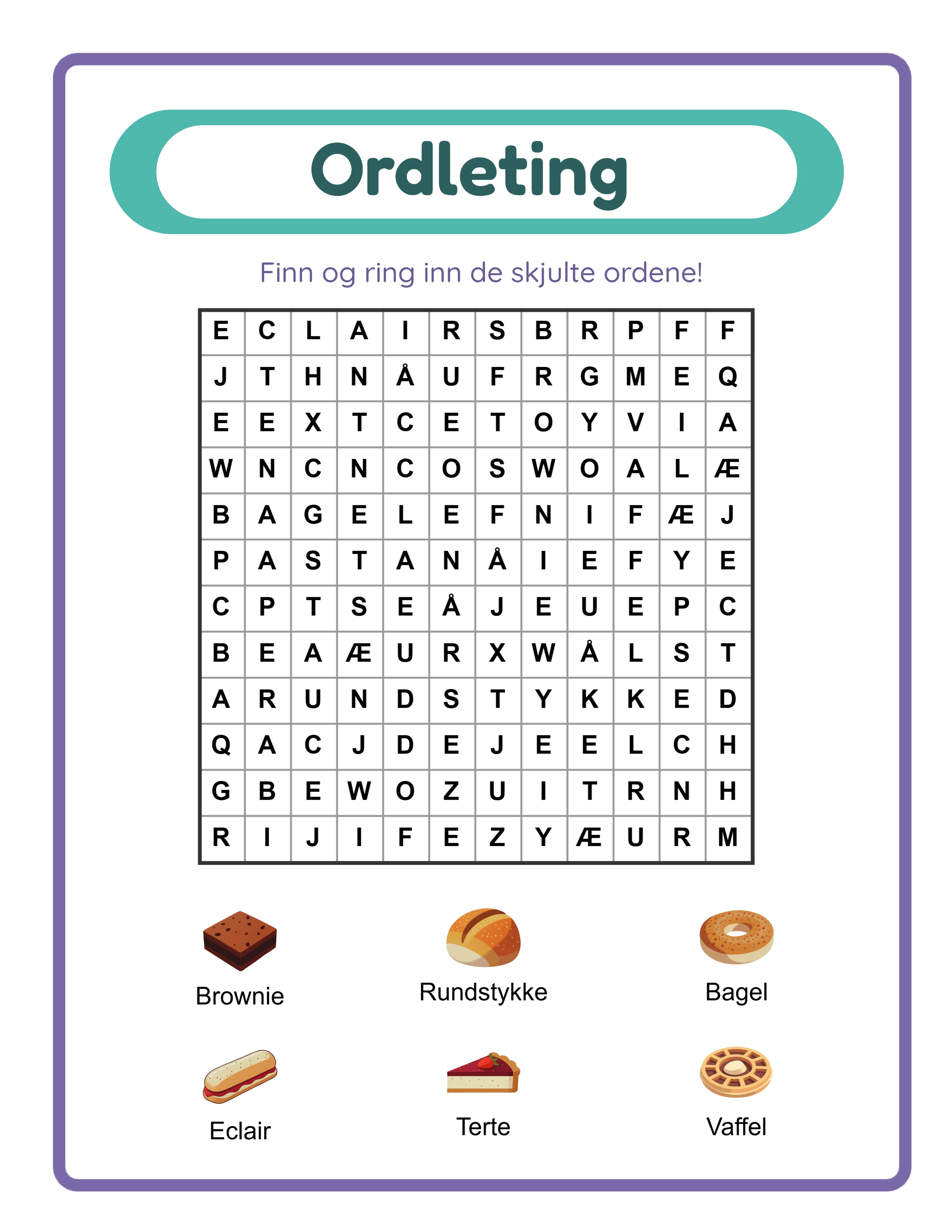
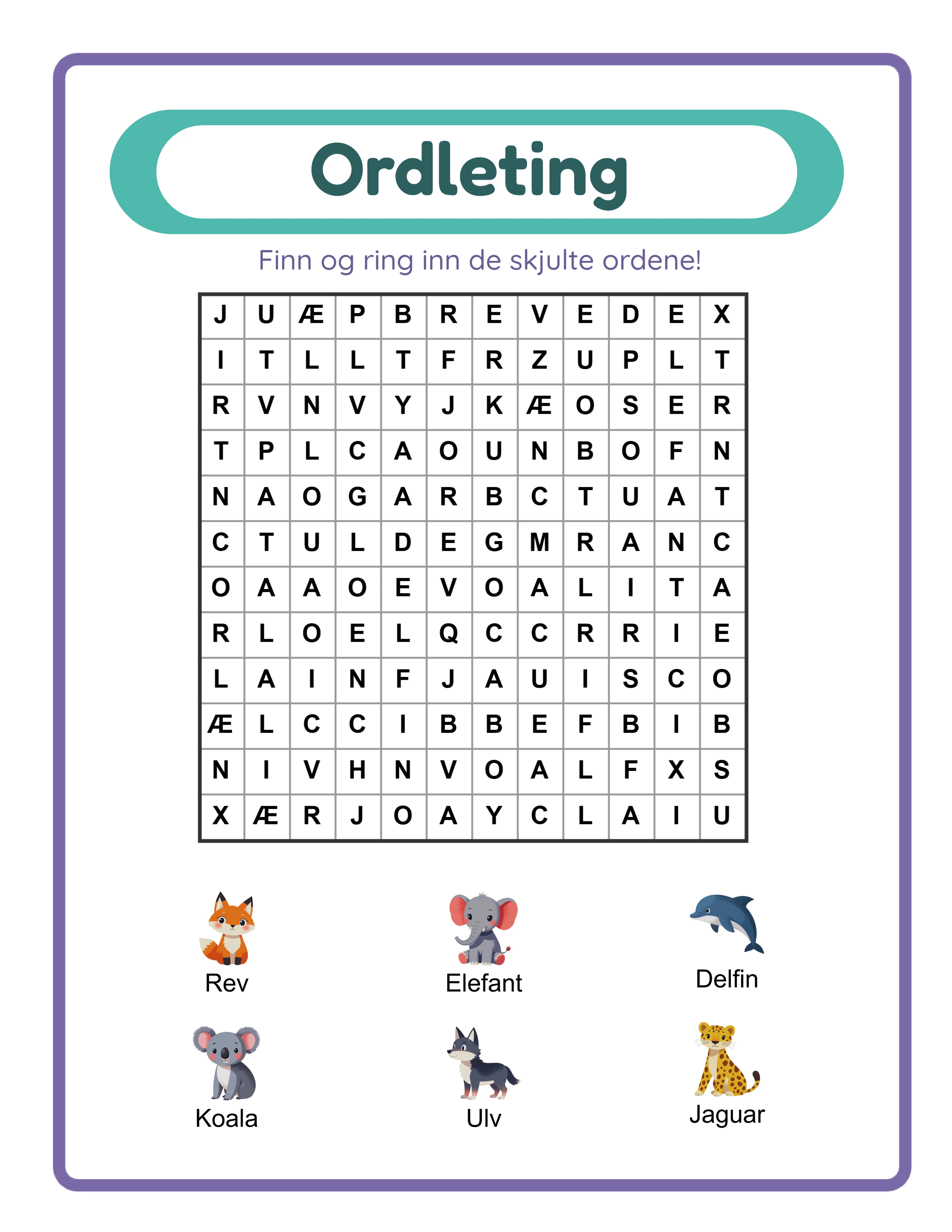
Word Search Generator: Select "Norsk" from the language dropdown. The generator fills word search puzzles with Norwegian vocabulary from the selected theme. An "animals" theme generates puzzles with words like "elefant" (elephant), "sjiraff" (giraffe), "skilpadde" (turtle), "sommerfugl" (butterfly), and "krokodille" (crocodile). Filler letters include the three Norwegian special characters (a-diaeresis, o-with-stroke, a-ring), creating authentically Norwegian puzzles.
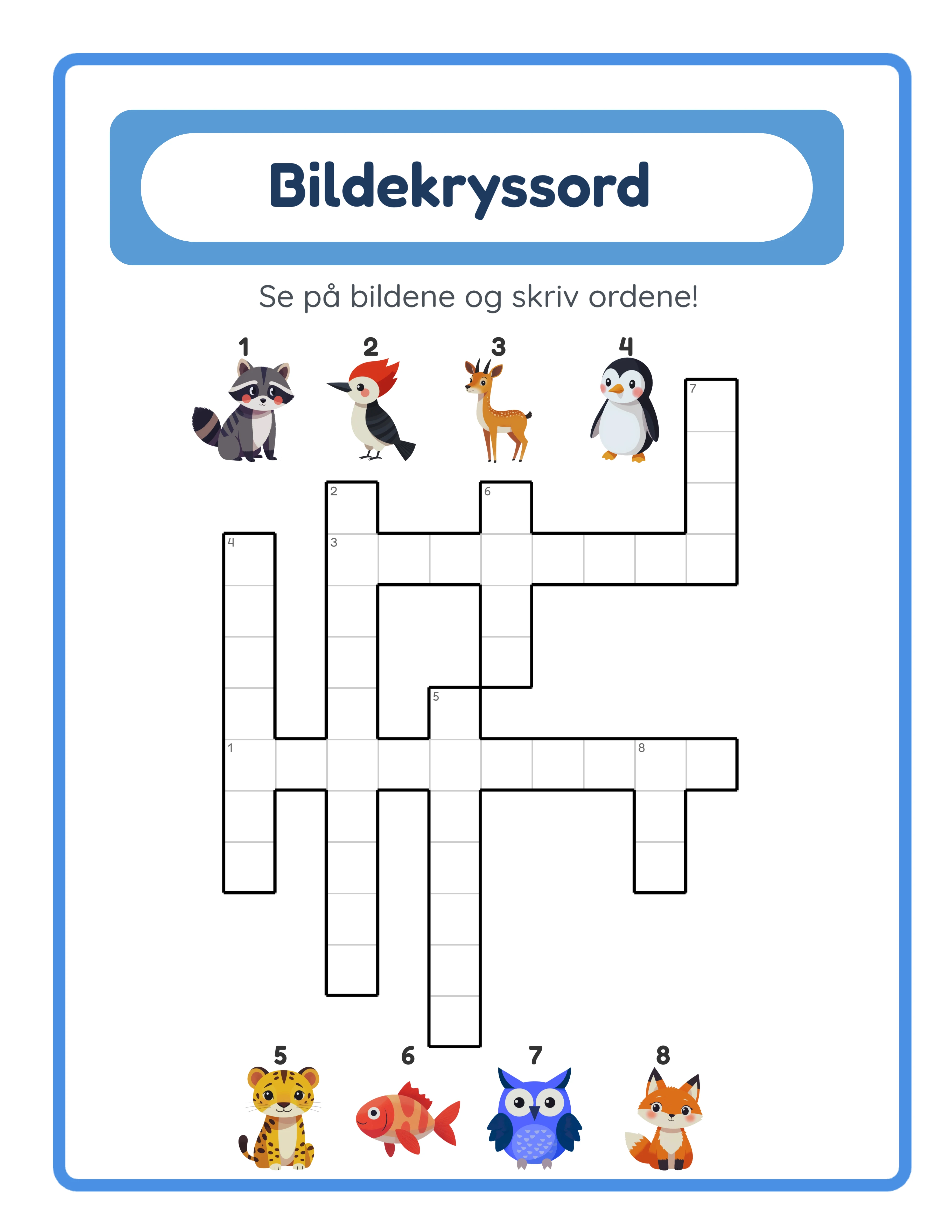
Crossword Generator: Norwegian crosswords use Norwegian Bokmal vocabulary with image-based clues. The image format works exceptionally well because visual clues are universal -- a picture of a "sykkel" (bicycle) communicates instantly regardless of the solver's reading level. Crossword grids accommodate Norwegian characters correctly throughout.
Addition Worksheet Generator: Norwegian math worksheets use the same numerical operations but render instructions and labels in Norwegian. "Addisjon" (addition), "svar" (answer), and "navn" (name) appear correctly. The 104 themed image collections add visual engagement to math practice -- a Norwegian child solving addition problems with pictures of "biler" (cars) or "blomster" (flowers) stays more engaged than with plain number exercises.
For all generators, the workflow mirrors English: select your theme, configure layout and difficulty, generate the worksheet, and export as PDF. The only change is selecting "Norsk" as the language. The generators handle vocabulary, character encoding, and instruction text automatically.
Bokmal versus Nynorsk note: The generators produce Norwegian Bokmal content. Bokmal is used by approximately 85% of Norwegian speakers and is the standard written form in most of Norway, particularly in urban areas and eastern Norway. For commercial products targeting the broadest Norwegian audience, Bokmal is the correct choice.
3
Research Norwegian Keywords for Etsy Listings
Effective Norwegian Etsy listings require Norwegian-language keywords that match how Norwegian buyers actually search.
Core keyword categories for Norwegian printables:
Worksheet terms: "arbeidsark" (worksheet), "oppgaver" (tasks/exercises), "ovingsark" (practice sheet), "aktivitetsark" (activity sheet)
Activity terms: "ordsoking" (word search), "kryssord" (crossword), "fargelegging" (coloring), "regneark" (math worksheet), "skriveovelse" (writing exercise), "puslespill" (puzzle)
Age and level terms: "1. trinn" through "7. trinn" (grades 1-7), "barneskole" (primary school), "SFO" (school-age childcare), "barn" (children), "smabarn" (small children/toddlers)
Purpose terms: "leksehjelp" (homework help), "ove" (practice), "laere" (learn), "pedagogisk" (educational), "undervisningsmateriell" (teaching materials), "utskrivbar" (printable)
Etsy gives you 13 tags per listing. For a Norwegian word search worksheet:
1. ordsoking barn
2. Norwegian word search printable
3. arbeidsark barneskole
4. ordsoking puslespill norsk
5. norsk arbeidsark
6. utskrivbart arbeidsark
7. pedagogisk materiell
8. 1 trinn arbeidsark
9. sprak ovelse barn
10. ordpussel norsk
11. aktivitet barn hjemme
12. hjemmeskole norsk
13. instant download arbeidsark
Mix Norwegian-only tags with bilingual tags to capture both native Norwegian searches and searches from Norwegian-speaking families abroad. Norway has a significant diaspora community, particularly in the US (where millions claim Norwegian heritage) and in other European countries.
4
Optimize Etsy Listing Titles and Descriptions in Norwegian
Structure your Norwegian Etsy listings to maximize search visibility and conversion.
Title formula (140-character limit):
[Product Type in Norwegian] | [Theme/Subject] | [Age/Level] | [Format qualifier]
Examples:
Ordsoking Dyr | Arbeidsark Barneskole 1.-3. Trinn | Utskrivbar PDF Direkte Nedlasting
Kryssord Barn | Norsk Ordpuslespill | Pedagogisk Arbeidsark Hjemme
Regneark Addisjon | 1. Trinn Matematikk Ove | Utskrivbart Arbeidsark Barneskole
Description structure:
Paragraph 1: Describe the product clearly and directly. "Denne pakken inneholder 15 ordsokinger med dyretema, spesielt laget for barn pa 1. til 3. trinn. Hvert arbeidsark inkluderer fasit."
Paragraph 2: List exactly what is included. Number of worksheets, answer keys, page format, and file type. Norwegian buyers appreciate precision.
Paragraph 3: Provide practical usage instructions. "Last ned PDF-filen, skriv ut pa A4-papir, og barnet ditt kan begynne med en gang." Norwegians value straightforward, practical communication.
Paragraph 4: Highlight educational value. "Ordsokinger hjelper barn med a utvide ordforradet, forbedre stavingen og trene konsentrasjonen." Connect to skills valued in the Norwegian curriculum.
Paragraph 5: Promote your shop. "Besok butikken var for flere norske arbeidsark i ulike temaer og vanskelighetsgrader."
Norwegian communication style: Norwegians, like other Scandinavians, prefer understated, honest communication over hype. Avoid superlatives and exaggerated claims in your descriptions. Clearly state what the product is, what it includes, and how it helps. This direct approach builds trust with Norwegian buyers far more effectively than enthusiastic marketing language.
5
Handle Norwegian Special Characters Correctly
Norwegian has three special characters that are essential for authentic content. Incorrect handling is the single most obvious quality signal to Norwegian buyers.
The three Norwegian special characters:
A-diaeresis: The letter A with two dots above. It is the 27th letter of the Norwegian alphabet. Examples: "laere" (learn/teacher), "vaer" (weather/be), "baer" (berry).
O-with-stroke: The letter O with a diagonal stroke. It is the 28th letter. Examples: "ore" (ear), "oye" (eye), "o" (island). This character is shared with Danish but does not appear in Swedish.
A-ring: The letter A with a small circle above. It is the 29th and final letter. Examples: "ar" (year), "ga" (walk/go), "pa" (on).
The LessonCraftStudio generators handle all three characters correctly in every output context: word search grids, crossword answers, word lists, answer keys, filler letters, and instruction text. This is not cosmetic -- it is functionally essential for producing content that Norwegian speakers accept as native quality.
Norwegian versus Danish character usage: While Norwegian and Danish share the same three special characters, their usage in words often differs. "O-with-stroke" appears in different words and at different frequencies in each language. The generators use Norwegian Bokmal vocabulary specifically, not Danish approximations. This distinction matters to Norwegian buyers.
For your Etsy listing text: Type Norwegian characters directly using your operating system's language support. On Windows, add the Norwegian keyboard layout. On Mac, use Option key combinations. Never substitute anglicized spellings for proper Norwegian characters.
Product mockup images: Verify that any Norwegian text in your preview images displays special characters correctly. A mockup showing "Ordsoking" without the proper characters in the actual worksheet undermines your quality promise.
Proofreading: If you are not a Norwegian speaker, invest in a native Norwegian proofreader for your listing text. This costs NOK 200 to NOK 400 (approximately EUR 20 to EUR 40) per batch and is essential for credibility in the Norwegian market.
6
Norwegian Pricing Strategy
Norway's exceptional purchasing power creates unique pricing dynamics for printable sellers.
Norwegian purchasing power: Norway has one of the highest costs of living and highest average incomes in the world. Norwegian consumers are accustomed to paying premium prices for goods and services. A product that costs EUR 5.00 (approximately NOK 55) is perceived as very affordable by Norwegian standards. This means you can price Norwegian products at the higher end of your range without resistance.
Currency: Norway uses the Norwegian krone (NOK). As of 2026, EUR 1 equals approximately NOK 11. Etsy converts prices automatically, but understanding that your EUR 5.00 listing shows as approximately NOK 55 helps you gauge price perception. NOK 55 is an impulse purchase price for most Norwegian families.
Pricing guidelines for Norwegian printables on Etsy:
Individual worksheets: EUR 2.00 to EUR 3.50 (NOK 22 to NOK 39). Price at the higher end of the range -- Norwegian buyers do not balk at these prices for quality content.
Small packs (5-10 worksheets): EUR 4.00 to EUR 7.00 (NOK 44 to NOK 77). Well within impulse purchase territory for Norwegian families.
Large packs (15-30 worksheets): EUR 8.00 to EUR 14.00 (NOK 88 to NOK 154). Comprehensive collections that justify a considered purchase.
Mega bundles (50+ worksheets): EUR 18.00 to EUR 30.00 (NOK 198 to NOK 330). Premium packages for committed buyers. Norwegian families are comfortable spending NOK 300+ on educational materials.
VAT: Norway has a 25% VAT rate on digital products. Etsy handles VAT collection automatically. Factor this into your per-sale revenue calculations.
Premium positioning: In the Norwegian market, premium pricing signals quality. Underpricing your products can actually hurt conversions because Norwegian buyers may perceive very cheap products as low quality. Price confidently based on the comprehensiveness and quality of your content.
7
Build a Norwegian Printable Catalog
Systematic catalog building for the Norwegian market follows a phased approach with Norwegian-specific seasonal timing.
Phase 1 -- Foundation (Month 1-2): Create 12 to 18 listings covering word searches, crosswords, and addition worksheets across 4 to 6 themes. Prioritize themes with strong Norwegian appeal: animals ("dyr"), nature ("natur"), seasons ("arstider"), and Norwegian-themed content.
Phase 2 -- Depth and bundles (Month 3-4): Expand your best-performing product type and create theme bundles. If word searches drive the most traffic, add more themes. Create bundles combining word searches, crosswords, and math within single themes.
Phase 3 -- Seasonal and premium (Month 5-6): Create seasonal products and premium catalog bundles.
Norwegian seasonal calendar:
August: "Skolestart" (school start). Norwegian schools begin in mid to late August. This is the peak purchasing period for educational materials.
October: "Hostferie" (autumn break). A one-week school holiday creates demand for home activities.
December: "Jul" (Christmas). Norwegian Christmas traditions drive demand for themed worksheets and activity books throughout December.
February: "Vinterferie" (winter break). A one-week school holiday, often used for skiing but also for indoor activities.
March-April: "Paskeferie" (Easter break). A longer school break (often 8-9 days) creating sustained demand for activities.
June-August: "Sommerferie" (summer vacation). Approximately 8 weeks of summer break -- the longest school holiday, creating ongoing demand for activities.
Norwegian-specific product opportunities:
"17. mai" (May 17, Norwegian Constitution Day) themed activities. This is Norway's most celebrated national day -- themed worksheets capture patriotic seasonal energy.
"Samisk" (Sami culture) themed worksheets tap into Norway's indigenous cultural education requirements.
Norwegian nature themes -- "skog" (forest), "fjord" (fjord), "fjell" (mountain), "hav" (sea) -- resonate deeply with Norwegian outdoor culture.
"SFO" (skolefritidsordning -- after-school care) activity packs serve institutions that need structured activities for children aged 6-10.