Tutorial
1
Understanding KDP Requirements for Puzzle Books
Amazon KDP has specific technical requirements for puzzle book interiors. Understanding these before you generate a single puzzle prevents costly reformatting later.
Trim size: The most popular sizes for puzzle and activity books on KDP are 8.5 x 11 inches (US Letter), 8 x 10 inches, and 6 x 9 inches. US Letter gives the most space for 4x4 picture grids with large, clear images. The 8 x 10 format also works well and has slightly lower printing costs. For travel-sized or pocket puzzle books, 6 x 9 keeps costs down but requires smaller images.
Page count: KDP requires a minimum of 24 pages for paperback books. For picture sudoku books, aim for 50 to 120 puzzle pages plus matching answer key pages. A 100-puzzle book with 100 answer key pages produces a 200-page book that communicates strong value to buyers.
Margins: KDP margin requirements vary by page count. For a 200-page 8.5 x 11 book, you need at least 0.75 inches on the inside margin (gutter) and 0.25 inches on the outside, top, and bottom margins. The sudoku generator's export function produces PDFs with adequate margins for KDP compliance.
Bleed: Picture sudoku books typically do not require bleed since puzzle grids do not extend to page edges. Select "no bleed" when setting up your KDP paperback to simplify formatting.
File format: KDP accepts PDF manuscripts. The sudoku generator exports 300 DPI PDFs that meet Amazon's quality thresholds for both image sharpness and line clarity -- critical for picture-based puzzles where image recognition is part of the solving experience.
2
Generating Picture Sudoku Puzzles with the LCS Generator
The LessonCraftStudio sudoku generator creates 4x4 picture sudoku grids where images replace numbers. Here is the optimal configuration for KDP puzzle books.
Open the sudoku generator and select your theme from the 104 available image collections. Each collection contains hand-drawn educational images covering topics like animals, food, vehicles, nature, weather, household items, musical instruments, sports equipment, and dozens more. The theme you select determines which images appear in each puzzle grid.
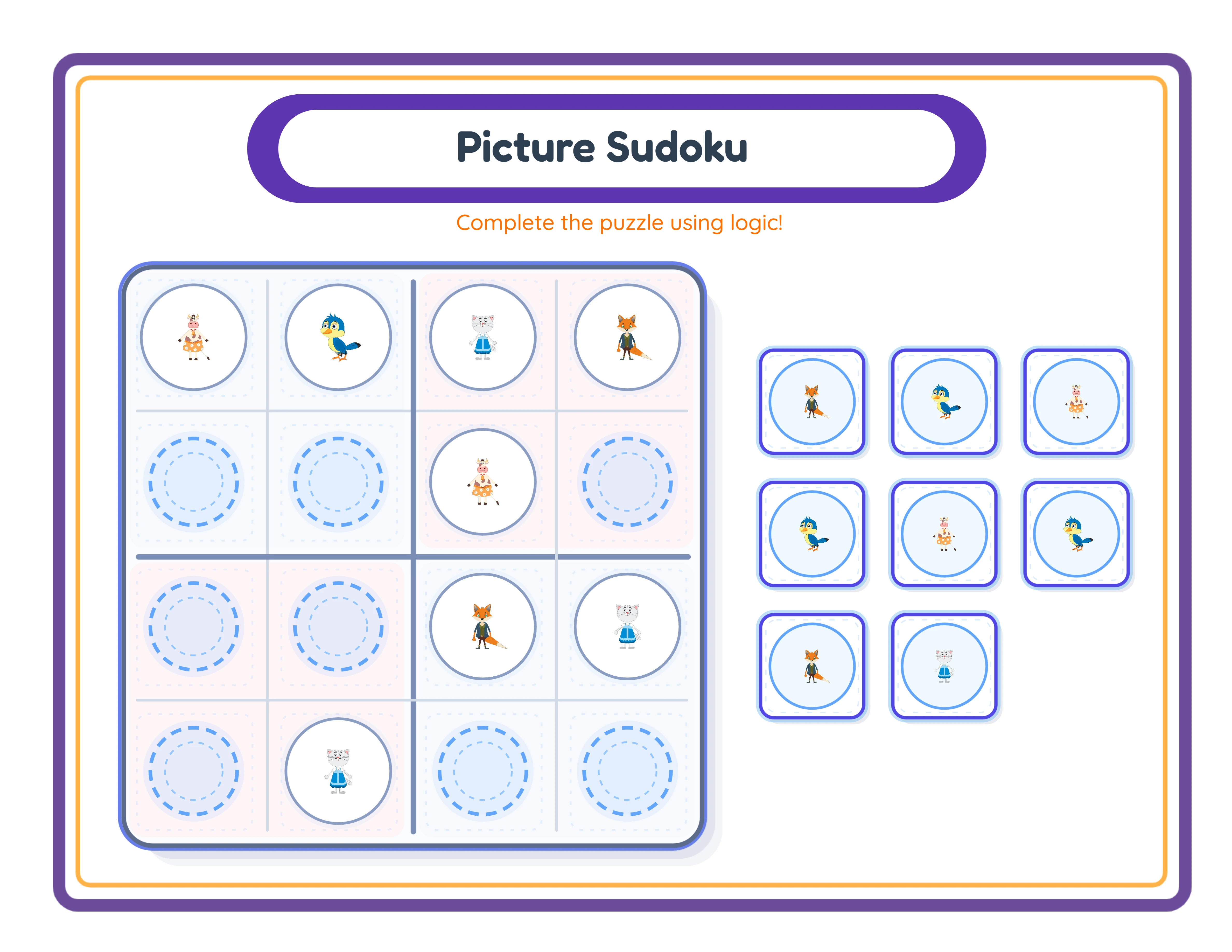
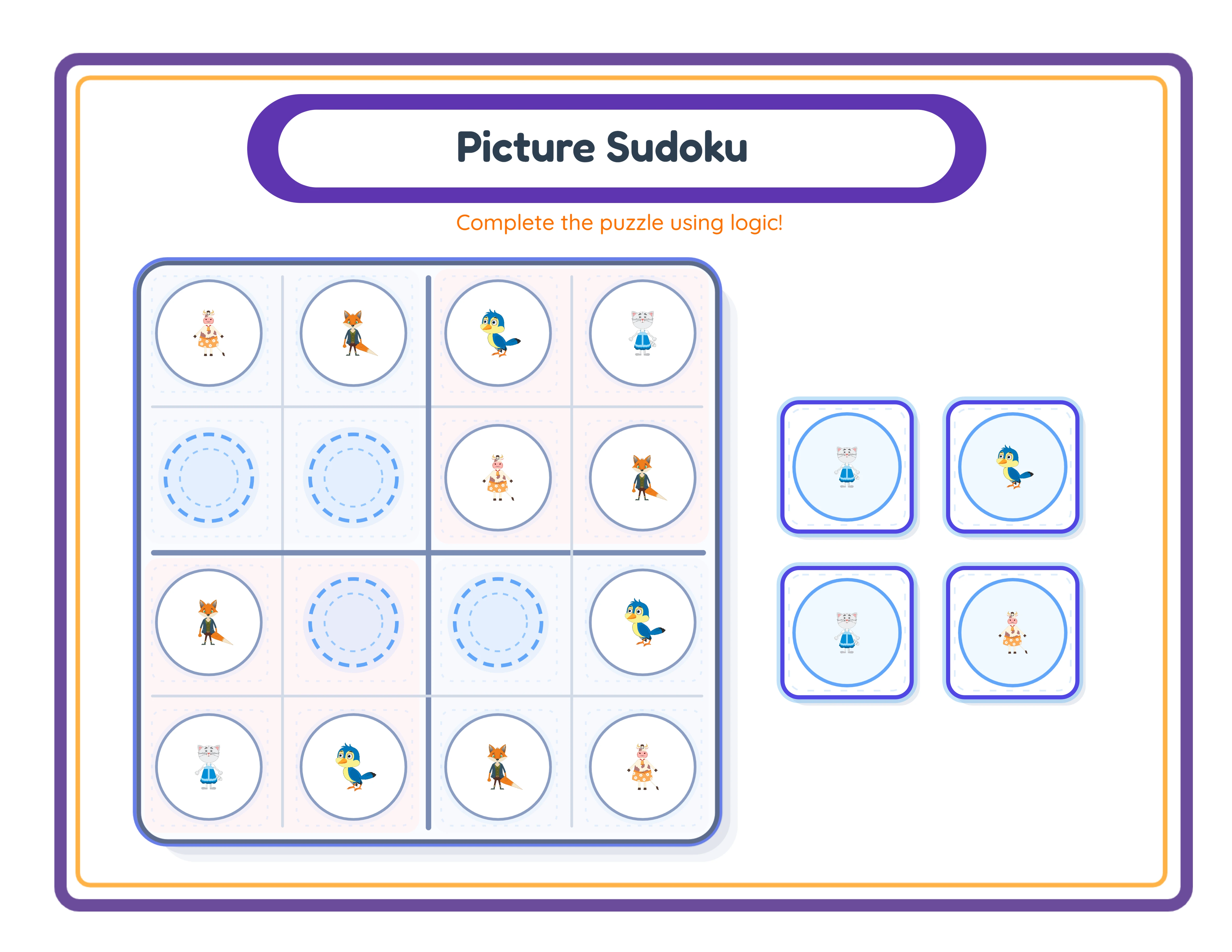
Grid format: The generator produces 4x4 grids -- four rows and four columns using four distinct images. Each row, each column, and each 2x2 sub-grid must contain all four images exactly once. This format is ideal for younger audiences and puzzle beginners while still providing genuine solving satisfaction.
Difficulty levels: Control difficulty by adjusting how many images are pre-filled in each grid. An easy puzzle might show 8 to 10 of the 16 cells pre-filled, leaving 6 to 8 cells for the solver. A medium puzzle shows 5 to 7 pre-filled cells. A hard puzzle shows only 3 to 4, requiring more deductive reasoning. Each difficulty level represents a separate product you can publish on KDP.
Image clarity: The generator uses high-resolution images from the LessonCraftStudio image library. At 300 DPI export quality, each image in the grid prints sharp and recognizable -- essential for picture sudoku where solvers must identify images to solve the puzzle.
Generate each puzzle, preview the grid layout, and export as PDF. The generator automatically creates a matching answer key showing the complete solution. For a 100-puzzle book, expect 2 to 3 hours of generation time.
3
Working with Difficulty Levels for Different Audiences
Difficulty levels in picture sudoku are determined by the number of pre-filled cells and the logical complexity required to solve each puzzle. Managing difficulty well lets you publish multiple products from the same theme.
Easy level (8-10 pre-filled cells out of 16): Most cells are already filled. The solver needs only basic observation to place the remaining images. This difficulty suits children ages 4 to 7 and puzzle beginners. Easy picture sudoku books are popular gifts for young children and have strong sales during holiday seasons.
Medium level (5-7 pre-filled cells): The solver must use elimination logic across rows and columns. This suits children ages 7 to 10 and adults who enjoy relaxing puzzles. Medium difficulty is the most versatile -- it appeals to the broadest audience and tends to generate the most consistent sales.
Hard level (3-4 pre-filled cells): Requires careful deductive reasoning across rows, columns, and sub-grids simultaneously. Though the 4x4 format keeps even hard puzzles accessible, the reduced clue count makes these genuinely challenging. This level targets older children, teens, and adults who want a step up from standard easy picture sudoku.
The publishing strategy is straightforward: create one themed picture sudoku book at each difficulty level. "Dinosaur Picture Sudoku -- Easy," "Dinosaur Picture Sudoku -- Medium," and "Dinosaur Picture Sudoku -- Hard" are three separate KDP products generated from the same theme with different difficulty settings. Buyers who enjoy one difficulty level often purchase the next level up, creating natural cross-selling within your catalog.
4
Compiling Your KDP Manuscript from Generated Puzzles
After generating all puzzles and answer keys as individual PDFs, compile them into a single manuscript file for KDP upload.
Recommended manuscript structure for a picture sudoku book:
Page 1: Title page -- book title, subtitle, and publisher or author name
Page 2: Copyright page -- standard copyright notice, commercial license reference, year of publication
Pages 3-4: Instructions page -- explain the rules of picture sudoku with a solved example grid. Include simple language like "Place one of each image in every row, column, and box." This page adds perceived value and helps buyers who are unfamiliar with picture sudoku.
Pages 5-104: Puzzle pages -- one puzzle per page, numbered sequentially
Pages 105-204: Answer key pages -- one complete solution per page, numbered to match corresponding puzzles
Final page: Optional catalog page listing your other puzzle books with titles and ASINs
To merge individual PDFs, use a PDF merging tool such as PDFsam Basic, Sejda, or macOS Preview. Arrange files in the correct order: front matter first, then puzzles in sequence, then answer keys in matching sequence.
Pre-upload checklist:
- All pages are the same trim size (e.g., 8.5 x 11 inches throughout)
- Page numbers are consistent between puzzle pages and answer key pages
- Margins meet KDP minimums at every page
- The final PDF is under 650 MB (KDP file size limit)
- No watermarks appear on any page -- use commercially licensed exports only
- Images print clearly at the intended size (test by zooming to 100% in your PDF viewer)
5
Designing an Effective KDP Book Cover
Your cover determines whether a browsing shopper clicks on your listing or scrolls past it. For picture sudoku books, the cover must communicate three things instantly: this is a puzzle book, it uses pictures instead of numbers, and it matches the buyer's target audience.
Cover dimensions: Use KDP's cover calculator to get exact dimensions based on your page count and trim size. For a 200-page 8.5 x 11 book, the full cover spread (front + spine + back) is approximately 17.75 x 11.25 inches at 300 DPI.
Front cover essentials:
Show a sample puzzle grid. Include an actual 4x4 picture sudoku grid on the cover so buyers immediately understand the format. This is especially important for picture sudoku since many buyers are unfamiliar with the concept.
State contents clearly. "75 Picture Sudoku Puzzles with Answer Keys" or "4x4 Image Sudoku for Kids Ages 4-8" tells the buyer exactly what they are purchasing.
Include the difficulty level. "Easy," "Medium," or "Challenge" helps buyers self-select the appropriate product.
Name the theme. "Animal Picture Sudoku" or "Dinosaur Sudoku Puzzle Book" targets specific keyword searches and sets expectations.
Use large, readable fonts. Your title must be legible at thumbnail size -- the format in which most Amazon shoppers first encounter your listing.
Back cover: Include a brief description, a second sample puzzle, key selling points (puzzle count, answer keys included, difficulty level, age range), and your ISBN barcode area.
Design tools: Canva offers free KDP cover templates. Book Bolt has KDP-specific cover tools. For a polished result, a Fiverr designer typically charges $20 to $50 for a complete KDP cover.
6
Optimizing Your KDP Listing for Maximum Visibility
A well-optimized listing puts your picture sudoku book in front of buyers actively searching for this type of product. KDP listing optimization involves title, subtitle, description, keywords, categories, and pricing.
Title: Make it descriptive and keyword-rich. Example: "Picture Sudoku for Kids: 100 Easy 4x4 Image Puzzles with Answer Keys -- Animal Theme"
Subtitle: Add details the title cannot fit. Example: "Fun Visual Logic Puzzles for Ages 4-8 -- Large Print Activity Book"
Description: Write 300 to 1,000 words describing the book. Include puzzle count, theme, difficulty level, age range, page dimensions, and that answer keys are provided. Use HTML formatting (bold text, bullet points) to make the description scannable on Amazon's product page.
Keywords: KDP provides 7 keyword slots. Use specific buyer-intent phrases:
- "picture sudoku for kids"
- "image sudoku puzzle book"
- "visual sudoku activity book"
- "4x4 sudoku puzzles children"
- "easy sudoku with pictures"
- "animal puzzle book for kids"
- "picture logic puzzles with answers"
Categories: Select two relevant categories. "Children's Puzzle Books" and "Sudoku Puzzles" are primary choices. Add "Activity Books" or "Logic Puzzles" as a secondary category if available.
Pricing: For a 200-page US Letter paperback, price between $5.99 and $8.99 to stay in the 60% royalty tier. Check what competing picture sudoku books charge and price within 10% of the average. Start at $6.99 and adjust based on sales velocity.
After publishing, KDP typically makes your book available within 72 hours. Order an author copy to verify print quality -- especially image clarity -- before investing in advertising.
7
Scaling Your Picture Sudoku Catalog Across Themes and Languages
A single picture sudoku book generates modest revenue. A catalog of 15 to 30 books across themes, difficulty levels, and languages builds a meaningful publishing business. The LessonCraftStudio generator makes scaling efficient because the 104 themed image collections and 11-language support multiply every concept you create.
Theme expansion: Each of the 104 image collections is a potential book theme. Animals, dinosaurs, food, vehicles, weather, musical instruments, household items, space, ocean life, farm -- the list covers dozens of niches. Create one book per theme and you build a catalog that captures traffic across many keyword searches.
Difficulty series: Publish each theme at three difficulty levels. "Animal Picture Sudoku -- Easy," "Animal Picture Sudoku -- Medium," and "Animal Picture Sudoku -- Challenge" triples your catalog from one theme with minimal additional effort.
Language expansion: Switch the generator's language selector and regenerate puzzles with localized image labels and instructions. The generator supports English, German, French, Spanish, Portuguese, Italian, Dutch, Swedish, Danish, Norwegian, and Finnish -- 11 languages total. Each language version targets a different Amazon marketplace: amazon.de for German, amazon.fr for French, amazon.es for Spanish, amazon.it for Italian, amazon.com.br for Portuguese, amazon.nl for Dutch, and amazon.se for Scandinavian markets.
Age-targeted editions: Create "toddler" editions with very easy puzzles (10+ pre-filled cells), "kids" editions at medium difficulty, and "family" editions mixing easy and medium puzzles. Each targets different search queries and buyer segments.
Seasonal books: Christmas picture sudoku, Halloween picture sudoku, Easter picture sudoku. Seasonal titles spike 4 to 6 weeks before each holiday and sell year after year without updates.
Bundle books: Compile multiple themes into a single mega-book. "Ultimate Picture Sudoku Collection -- 300 Puzzles Across 30 Themes" at $12.99 to $14.99 targets buyers seeking maximum value and justifies a higher price point.
The compounding effect is powerful. Twenty books each selling 2 copies per day at $6.99 with an average $0.80 royalty generates approximately $11,680 per year -- and every book continues selling without additional production effort.