
Doubles and Halves Worksheet
Doubles and Halves to 20, Still with Pictures to Count
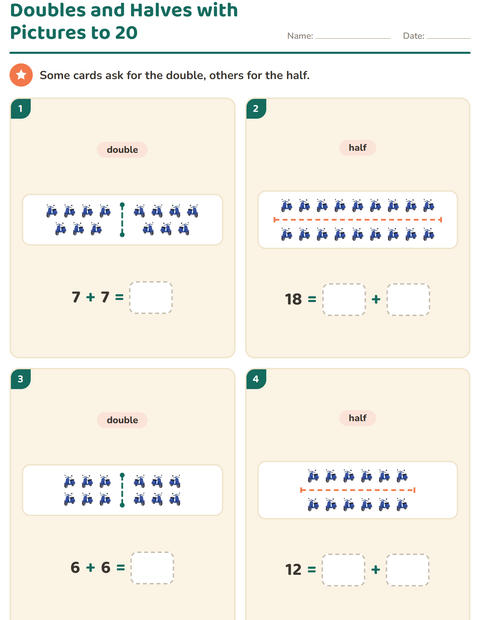
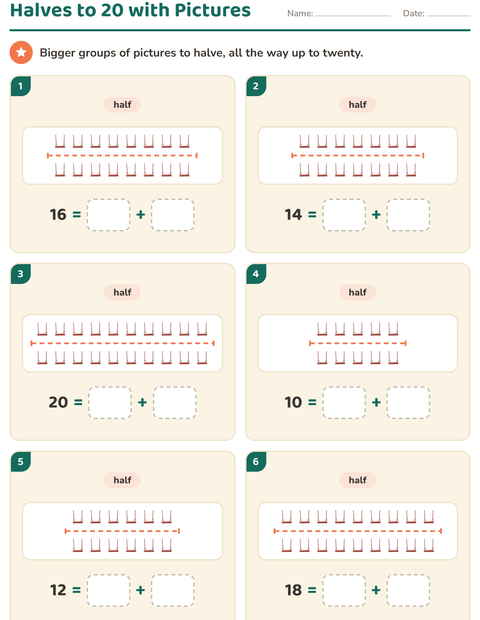
The groups on this 1st grade doubles and halves page have grown past the size a child can take in at a glance. Four cards fill the sheet two by two, each holding a white box of toys with an equation beneath it. The two marked double show a row and its exact mirror either side of a teal line, with a fact like 7 + 7 = and an empty answer box under them. The two marked half show a larger group cut across by a dashed orange rule, with a line like 18 = and two boxes to fill. Every total on the page lands between ten and twenty.
Ten is the ceiling most children can count reliably without losing their place, and the numbers here sit just above it on purpose. Counting one by one still works, but it starts to cost something, and that cost is what nudges a child toward counting the top row and doubling it, or splitting a group of eighteen down the middle by eye. Keeping doubling and halving on the same sheet keeps the pair visible: double 9 is 18, and 18 halved is 9 and 9. The thing to watch is the second card of each type, where a child who counted every picture on the first one often stops doing so.
Print the PDF free and allow a finger to run along the pictures for the first card of each kind, then ask for the second to be tried without. Four cards is a short page, which suits it as a first meeting with the teens in this form. Doubles and halves first steps keeps the groups down to four if these are still too big, and doubles and halves to 20 in numbers only is where the pictures come away and the same facts are met bare.
What's inside
- Answer key included
- Print as PDF or play online — free, no sign-up
Updated September 3, 2026
This worksheet at different levels
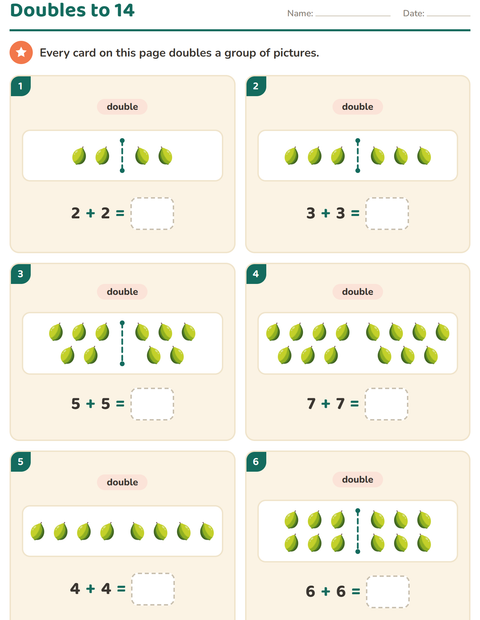
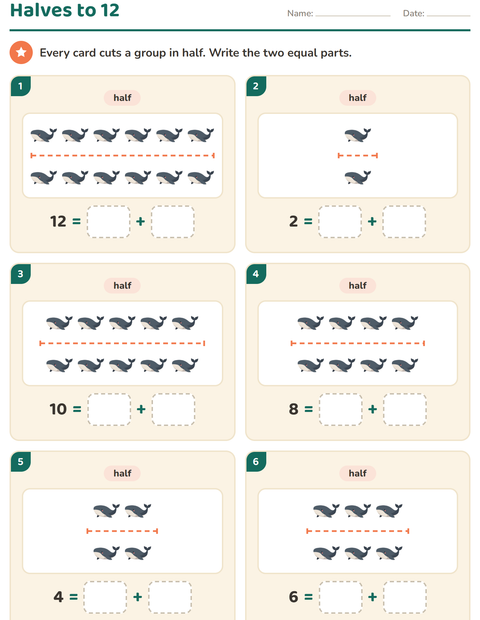
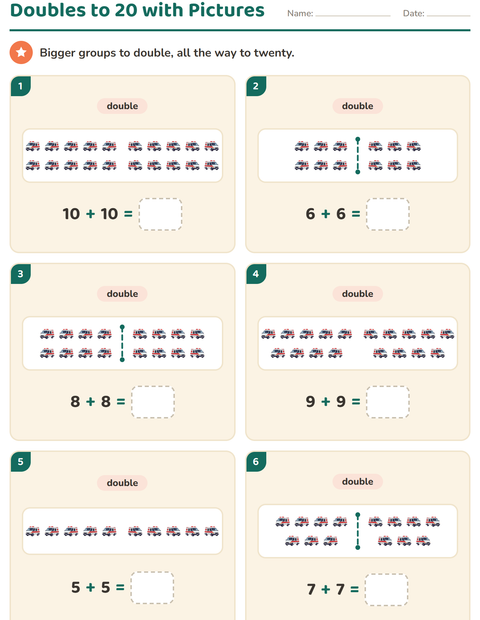
The same task also comes at other levels, with more practice pages at every level.
More worksheets to try
More with this theme
- ABC Order When Words Start the Same: Baby, Boat, Scooter, Swing
- Addition with Toys — Kindergarten
- Addition with Toys — Kindergarten
- Addition with Toys — Kindergarten
- Advanced Pre-Writing: Five Tricky Trace Lanes
- Alphabet Train with Toys: Sort the Pictures by First Letter
- Alphabet Train with Toys
- Balance Scales in Grams: Read the Mass
Math · grade 1
→
Made with the Doubles and Halves Worksheets maker
Worksheet-maker page coming soon.