
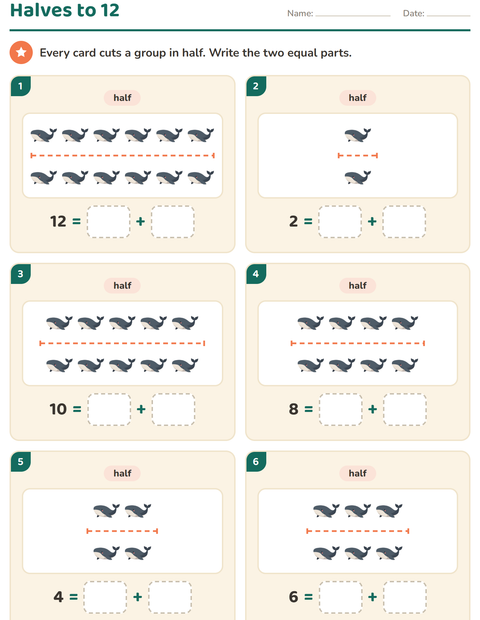
Halving Worksheet
Halves to 12: Cut Each Group into Two Equal Parts
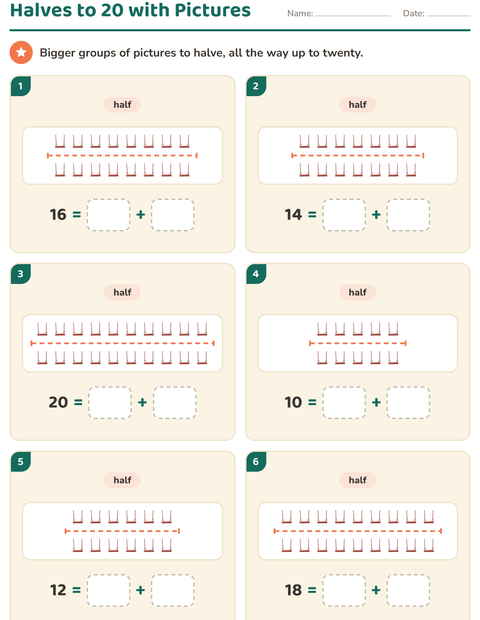
A dashed orange rule runs straight through the middle of every group on this 1st grade doubles and halves page. Six cards are laid out two across and three down, all labelled half, and each holds a set of animal pictures arranged in two equal rows with the cut line between them. Under the box the number of animals is printed with an equals sign and two empty answer boxes: 12 =, 10 =, 8 =, down to 2 =. The child counts one row, writes it in both boxes, and the sentence reads 12 = 6 + 6.
Halving is subtraction wearing an unfamiliar coat, and children meet it far less often than they meet taking away. Setting the groups out as two matched rows is what makes it visible: the answer can be read off the page by counting either row, so the arithmetic never blocks the idea. The two boxes are the part worth watching. A child who writes different numbers in them has not understood that a half is a fair split rather than any two parts, and that misconception hides easily in a spoken lesson. Twelve is the largest group here, and the smallest can be as low as 2 = 1 + 1.
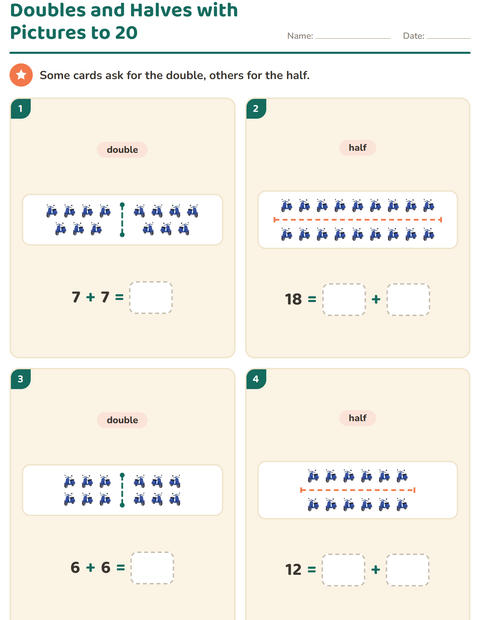
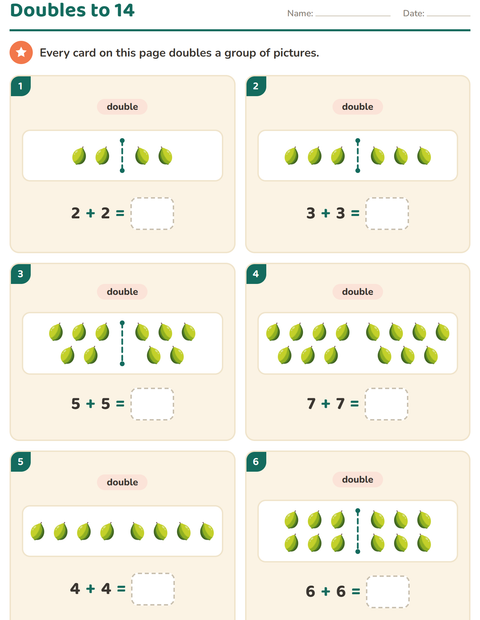
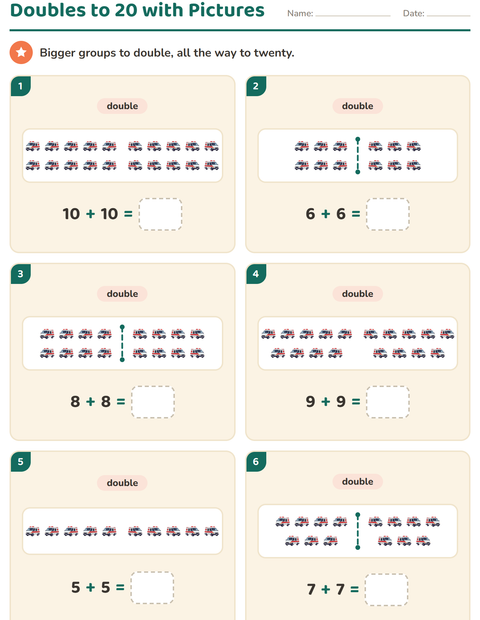
Print the PDF free and ask for both rows to be counted on the first two cards, one after the other, so the equality is checked rather than assumed. Six cards of this size fits a short session. Halves to 20 with pictures continues into the teens, doubles to 14 is the same page in reverse for building the facts the other way, and number walls to 20 puts the sums these halves come from into a structure.
What's inside
- Answer key included
- Print as PDF or play online — free, no sign-up
Updated September 3, 2026
This worksheet at different levels
The same task also comes at other levels, with more practice pages at every level.
More worksheets to try
More with this theme
- A or An? Circle the Right Word for Each Animal
- ABC Order: Put Six Animal Words in Alphabetical Order
- Find the Missing Part — Animals — Kindergarten
- Addition with Animals — Kindergarten
- Addition with Animals — Kindergarten
- Addition with Animals — Kindergarten
- Alphabet Train with Animals
- Alphabet Train with Animals: Sort the Pictures by First Letter
Math · grade 1
→
Made with the Halving Worksheets maker
Worksheet-maker page coming soon.