
Halving Worksheet
Halves to 20: Split Bigger Groups Down the Middle
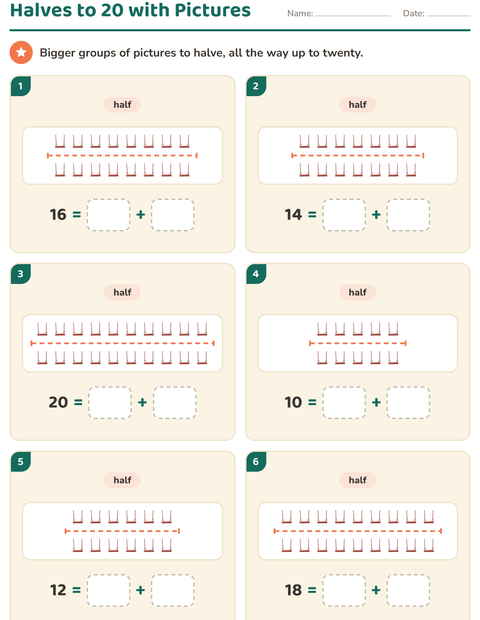
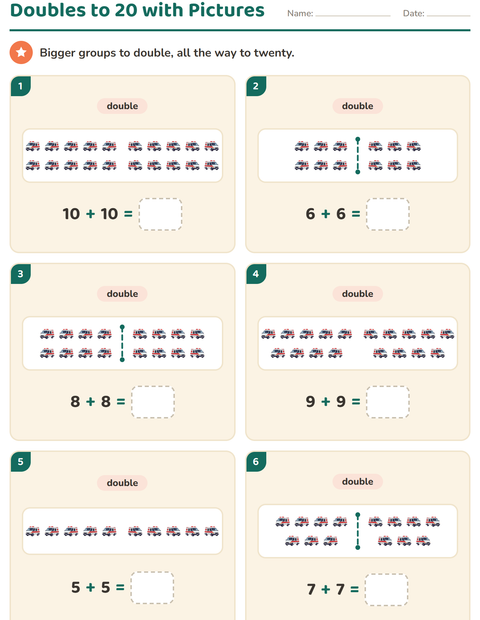
Halving begins at ten on this 1st grade doubles and halves page and climbs to twenty. Six cards, all labelled half, each hold a group of toys set out as two matching rows with a dashed orange line cutting between them, and underneath each box the total is printed with two empty answer boxes after it: 16 =, 14 =, 20 =, 10 =, 12 =, 18 =. The rows are long, ten pictures across at the widest, so the cut line stretches most of the way over the card and the two halves stay easy to tell apart.
Halving numbers into the teens is where the picture stops being decoration and starts being the method. A child asked for half of eighteen with nothing in front of them will often guess; a child looking at nine and nine can count one row and be right. That is a legitimate strategy and worth allowing for as long as it is needed, because the alternative, guessing, teaches nothing. What the page reveals is which halves have already gone into memory: most children have half of ten and half of twenty before they have half of fourteen, and the middle cards are where the pencil slows.
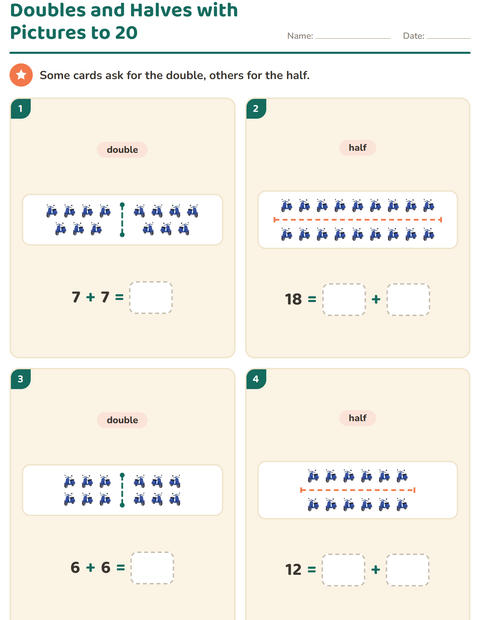
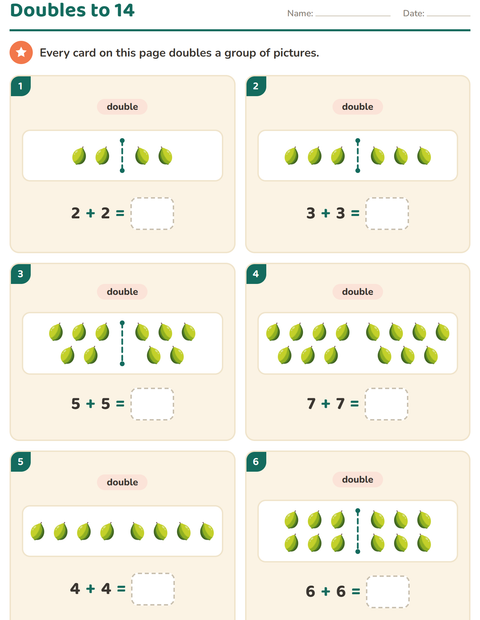
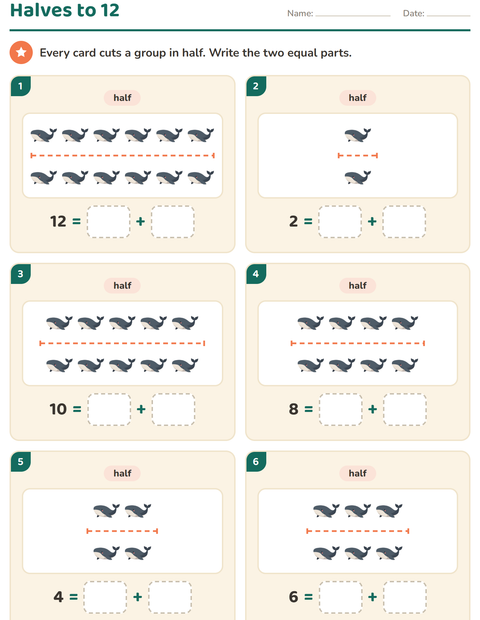
Print the PDF free and ask for the answer before the counting on the two cards a child seems confident about, and let the rows be counted everywhere else. Halves to 12 is the smaller version if the teens are too much, doubles to 20 with pictures is the same range going the other way, and halves to 20 with just the numbers takes the pictures away once the row counting is no longer needed.
What's inside
- Answer key included
- Print as PDF or play online — free, no sign-up
Updated September 3, 2026
This worksheet at different levels
The same task also comes at other levels, with more practice pages at every level.
More worksheets to try
More with this theme
- ABC Order When Words Start the Same: Baby, Boat, Scooter, Swing
- Addition with Toys — Kindergarten
- Addition with Toys — Kindergarten
- Addition with Toys — Kindergarten
- Advanced Pre-Writing: Five Tricky Trace Lanes
- Alphabet Train with Toys: Sort the Pictures by First Letter
- Alphabet Train with Toys
- Balance Scales in Grams: Read the Mass
Math · grade 1
→
Made with the Halving Worksheets maker
Worksheet-maker page coming soon.