
Halving Worksheet
Halves to 20 with No Pictures: Split the Number in Two
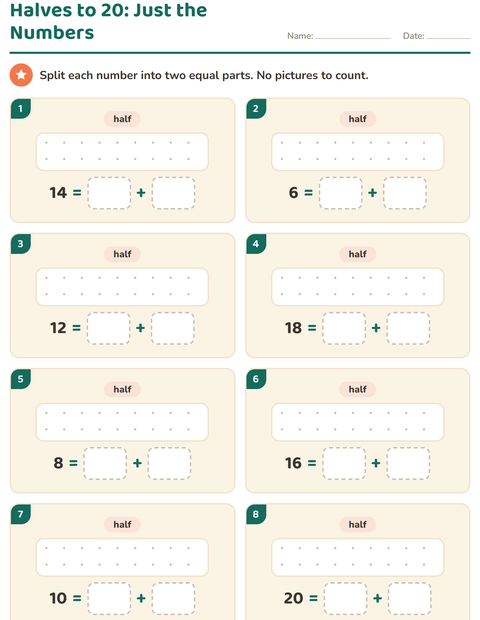
14 = and two empty boxes. That is the whole of the first card on this 1st grade doubles-halves page, and the seven cards after it are built the same way: a pink half label, a blank dotted panel where a picture would otherwise be, and an even number waiting to be split into two equal parts. The numbers run 14, 6, 12, 18, 8, 16, 10 and 20, so the page works its way through the even numbers up to twenty without repeating one. Nothing on the sheet can be counted, because there is nothing on it to count.
Halving without a picture asks a genuinely different question from halving with one. There is no row to count, so the child either recalls the double it comes from or works it out, and the second route is the interesting one: some children take ten away first and halve what is left, others halve the tens and the ones separately, and a few still draw. All three are legitimate, and the empty panel is there so drawing stays available. Watching which numbers get an answer straight away tells you exactly which doubles are stored, since half of sixteen only comes quickly to a child who already has 8 + 8.
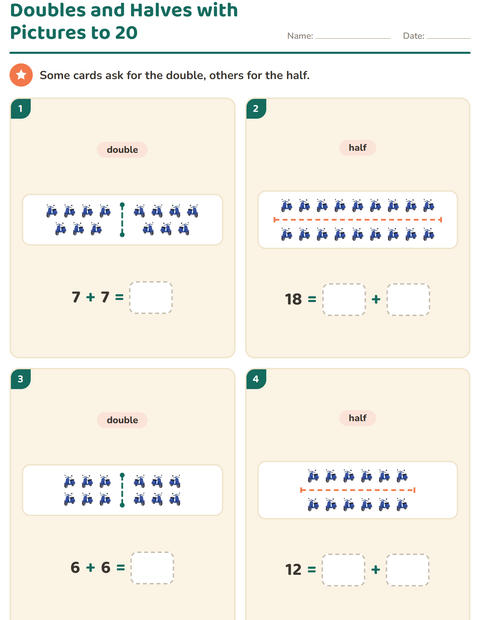
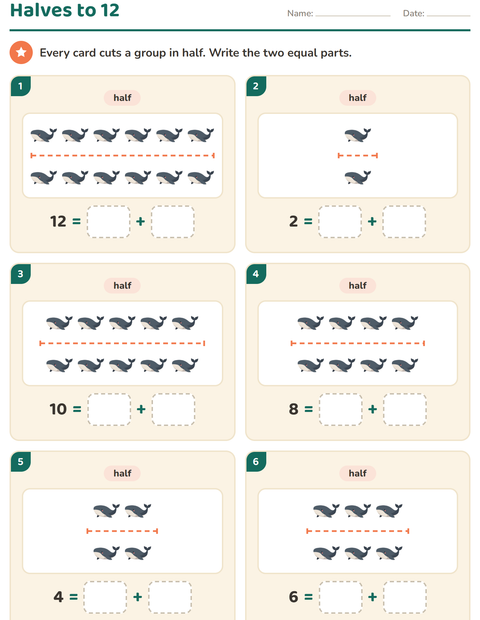
Print the PDF free and ask, on one card only, how the answer was reached; the method is more informative than the number and it takes half a minute to hear. Halves to 20 with pictures is where to send a child whose boxes are all covered in dots, doubles to 20 with just the numbers is the same page for the opposite operation, and number walls with two-digit answers is where halving stops and adding upward begins.
What's inside
- Answer key included
- Print as PDF or play online — free, no sign-up
Updated September 3, 2026
This worksheet at different levels
The same task also comes at other levels, with more practice pages at every level.
More worksheets to try
Math · grade 1
→
Made with the Halving Worksheets maker
Worksheet-maker page coming soon.