
Comparing Prices Worksheet
Shopping Math: How Much More Does One Toy Cost Than Another?
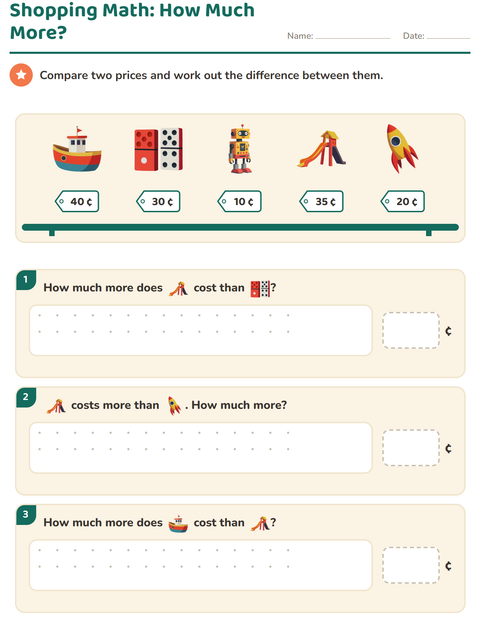
Nothing is bought on this 2nd grade money worksheet. Five toys hang from the shelf with their tags, a boat at 40¢, a set of dominoes at 30¢, a robot at 10¢, a slide at 35¢ and a rocket at 20¢, and all three cards below pair two of them and ask for the gap between the prices. Two cards put it as a question, how much more does one cost than the other, and one puts it as a statement followed by a question, the slide costs more than the rocket, how much more? The answer goes in a dashed box marked ¢ after working on the dot grid.
Difference is the money question children answer by adding, and the wording is why. How much more sounds like more, and more sounds like plus, so the child who is matching key words to operations rather than picturing the situation gets it exactly backwards. Two prices side by side on a shelf make the gap visible, which is the correction: the child can see that one tag is bigger and that the question is about the space between them. The reversed phrasing on the third card is a deliberate check that the reading is real and not a template.
Print the PDF free and have the two prices written one under the other before anything is worked out, or counted up from the smaller tag to the larger on the dot grid, which is the safer method for most second graders. Comparing three-digit numbers gives the same comparison without money. Is there enough money is the other comparison page, ending in a yes or no instead of a gap, and the four questions page puts differences back among totals and change.
What's inside
- 5 pictures
- Answer key included
- Print as PDF or play online — free, no sign-up
Updated September 2, 2026
This worksheet at different levels
The same task also comes at other levels, with more practice pages at every level.
More worksheets to try
More with this theme
- ABC Order When Words Start the Same: Baby, Boat, Scooter, Swing
- Addition with Toys — Kindergarten
- Addition with Toys — Kindergarten
- Addition with Toys — Kindergarten
- Advanced Pre-Writing: Five Tricky Trace Lanes
- Alphabet Train with Toys: Sort the Pictures by First Letter
- Alphabet Train with Toys
- Balance Scales in Grams: Read the Mass
Math · grade 2
→
Made with the Comparing Prices Worksheets maker
Worksheet-maker page coming soon.