Tutorial
1
Brazil -- The Giant Underserved Market
Brazil is the Portuguese printable market's main event. Understanding its unique characteristics is essential for any seller entering this space.
Population and demographics: Brazil has 215 million people, making it the world's sixth most-populous country. Roughly 50 million Brazilian households have children under 18. The middle class has expanded significantly, and education spending is a priority for Brazilian families at all income levels.
E-commerce growth: Brazil's e-commerce market is the largest in Latin America and among the fastest-growing globally. Online shopping has become mainstream, driven by smartphone adoption and improved payment infrastructure. Digital product downloads are increasingly familiar to Brazilian consumers.
Educational culture: Brazil's education system emphasizes supplemental learning. Parents routinely purchase "cadernos de atividades" (activity workbooks) and "material complementar" (supplementary material) for children. The tradition of "atividades de ferias" (vacation activities) mirrors France's cahiers de vacances -- parents buy activity workbooks for children to complete during school breaks.
Competition analysis: The Portuguese printable market has almost no serious competition. On Etsy, Portuguese-language printables are rare. On amazon.com.br, the activity book category exists but is dramatically underserved compared to amazon.com. This is not because demand is absent -- it is because suppliers have not yet arrived in meaningful numbers.
Payment infrastructure: Boleto bancario (a Brazilian payment slip) and PIX (instant payment system) are popular payment methods in Brazil. Etsy accepts credit card payments from Brazilian buyers. Amazon.com.br handles local payment methods. For maximum reach, using platforms that support Brazilian payment preferences is important.
Language note: Brazilian Portuguese and European Portuguese differ in vocabulary and spelling (similar to American vs. British English). The LCS generators produce vocabulary that works across both variants, but listing optimization should use Brazilian Portuguese terms if targeting Brazil specifically.
2
Product Types That Sell Best in Portuguese
The Portuguese market has strong demand across multiple printable categories, with some unique opportunities tied to Brazilian educational culture.
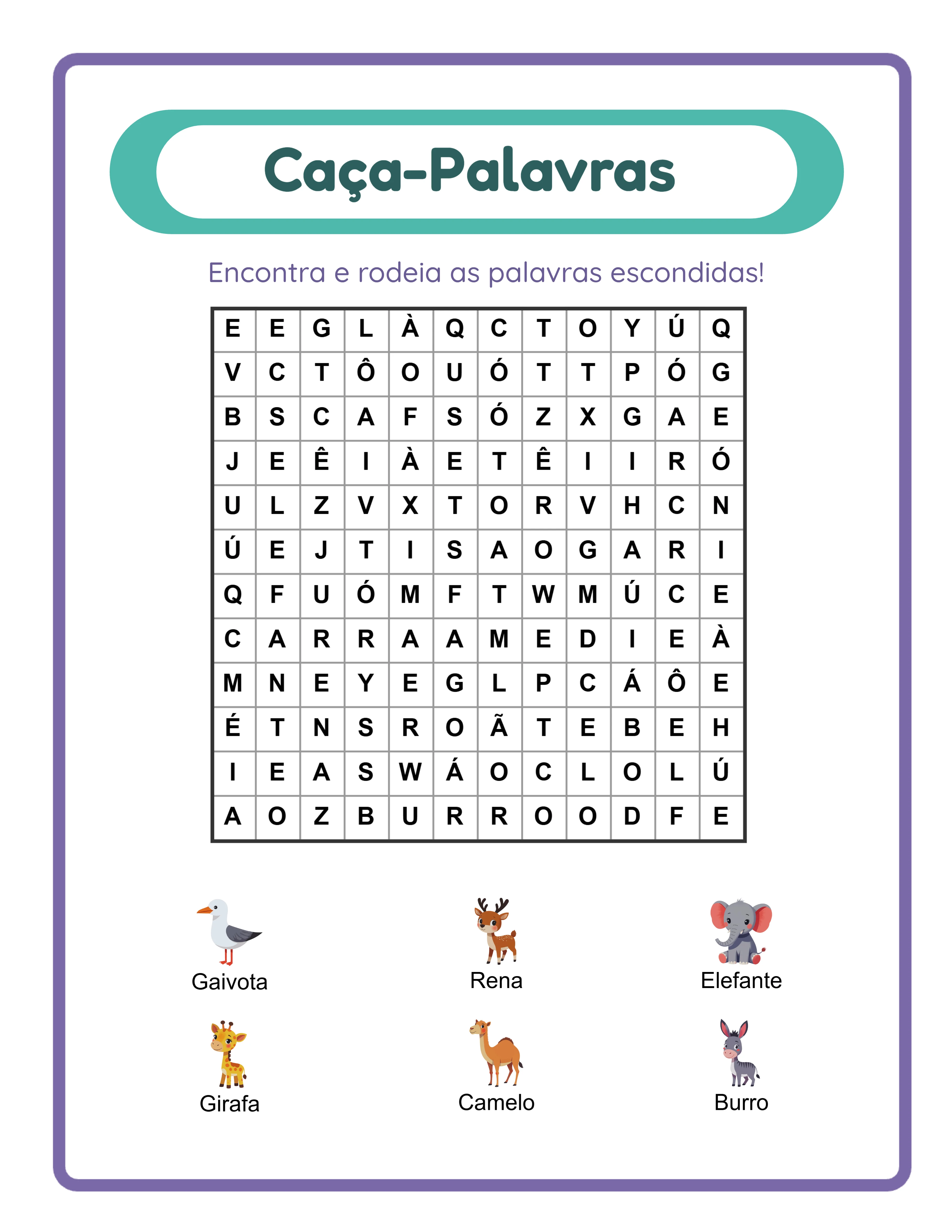
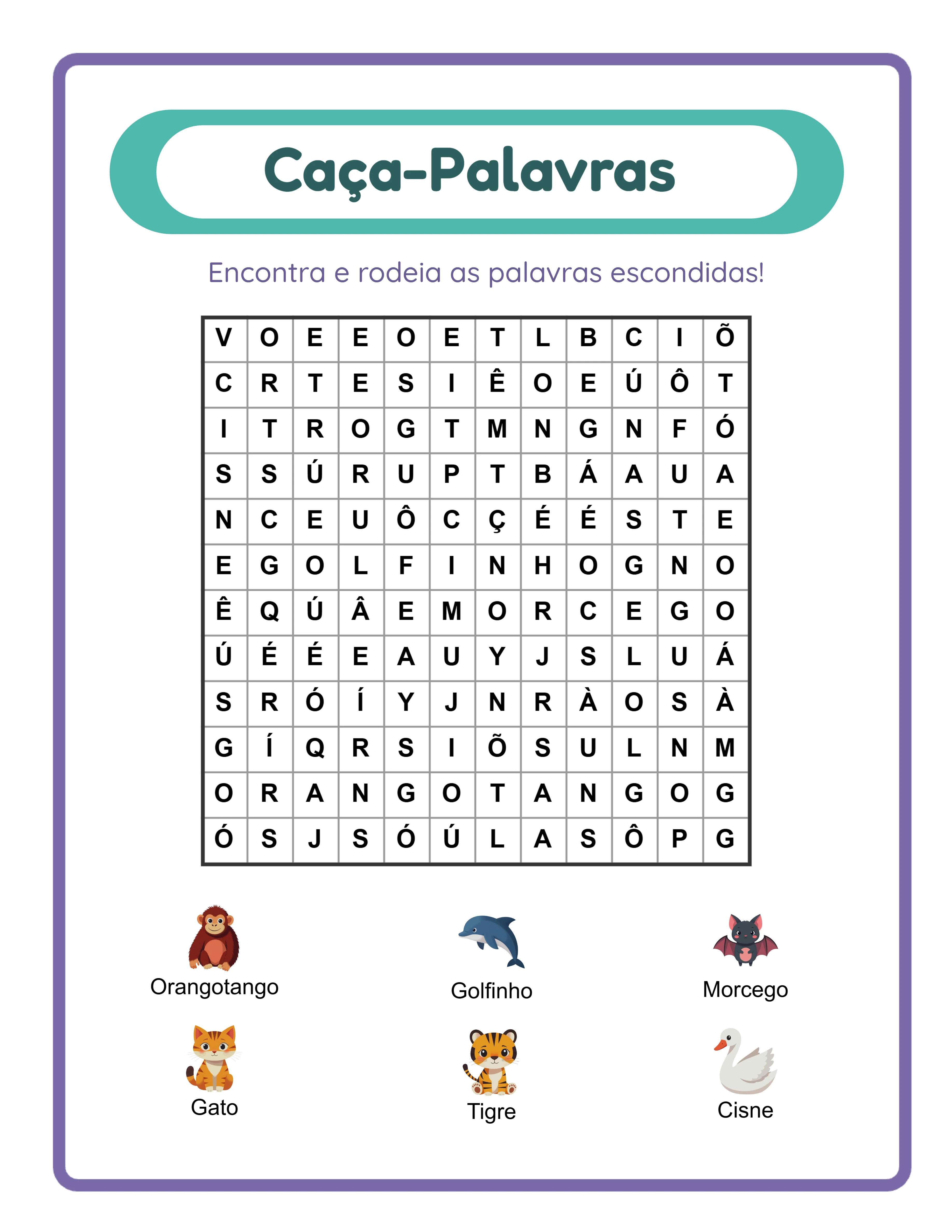
Word search puzzles (Caca-palavras): The most popular puzzle type in Brazil by a wide margin. "Caca-palavras" is a household activity -- newspapers, magazines, and activity books throughout Brazil feature word search puzzles. Brazilian families are already conditioned to seek out and purchase word search content. The LCS word search generator produces Portuguese puzzles with native vocabulary and proper accented characters.
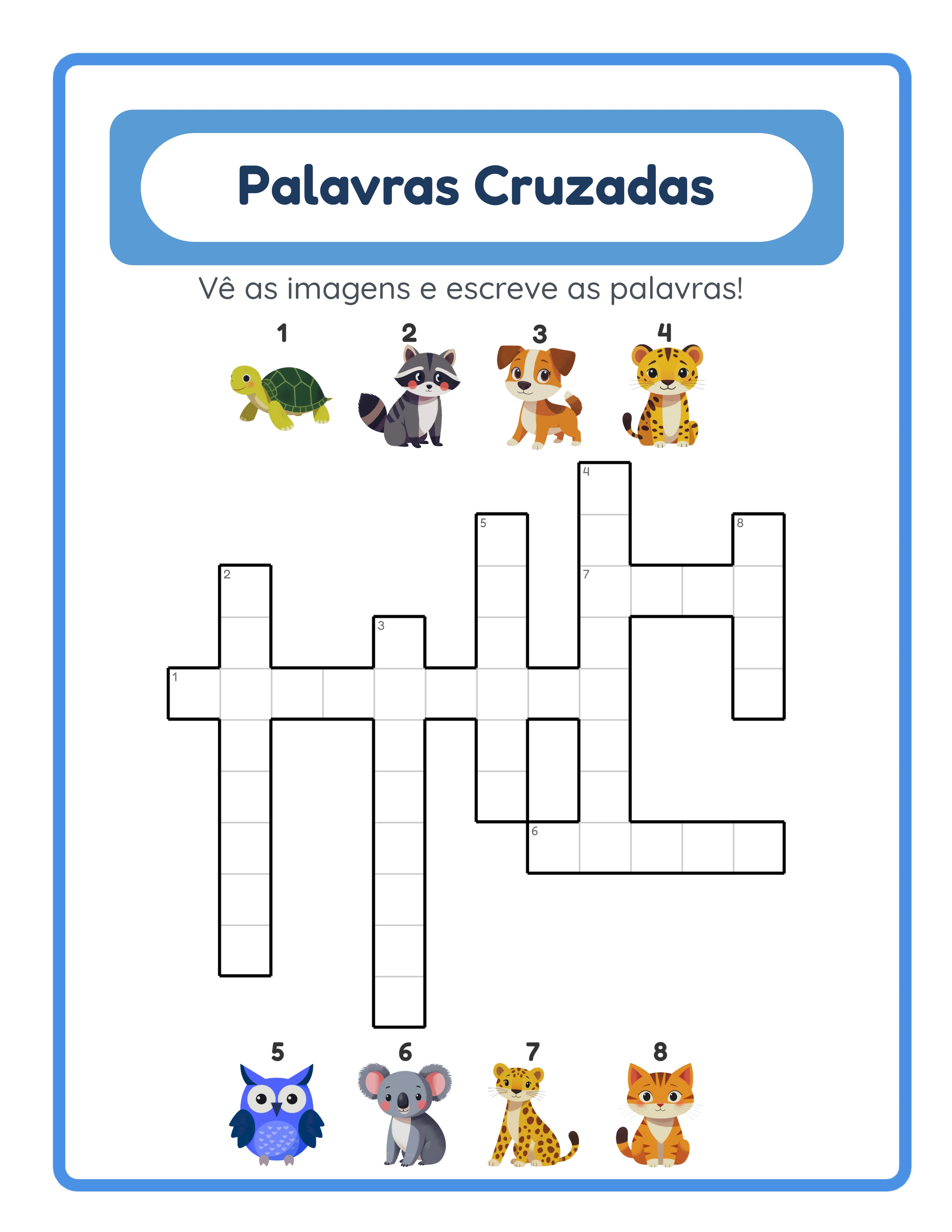
Crossword puzzles (Palavras cruzadas): Crossword puzzles have a strong tradition in Brazil and Portugal. Picture crosswords with image clues and Portuguese answer words work particularly well because they bypass the need for written Portuguese clue text. This format lets you produce professional crosswords without Portuguese fluency.
Math worksheets (Fichas de matematica): Addition (adicao), subtraction (subtracao), and multiplication (multiplicacao) worksheets with Portuguese-language instructions serve a massive market. Brazilian parents actively search for "atividades de matematica" (math activities) for supplemental learning. The LCS math generators handle Portuguese formatting automatically.
Alphabet and literacy worksheets (Atividades de alfabetizacao): Literacy worksheets are in extremely high demand in Brazil, where early childhood education ("educacao infantil") is a major focus for families. Portuguese alphabet worksheets, letter tracing, and phonics activities fill a gap that English products cannot serve.
Coloring pages (Desenhos para colorir): Coloring is popular across all ages in Brazil. Themed coloring pages with Portuguese vocabulary labels combine art and education. The adult coloring trend also has a strong following among Brazilian consumers.
Seasonal activity packs: Brazilian seasons are reversed from the Northern Hemisphere. Summer break runs from December to February, creating demand for vacation activity packs during a period when English-market sellers are focused on Christmas. Festa Junina (June festivals), Carnaval, and other Brazilian holidays create unique seasonal demand windows.
3
Handling Portuguese Characters and Formatting
Portuguese uses several special characters and formatting conventions that must be handled correctly for professional-quality printables.
Accented vowels: Portuguese uses acute accents (a, e, i, o, u), grave accents (a), circumflex accents (a, e, o), and tildes (a, o). These accents are mandatory in written Portuguese -- omitting them is a spelling error that any native speaker will notice immediately. Words like "educacao" (education), "matematica" (mathematics), and "caca-palavras" (word search) all require correct accent placement.
Cedilla: The cedilla appears on c before a, o, and u to produce a soft "s" sound. Found in common words like "crianca" (child), "servico" (service), and "comeco" (beginning). Missing cedillas mark content as non-native.
Tilde: The tilde over a and o indicates nasal pronunciation. This diacritic is extremely common in Portuguese and appears in everyday words: "mao" (hand), "pao" (bread), "coracaoo" (heart), "nao" (no). The tilde is one of the most distinctive features of written Portuguese.
Brazilian vs. European Portuguese: Since the 2009 Orthographic Agreement, Brazilian and European Portuguese have converged in spelling. However, some differences remain. "Fato" means "suit" in European Portuguese but "fact" in Brazilian Portuguese. For educational printables, these differences are minimal -- basic vocabulary for themes like animals, food, and colors is consistent across variants.
Number formatting: Brazil uses commas for decimal separators and periods for thousands (opposite to the US). Math worksheets should follow this convention if specifically targeting the Brazilian market. The LCS generators handle locale-specific number formatting.
The LCS generators produce properly accented Portuguese vocabulary with all special characters intact. Word search filler letters include accented characters at natural frequency. You do not need Portuguese language knowledge to produce professional-quality output.
4
Platform Strategy for the Portuguese Market
The Portuguese market is served by several platforms, each reaching different segments of Portuguese speakers.
Etsy (global reach): Etsy reaches Portuguese-speaking buyers in Brazil, Portugal, and Portuguese-speaking communities worldwide. Create listings with Portuguese titles and tags for maximum visibility. Brazilian Etsy adoption is growing rapidly as more Brazilian consumers discover international e-commerce platforms.
Amazon.com.br (Brazil): Amazon's Brazilian marketplace is the most direct route to Brazilian buyers. KDP is available on amazon.com.br, allowing you to publish and sell printed Portuguese activity books directly to Brazilian households. The activity book category on amazon.com.br has dramatically less competition than amazon.com.
Amazon.es (Portugal): While Portugal does not have its own Amazon marketplace, Portuguese buyers shop on amazon.es. Publishing KDP books in Portuguese on amazon.es reaches Portuguese buyers alongside the Spanish market.
Mercado Livre (Brazil): Mercado Livre (the Brazilian branch of Mercado Libre) is the largest e-commerce platform in Brazil, with more market share than Amazon in the country. While setting up a Mercado Livre seller account requires Brazilian documentation, it provides access to the largest pool of Brazilian online shoppers. Consider this for long-term market penetration.
Hotmart (Brazil): Hotmart is a Brazilian digital product marketplace specializing in e-books, courses, and digital downloads. It is well-known among Brazilian consumers for digital educational content. Listing Portuguese printable bundles on Hotmart reaches an audience already conditioned to purchase digital educational materials.
Recommended starting strategy: Begin with Etsy (lowest barrier to entry, global reach) and amazon.com.br KDP (direct access to Brazil's massive market). Add Mercado Livre and Hotmart as your Portuguese catalog grows and justifies platform diversification.
5
Creating Your First Portuguese Product Line
Follow this step-by-step workflow to create and launch your first Portuguese printable products.
Step 1 -- Start with caca-palavras: Word search puzzles are the number one puzzle format in Brazil. Open the LCS word search generator, select Portuguese. The generator produces vocabulary like: gato (cat), cachorro (dog), cavalo (horse), vaca (cow), porco (pig), galinha (hen), coelho (rabbit), pato (duck).
Step 2 -- Choose universally appealing themes: Select 5 strong themes: animais (animals), comida (food), natureza (nature), familia (family), esportes (sports). Generate 5 word search puzzles per theme for a 25-puzzle starter bundle.
Step 3 -- Add crosswords: Switch to the crossword generator in Portuguese mode. Generate 10 picture crosswords using the same themes. Image clues with Portuguese answer words require zero Portuguese knowledge to produce.
Step 4 -- Include math worksheets: Generate 15 addition worksheets using the addition generator in Portuguese mode. Math is universal but Portuguese-language formatting and instructions add professional polish.
Step 5 -- Compile for Etsy: Create a PDF bundle in A4 format (standard in Brazil): "Pacote de Atividades: 50 Caca-Palavras, Palavras Cruzadas e Matematica -- PDF Download Imediato." Price at 4.99 to 6.99 USD.
Step 6 -- Compile for KDP: Format the same content as a KDP manuscript. Publish on amazon.com.br with Portuguese title: "Livro de Atividades para Criancas: 50 Caca-Palavras, Palavras Cruzadas e Contas de Somar com Respostas." Price at 39.90 to 49.90 BRL.
Step 7 -- Monitor and expand: Track which themes and product types sell best. Add coloring pages, alphabet worksheets, and seasonal activity packs based on demand signals.
6
Seasonal Opportunities in the Brazilian Market
Brazil's seasonal calendar creates unique demand patterns that Northern Hemisphere sellers often miss entirely.
Summer vacation (December-February): Brazilian summer break overlaps with the Christmas and New Year period. "Atividades de ferias" (vacation activities) sell strongly from November through January. This timing is perfect for sellers in the Northern Hemisphere -- while your English Christmas products wind down, Brazilian summer activity packs are just ramping up.
Carnaval (February-March): Brazil's biggest cultural celebration creates demand for themed coloring pages, word searches with Carnival vocabulary, and festive activity packs. Publish Carnival-themed products in January for peak sales.
Festa Junina (June): Brazil's beloved June festival season is a rich source of themed printable content. Activities featuring corn (milho), bonfires (fogueira), fireworks (fogos de artificio), and traditional foods create engaging seasonal products.
Dia das Criancas (October 12): Children's Day in Brazil is a major gift-giving occasion. Activity books and educational materials make popular gifts. Publish children's activity products in September for the October sales peak.
Back to school (February): The Brazilian school year starts in February (after summer break). Educational printables see strong demand from January through February as parents prepare children for the new school year.
Volta as aulas (return to classes): Each semester return creates a demand mini-spike. First semester starts in February, second semester starts in July-August after the brief winter break.
This reversed seasonal calendar means your Portuguese products have demand peaks when your English products may be in slower periods, creating natural revenue smoothing across your full product catalog.
7
Building Long-Term Competitive Advantage in Portuguese
The Portuguese market's current low competition will not last forever. Building now creates advantages that persist as the market matures.
First-mover advantage: Being among the first professional-quality Portuguese printable sellers on Etsy and amazon.com.br establishes your brand before competition arrives. Early reviews, sales history, and search algorithm authority compound over time. A product with 50 reviews consistently outsells a new competitor's identical product with zero reviews.
Catalog depth as a moat: Building a comprehensive Portuguese catalog of 50 to 100 products across multiple categories (word searches, crosswords, math, coloring, alphabet) creates a barrier that new entrants cannot quickly replicate. Buyers who find one of your products and see a deep catalog in their language become loyal repeat customers.
Review accumulation: Portuguese-language reviews on your products signal authenticity to other Portuguese-speaking buyers. Each positive review makes future sales easier. Start accumulating reviews now while competition is near zero.
LCS 11-language advantage: Your Portuguese products are part of a broader multilingual catalog. When you produce a Portuguese caca-palavras bundle, the same generation session can produce Spanish, French, German, and Italian versions. This language efficiency is a structural advantage that single-language sellers cannot match.
Portuguese to Spanish pipeline: Portuguese and Spanish share significant linguistic similarity. Products that sell well in Portuguese almost always translate to the Spanish market successfully. Your Portuguese catalog doubles as a product testing ground for the even larger Spanish market.
Brazil's growth trajectory: Brazil's middle class is expanding, internet penetration is increasing, and e-commerce is growing at double-digit rates annually. The addressable market for Portuguese educational printables will be larger next year than this year, and larger the year after that. Building your catalog now positions you to capture that growing demand automatically.