Tutorial
1
Understanding What Picture Cryptograms Are
Before diving into KDP publishing, you need to understand the puzzle format you are creating -- because picture cryptograms are fundamentally different from every other puzzle type on the market.
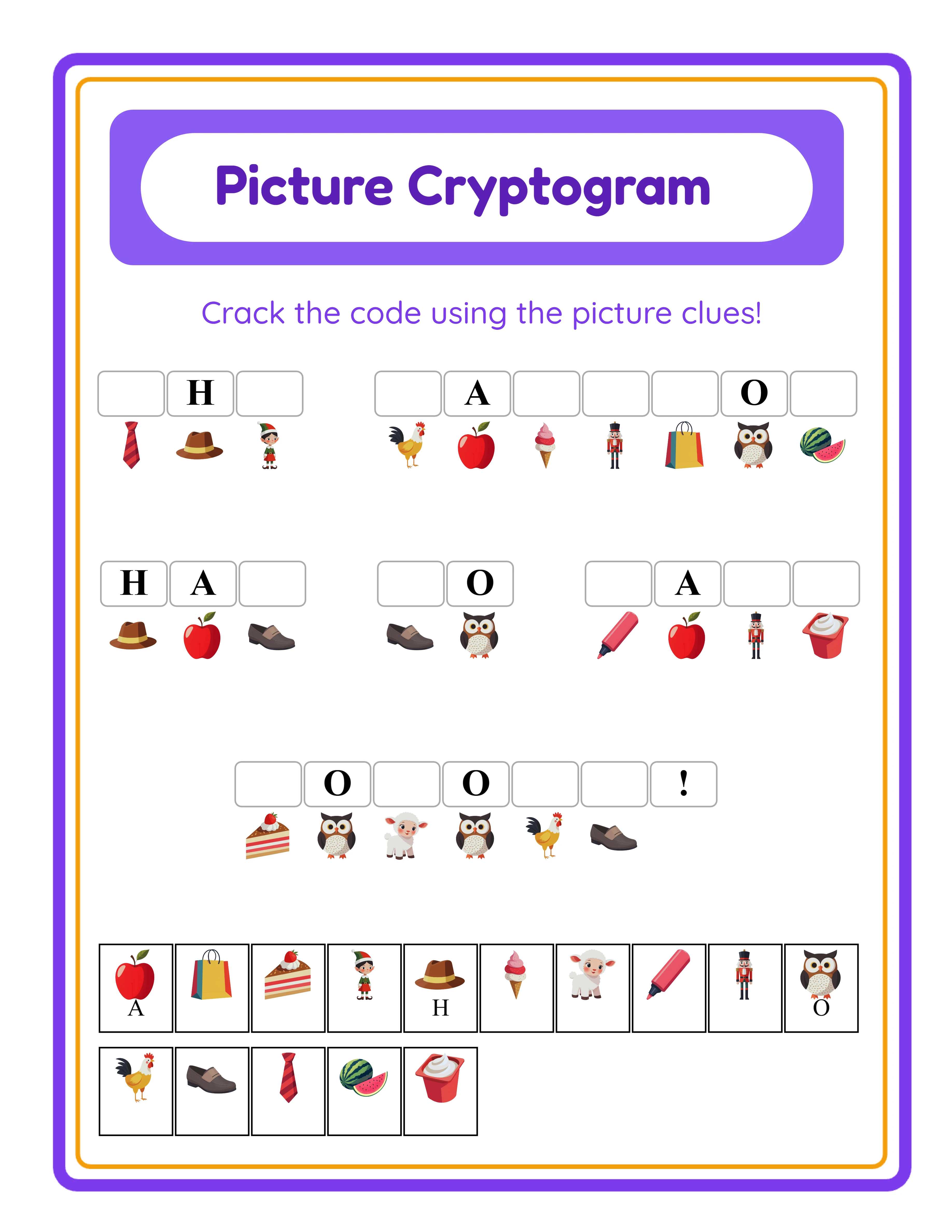
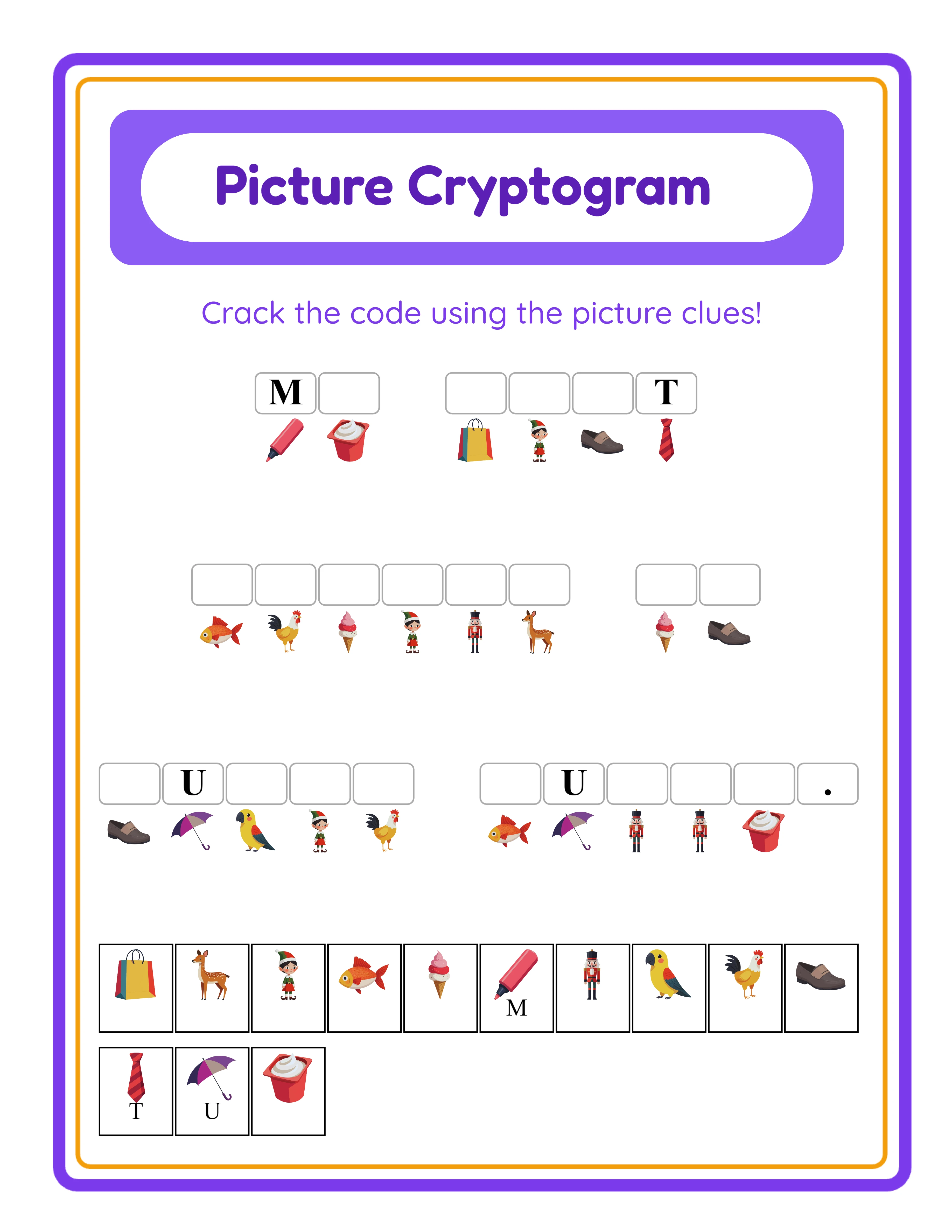
A picture cryptogram is a letter-to-image cipher puzzle. Every letter of the alphabet is assigned a unique image from a themed collection. A secret phrase or sentence is then encoded by replacing each letter with its assigned image. The solver sees a row of images with blank lines beneath them and must figure out which image represents which letter.
The solving mechanic relies on pattern recognition and contextual deduction. Spaces and punctuation are preserved, so word boundaries remain visible. This is crucial because common short words provide natural entry points for cracking the cipher. A three-image word appearing multiple times is likely "the." A single-image word is probably "a" or "I." Once a solver identifies one or two letters, the decoded characters unlock adjacent letters in other words, creating a cascading chain of deductions that progressively reveals the entire message.
This deduction-based mechanic creates sustained engagement that other puzzle formats cannot match. A word search is a scanning exercise -- you know all the words and just need to find them. A crossword gives you clue-answer pairs. But a cryptogram requires genuine detective work where each solved letter unlocks new possibilities. Solvers describe the experience as addictive, which translates directly to strong reviews and repeat purchases on Amazon.
The visual component sets picture cryptograms apart from traditional letter-substitution ciphers. Instead of replacing "A" with "Q" (a purely abstract substitution), picture ciphers replace "A" with an image of an apple or an airplane. This visual richness makes the puzzles more appealing on Amazon product pages, more engaging to solve, and more suitable for a wider age range than text-only ciphers. Children who struggle with abstract letter substitutions can engage with picture ciphers because the images are memorable and distinctive.
2
Understanding KDP Puzzle Book Requirements
Amazon KDP has specific formatting requirements for puzzle book interiors. Understanding these before generating your first cryptogram saves you from reformatting later.
Trim size: The most popular sizes for puzzle books on KDP are 8.5 x 11 inches (US Letter), 8 x 10 inches, and 6 x 9 inches. US Letter gives you the most space for cipher images and is the expected format for activity books. The 8 x 10 size works well for picture cryptograms because it provides ample room for themed images while keeping printing costs slightly lower. The 6 x 9 size suits travel-sized puzzle books.
Page count: KDP requires a minimum of 24 pages for paperback books. For cryptogram books, aim for 50 to 100 puzzle pages plus matching answer key pages. A 60-puzzle book with 60 letter legend answer key pages gives you a 124-page book (including front matter) that buyers perceive as solid value.
Margins: KDP has minimum margin requirements that vary by page count. For a 124-page book at 8.5 x 11, you need at least 0.625 inches on the inside margin (gutter) and 0.25 inches on the outside, top, and bottom. The cryptogram generator's page setup handles these dimensions when you select the correct page size.
Bleed: Cryptogram puzzle books typically do not need bleed (content extending to the page edge). Select "no bleed" in your KDP setup, which simplifies formatting.
Interior type: Select "black and white" for B&W interiors. The cryptogram generator's B&W mode produces grayscale images that render cleanly in KDP's black and white interior format. Black and white interiors have significantly lower printing costs than color, which directly increases your royalty per sale.
File format: KDP accepts PDF manuscripts. The cryptogram generator exports at 300 DPI resolution that meets KDP's quality requirements for both images and text. Export each puzzle and answer key as individual PDFs, then merge them into a single manuscript.
3
Generating Cryptograms with Adjustable Difficulty
Open the cryptogram generator and configure your first puzzle. The Letters to Reveal slider is the most important setting for KDP puzzle book production because it determines your entire product differentiation strategy.
The Letters to Reveal slider ranges from 0 to 10 and controls how many letter-to-image mappings are pre-solved as hints on the worksheet. This single control creates your entire difficulty gradient:
Easy difficulty (7--10 reveals): Many letter-to-image mappings are pre-solved. Solvers see several decoded letters already filled in and complete the remaining gaps. This setting suits beginners, younger solvers, and introductory puzzle books. A book titled "Easy Picture Cryptograms for Beginners" uses this range.
Medium difficulty (3--6 reveals): Roughly half the mappings are revealed. Solvers have enough decoded letters to build momentum and start recognizing words, but must independently decode the remaining half. This balanced setting works for general-audience puzzle books.
Hard difficulty (0--2 reveals): Nearly all mappings are unsolved. At zero reveals, solvers face a pure code-breaking challenge with no starting information. They must deduce every single letter-to-image mapping from scratch using only pattern recognition and contextual clues. This setting creates expert-level puzzles for dedicated puzzle enthusiasts.
Here is the critical insight for KDP publishing: each difficulty level is a separate product. Generate the same themed cryptograms at three difficulty levels and you have three books to publish from essentially the same design work. "Animal Picture Cryptograms -- Easy," "Animal Picture Cryptograms -- Medium," and "Animal Picture Cryptograms -- Hard" are three listings targeting three different buyer segments.
For each puzzle, type your secret phrase, select a theme, and use Auto-Assign to instantly map random images from the theme to all alphabet letters. Adjust the Letters to Reveal slider to your target difficulty. Generate the puzzle, preview it, and export as PDF. Repeat for each puzzle in your book. A 60-puzzle book takes approximately 2 to 3 hours to generate with Auto-Assign handling the image mapping.
4
Choosing Themes and Phrases for KDP Books
Theme selection and phrase design are the creative decisions that differentiate your cryptogram books from competitors. The generator offers 104 themed image collections with over 3,100 illustrations spanning animals, food, vehicles, nature, holidays, professions, sports, seasons, and dozens more.
Theme strategy for KDP: Each theme is a potential book niche. "Animal Picture Cryptograms" targets buyers searching for animal puzzle books. "Holiday Cipher Puzzles" targets seasonal buyers. "Nature Code-Breaking Book" appeals to nature enthusiasts. Choose themes that align with established KDP search categories where buyers actively look for puzzle content.
The visual consistency within each theme collection creates professional-looking cipher puzzles where every image belongs to the same visual family. An animal-themed cryptogram uses animal images exclusively -- cats, dogs, elephants, butterflies -- creating a cohesive visual experience that buyers associate with quality production.
Phrase design for different audiences:
Children's books (ages 6--10): Use short, familiar phrases with common words. "The cat sat on the mat" or "I love sunny days" work well because the simple vocabulary and short word patterns give young solvers accessible entry points for cracking the cipher.
General audience: Use motivational quotes, fun facts, riddles, and seasonal messages. "Every day is a fresh start" or "Practice makes progress" give solvers a rewarding message when they complete the decode. Themed phrases that match the image theme add coherence -- animal facts in an animal-themed cipher book.
Expert audience: Use longer sentences with varied vocabulary and less common words. The challenge comes from both the cipher mechanic and the phrase complexity. "Curiosity is the engine of achievement" forces solvers to work through less predictable letter patterns.
Phrase length as secondary difficulty control: Short two-word phrases provide fewer contextual clues, making the cipher harder despite fewer symbols. Longer sentences with common words provide more pattern opportunities. Combine phrase length with Letters to Reveal settings for precise difficulty calibration.
For batch production, prepare a list of 60 to 100 phrases organized by theme before you start generating. This preparation streamlines the generation session so you can focus on rapid production rather than composing phrases on the fly.
5
Compiling Your KDP Manuscript
Once you have generated all your cryptogram puzzles and letter legend answer keys as individual PDFs, compile them into a single manuscript PDF for KDP upload.
Manuscript structure for a cryptogram puzzle book:
Page 1: Title page with book title, subtitle, and publisher name
Page 2: Copyright page with standard copyright notice and commercial license reference
Pages 3--4: Instructions page explaining how picture cryptograms work -- this is especially important because many buyers will be encountering picture ciphers for the first time. Include a simple diagram showing how letters map to images and how to use contextual clues to crack the code.
Pages 5--64: Puzzle pages (one cryptogram per page, numbered)
Pages 65--124: Letter legend answer key pages (one per puzzle, numbered to match)
Final page: Optional catalog page listing your other puzzle books
The instructions page is particularly valuable for cryptogram books because the format is less familiar than word searches or crosswords. A clear one-page explanation with a mini example puzzle builds buyer confidence and reduces the chance of negative reviews from buyers who do not understand the format.
To merge individual PDFs into a single manuscript, use any PDF merging tool. PDFsam Basic is a reliable option available at no cost. Sejda and macOS Preview also handle PDF merging. Arrange files in the correct page order before merging.
Important formatting checks before upload:
All pages must be the same trim size (e.g., all 8.5 x 11 inches)
Puzzle numbers must be consistent across puzzle pages and answer key pages
Margins must meet KDP minimums throughout the entire document
The final PDF should be under 650 MB (KDP file size limit)
Ensure no watermarks appear on any page -- use commercially licensed exports only
Verify that cipher images render clearly in B&W at the target print size
Check that letter legend answer keys are legible and correctly matched to their puzzles
6
Creating Your KDP Book Cover
Your cover is the single most important factor for KDP sales. Buyers browse search results and make split-second decisions based on cover appearance. For cryptogram books, the cover needs to both attract attention and communicate the unique puzzle format.
Cover requirements: KDP provides a cover calculator that generates exact dimensions based on your page count and trim size. For a 124-page 8.5 x 11 book, the full cover (front + spine + back) is approximately 17.5 x 11.25 inches. You need a front cover, spine, and back cover in a single image.
Design principles for cryptogram book covers:
Show the cipher mechanic. Include a visual preview of a picture cryptogram on the cover -- a row of themed images with blank lines beneath them. This immediately communicates that this is not a standard puzzle book and piques curiosity. Buyers who have never seen a picture cipher before will be intrigued enough to click.
State the contents clearly. "60 Picture Cipher Puzzles" or "Cryptogram Code-Breaking Puzzles with Answer Keys" communicates what the buyer receives. Include the difficulty level: "Easy," "Medium," or "Hard" helps buyers self-select.
Use the themed images. If your book uses animal themes, show colorful animal cipher images on the cover. The vibrant themed illustrations are one of the format's biggest visual advantages over text-heavy puzzle book covers.
Keep the title readable at thumbnail size. Most buyers first see your cover as a small thumbnail in Amazon search results. Bold, high-contrast text ensures your title is legible even at small sizes.
Back cover: Include a brief description explaining the picture cipher concept, a sample puzzle preview showing the image-to-letter mechanic, key selling points (number of puzzles, answer keys included, difficulty level), and your ISBN barcode area.
Cover design tools: Canva offers KDP cover templates at no cost. Book Bolt provides KDP-specific cover creators. For cryptogram covers, the themed cipher images themselves make compelling visual elements -- export a sample puzzle image and feature it prominently on the cover.
7
Publishing and Optimizing Your KDP Listing
With your manuscript and cover ready, navigate to kdp.amazon.com and start your new paperback listing. Listing optimization is especially important for cryptogram books because many buyers do not know the term "cryptogram" -- you need to capture searches across multiple keyword variations.
Title: Keep it descriptive and keyword-rich. Example: "Picture Cryptogram Puzzle Book: 60 Code-Breaking Cipher Puzzles with Answer Keys -- Easy Difficulty"
Subtitle: Add details the title does not cover. Example: "Animal-Themed Picture Ciphers for Kids Ages 6--12 -- Decode Secret Messages Through Pattern Recognition"
Description: Write 300 to 1,000 words explaining both the book contents and the puzzle format. Many potential buyers have never encountered picture cryptograms, so your description needs to educate and sell simultaneously. Explain that every letter maps to a themed image, solvers decode secret messages through pattern recognition, difficulty is controlled through pre-revealed letters, and answer keys are included. Use HTML formatting (bold, bullet points) to make the description scannable.
Keywords: KDP provides 7 keyword slots. Use specific phrases that match buyer search intent across multiple terms for the same concept:
- "cryptogram puzzle book"
- "picture cipher puzzles with answers"
- "code breaking activity book"
- "secret message puzzles for kids"
- "decode puzzles with answer keys"
- "cipher puzzle book for adults"
- "pattern recognition puzzle book"
Categories: Select two categories. "Puzzle Books" or "Activity Books" are primary categories. Add "Word Games" or "Logic Puzzles" as secondary categories since KDP does not have a specific "cryptogram" category.
Pricing: For a 124-page US Letter paperback:
- US marketplace: $6.99 to $8.99 (60% royalty)
- European marketplaces: price 15 to 20% lower to account for higher printing costs
- Start at $7.99 and adjust based on sales velocity and competitor pricing
After publishing, your book typically goes live within 72 hours. Order an author copy to verify that cipher images print clearly and answer keys are legible before investing in advertising.
8
Scaling to a Full KDP Cryptogram Catalog
One cryptogram book is a product. A catalog of 15 to 25 books is a business. The cryptogram generator's feature set creates natural scaling axes that multiply your catalog with minimal additional creative effort.
Difficulty series: Publish the same theme at three difficulty levels using the Letters to Reveal slider. "Animal Cryptograms -- Easy" (7--10 reveals), "Animal Cryptograms -- Medium" (3--6 reveals), and "Animal Cryptograms -- Hard" (0--2 reveals) are three separate listings from essentially the same generation session. Buyers who enjoy one difficulty level often purchase the next level up.
Theme expansion: The generator offers 104 themed image collections. Each theme is a potential book. Animals, food, vehicles, holidays, sports, nature, professions, and dozens more. Create one book per theme and you have a catalog covering dozens of keyword niches that most KDP publishers have never targeted with cryptogram content.
Language expansion: This is the most powerful scaling axis. Publish each successful English book in all 11 supported languages. The locale-aware alphabet produces genuinely different cipher puzzles per language -- German cryptograms use a 30-character alphabet with umlauts, French cryptograms include accented characters. Each language targets a different Amazon marketplace where picture cipher puzzle competition is essentially nonexistent.
English: amazon.com, amazon.co.uk, amazon.ca, amazon.com.au
German: amazon.de
French: amazon.fr
Spanish: amazon.es, amazon.com.mx
Italian: amazon.it
Portuguese: amazon.com.br
Dutch: amazon.nl
Swedish, Danish, Norwegian, Finnish: amazon.se and European marketplaces
Age-targeted editions: Create versions for different age groups. Children's editions use shorter phrases, higher reveals (7--10), and age-appropriate vocabulary. Adult editions use longer phrases, lower reveals (0--3), and more complex vocabulary. Large print editions use bigger images and larger fonts for the senior market.
Seasonal books: Halloween, Christmas, Valentine's Day, Easter, and summer-themed cryptogram books. These spike in demand 4 to 6 weeks before each holiday and sell year after year with no updates needed.
Format bundles: Compile cryptograms with crosswords and word searches into mixed puzzle books. "Ultimate Puzzle Book: Cryptograms, Crosswords & Word Searches" targets buyers looking for variety and commands premium pricing at $9.99 to $12.99.
The compounding effect of a catalog is where the real revenue emerges. Each new book adds to your total daily sales. Fifteen books each selling 2 copies per day at $7.99 generates roughly $24,000 per year in royalties -- and the books continue selling indefinitely with no additional production effort.