Tutorial
1
Understanding the German Printable Market
The German educational printable market has characteristics that make it particularly attractive for international sellers.
Market size: Germany has 83 million people, Austria 9 million, and Switzerland roughly 5 million German speakers. Combined, the DACH region exceeds the population of the United Kingdom and approaches that of the entire western United States. Education is culturally prioritized across all three countries, with families routinely purchasing supplemental materials outside the school system.
Buyer behavior: German buyers tend to be thorough researchers. They read product descriptions carefully, examine preview images, and value quality over rock-bottom pricing. This is good news for sellers who invest in professional-looking products -- German buyers are willing to pay fair prices for well-made materials rather than always choosing the cheapest option.
Seasonal patterns: The German school year runs from August or September through June or July, varying by state (Bundesland). Back-to-school demand peaks in July and August. Holiday worksheet demand spikes around Weihnachten (Christmas), Ostern (Easter), and Karneval (Carnival, mainly in western Germany). Summer break worksheet packets sell from May through July.
Competition levels: On Etsy, searching for "word search" returns hundreds of thousands of results. Searching for "Wortratsel" or "Buchstabenratsel" (German terms for word search puzzles) returns a tiny fraction of that. On amazon.de, English-language activity books vastly outnumber German ones in most categories. This supply gap is your opportunity.
Platform distribution: German buyers split their printable purchases primarily between Etsy (for instant-download digital products) and amazon.de (for printed books). Both platforms have strong German buyer bases and accept listings in German.
2
Product Types That Sell Best in German
Not all printable products perform equally in the German market. Some categories have stronger demand based on cultural and educational factors specific to German-speaking countries.
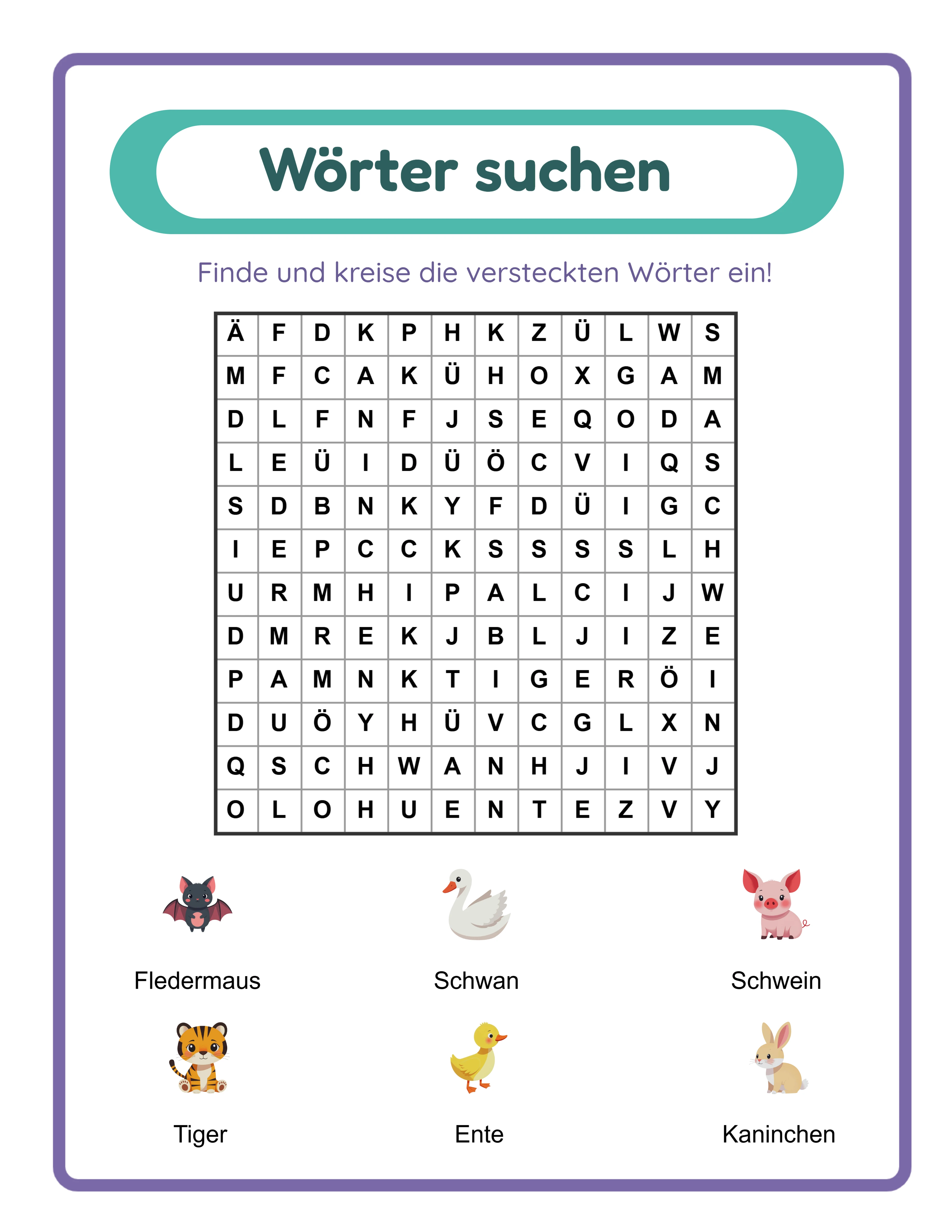
Word search puzzles (Wortratsel / Buchstabenratsel): Extremely popular across all ages. German word searches are inherently more interesting than English ones because German words tend to be longer and compound words create unique puzzle dynamics. A word like "Schmetterling" (butterfly) or "Krankenwagen" (ambulance) presents a satisfying find in a word grid. The LCS word search generator handles German vocabulary natively, including umlauts in the grid.
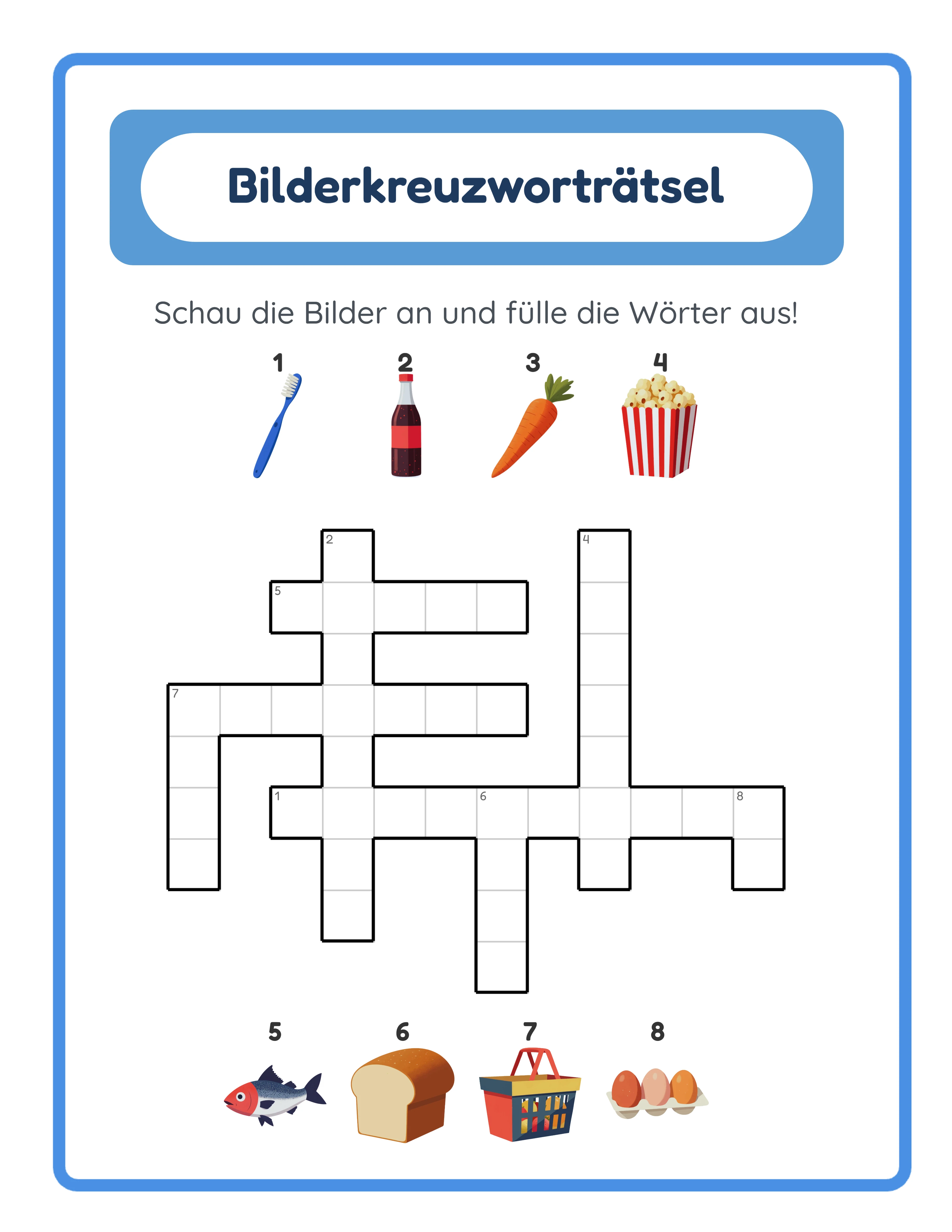
Crossword puzzles (Kreuzwortratsel): Crosswords have a strong tradition in German-speaking countries. Newspapers and magazines in Germany, Austria, and Switzerland all carry regular crossword sections. Picture crosswords where image clues replace text definitions work particularly well because they bypass the need for written clue translation.
Math worksheets (Rechenaufgaben): Addition, subtraction, multiplication, and division worksheets are universal -- numbers work the same way regardless of language. The key German-specific element is formatting instructions and headers in German. The LCS math generators handle this automatically when you select German as the language.
Coloring pages (Malvorlagen): The German coloring market is massive, driven by the popularity of "Ausmalen" culture across all ages. Adult coloring has particularly strong adoption in Germany. Themed coloring pages with German vocabulary labels add educational value.
Alphabet and handwriting worksheets (Buchstaben und Schreibubungen): These are high-demand for parents of young children. German handwriting includes special characters that English worksheets cannot cover -- specifically the umlauts (Ae, Oe, Ue) and the eszett. Worksheets that include these characters serve a need that English-only generators simply cannot meet.
Sudoku and logic puzzles (Logikratsel): These work across languages with minimal text, making them easy to adapt. Instructions in German are the primary localization requirement.
3
Handling Umlauts, Eszett, and German Characters
The technical handling of German characters is what separates professional German printables from amateurish ones. Getting this right is essential for credibility with German-speaking buyers.
Umlauts: German has three umlauted vowels -- ae (a with two dots), oe (o with two dots), and ue (u with two dots). These are not decorative variants of a, o, and u -- they are distinct letters with different pronunciations and meanings. "Schon" means "already" while "schoen" means "beautiful." A German printable that strips umlauts or replaces them with the base vowel looks unprofessional to native speakers.
Eszett: The eszett (the sharp-s character that looks like a stylized B) is unique to German. It appears in common words like "Strasse" (street), "Fussball" (football/soccer), and "grosse" (large). While modern German orthography sometimes replaces eszett with double-s, its correct use signals authentic German content.
Filler letters: In word search puzzles, the unused grid spaces are filled with random letters. For an authentic German word search, these filler letters should include umlauted characters at a frequency that matches natural German text. A word search grid filled only with A-Z letters without any umlauts immediately signals a non-native product.
Compound words: German is famous for compound words -- combining multiple words into one long word. "Kindergarten," "Handschuh" (glove, literally hand-shoe), and "Staubsauger" (vacuum cleaner, literally dust-sucker) are everyday examples. Using compound words in puzzles and worksheets creates a more engaging and authentically German experience.
The LCS generators handle all of these elements automatically. When you select German, the vocabulary database pulls native German words with correct umlauts and eszett. Filler letters include umlauted characters. Compound words appear naturally in themed vocabulary sets. You do not need to know German to produce German-quality output.
4
Setting Up Your Etsy Shop for German Buyers
Selling German printables on Etsy requires optimizing your shop and listings for German-speaking buyers. Here is how to set up effectively.
Shop language settings: Etsy allows you to create listings in German. You do not need a separate shop for German products -- you can list German and English products in the same shop. Use Etsy's translation feature or create separate listings with German titles and descriptions.
Listing titles: Write titles in German for maximum visibility on Etsy DE. Example: "Wortratsel Kinder -- 20 Themen Buchstabenratsel mit Losung -- PDF Sofort-Download" (Word Search Children -- 20 Themed Letter Puzzles with Answer Key -- PDF Instant Download). Include both the German term and occasionally the English term in tags for bilingual searchers.
Tags: Etsy provides 13 tags per listing. Use German-language tags for your German products. Examples: "Wortratsel," "Arbeitsblatt Deutsch," "Ratsel Kinder," "Buchstabenratsel," "Malvorlage," "Rechenaufgaben," "Kreuzwortratsel," "Sofort Download," "Druckvorlage," "Lernmaterial." Mix broad and specific terms.
Descriptions: Write product descriptions in German. Cover what is included, the age range, difficulty level, and how to use the product. German buyers appreciate thoroughness -- include page counts, dimensions, file format details, and printing instructions. If your German is limited, use a translation tool for the description and have a native speaker review it.
Preview images: Show the actual German content in your listing photos. Buyers need to see that the worksheet contains real German vocabulary, not translated English. Include close-up shots of the German text, umlauts, and any themed vocabulary.
Pricing for the DACH market: German buyers are accustomed to paying fair prices for quality. Price your German worksheets at parity with or slightly above your English equivalents -- do not discount them simply because they are in a different language. A 20-page German word search bundle at $4.99 to $7.99 is appropriate.
5
Selling German Activity Books on Amazon DE
Amazon.de is Germany's dominant e-commerce platform, and its KDP (Kindle Direct Publishing) program lets you sell printed activity books directly to German households.
Why amazon.de matters: Amazon holds roughly 50% of German e-commerce market share. German parents and grandparents routinely purchase activity books on amazon.de for birthdays, holidays, and supplemental learning. The activity book category on amazon.de is growing but remains far less crowded than on amazon.com.
KDP for German puzzle books: Use the same KDP publishing workflow you would for English books, but with German content. Upload your German-language word search, crossword, or math worksheet book as a paperback. Set the primary marketplace to amazon.de and the language to German.
Title optimization for amazon.de: Write your KDP title in German. Example: "Wortratsel fuer Kinder ab 6 Jahren: 100 Themen-Buchstabenratsel mit Loesungen -- Grossdruck" (Word Search for Children Ages 6+: 100 Themed Letter Puzzles with Answers -- Large Print). Use keywords that German buyers actually search for.
Pricing on amazon.de: Printing costs on amazon.de are slightly higher than amazon.com. A 200-page activity book on amazon.de might cost roughly 5 to 6 EUR to print. Price at 7.99 to 9.99 EUR for activity books. Check competitor pricing on amazon.de for your specific category.
Categories: Select German-language categories. "Kinder- und Jugendliteratur" (Children's and Young Adult Literature) and "Ratsel und Quiz" (Puzzles and Quizzes) are strong category choices.
Expanded distribution: Enable KDP's expanded distribution to make your German books available on amazon.at (Austria) and through other European Amazon marketplaces where German speakers shop.
6
Creating Your First German Product Line
Here is a practical step-by-step workflow for creating your first batch of German printable products using the LCS generators.
Step 1 -- Choose your first product type: Start with word search puzzles. They require no German language knowledge on your part, the generator handles all vocabulary, and word search is one of the highest-demand categories in the German market.
Step 2 -- Select themes: Pick 5 popular themes that work across cultures: animals (Tiere), food (Essen), vehicles (Fahrzeuge), nature (Natur), and holidays (Feiertage). These themes have strong search volume on both Etsy and amazon.de.
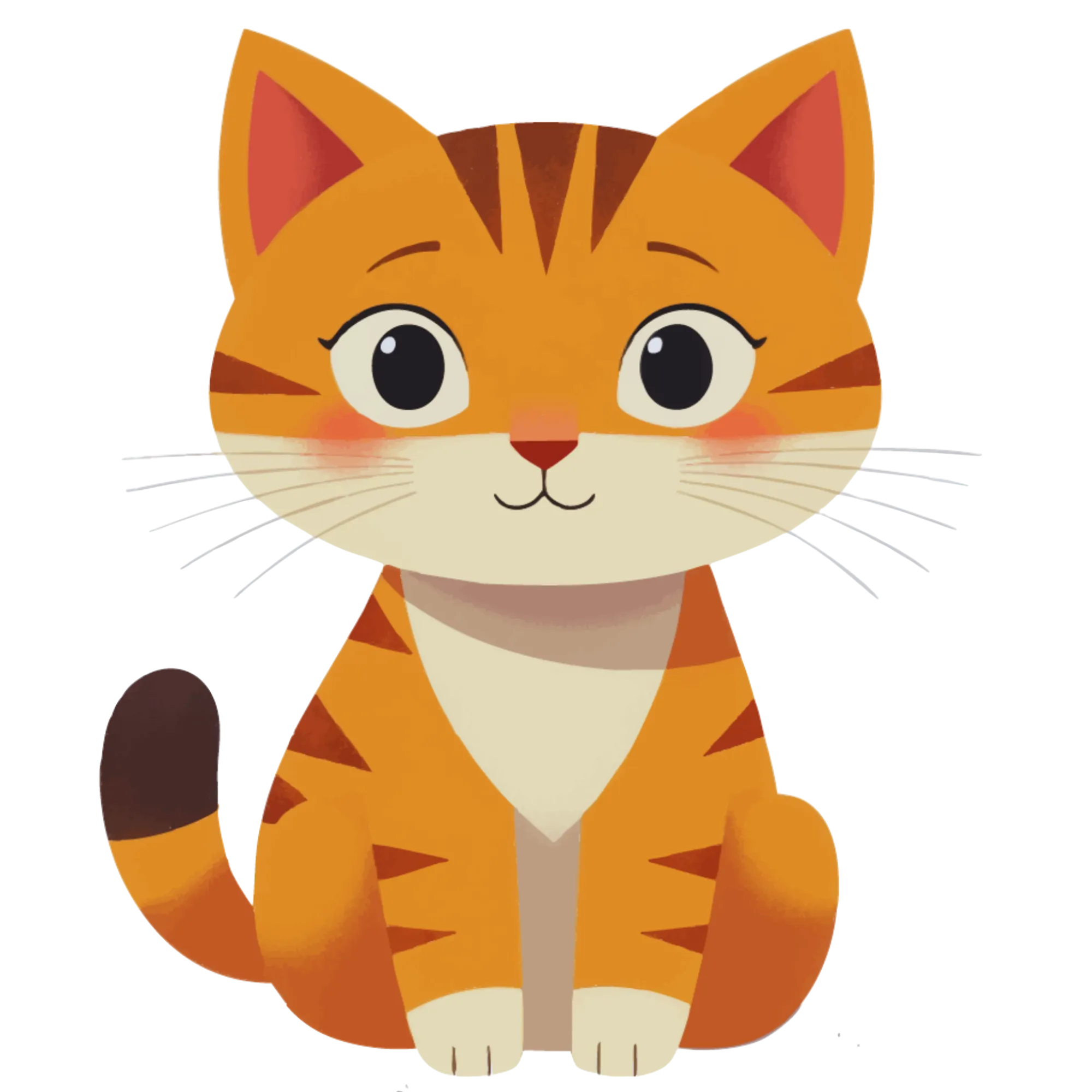
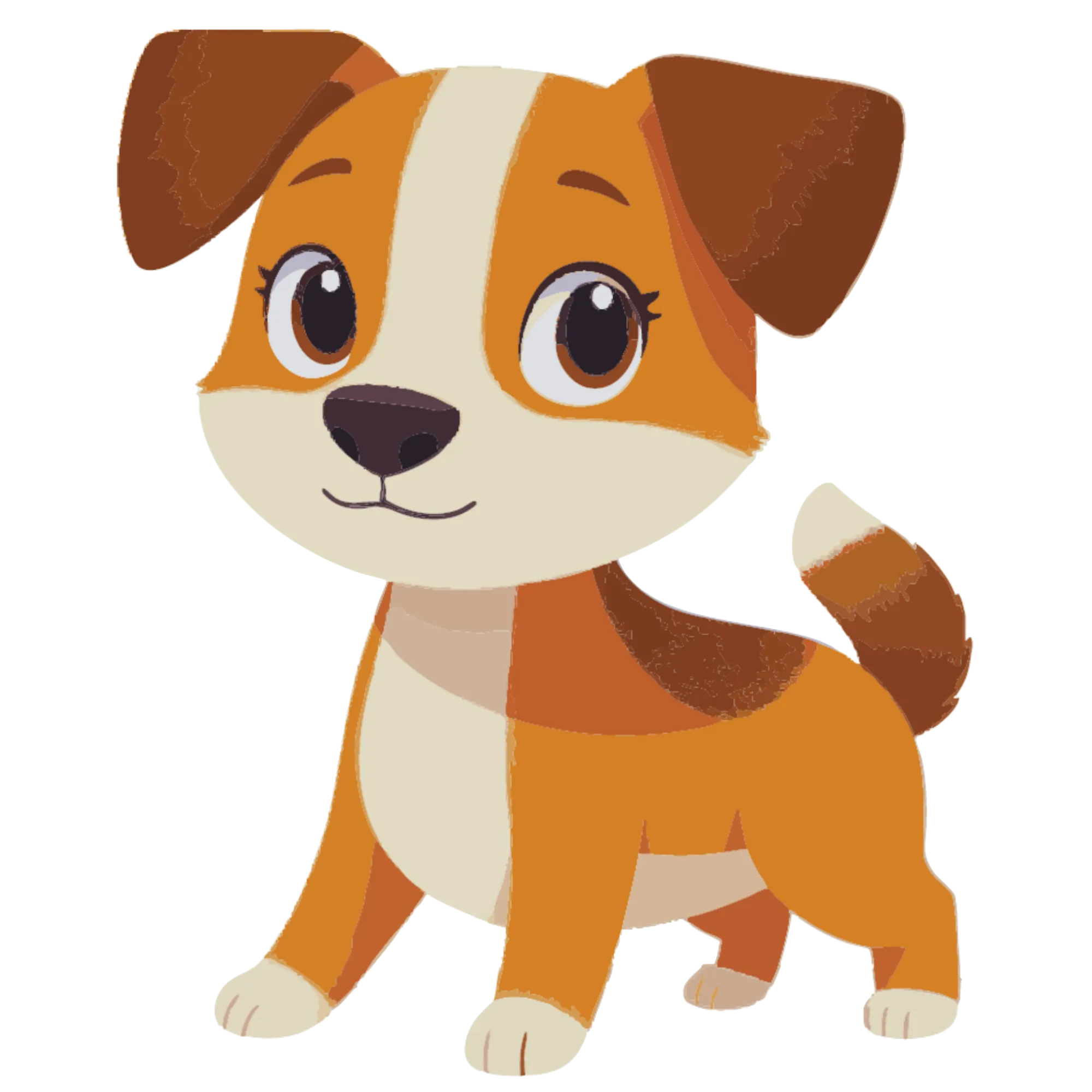
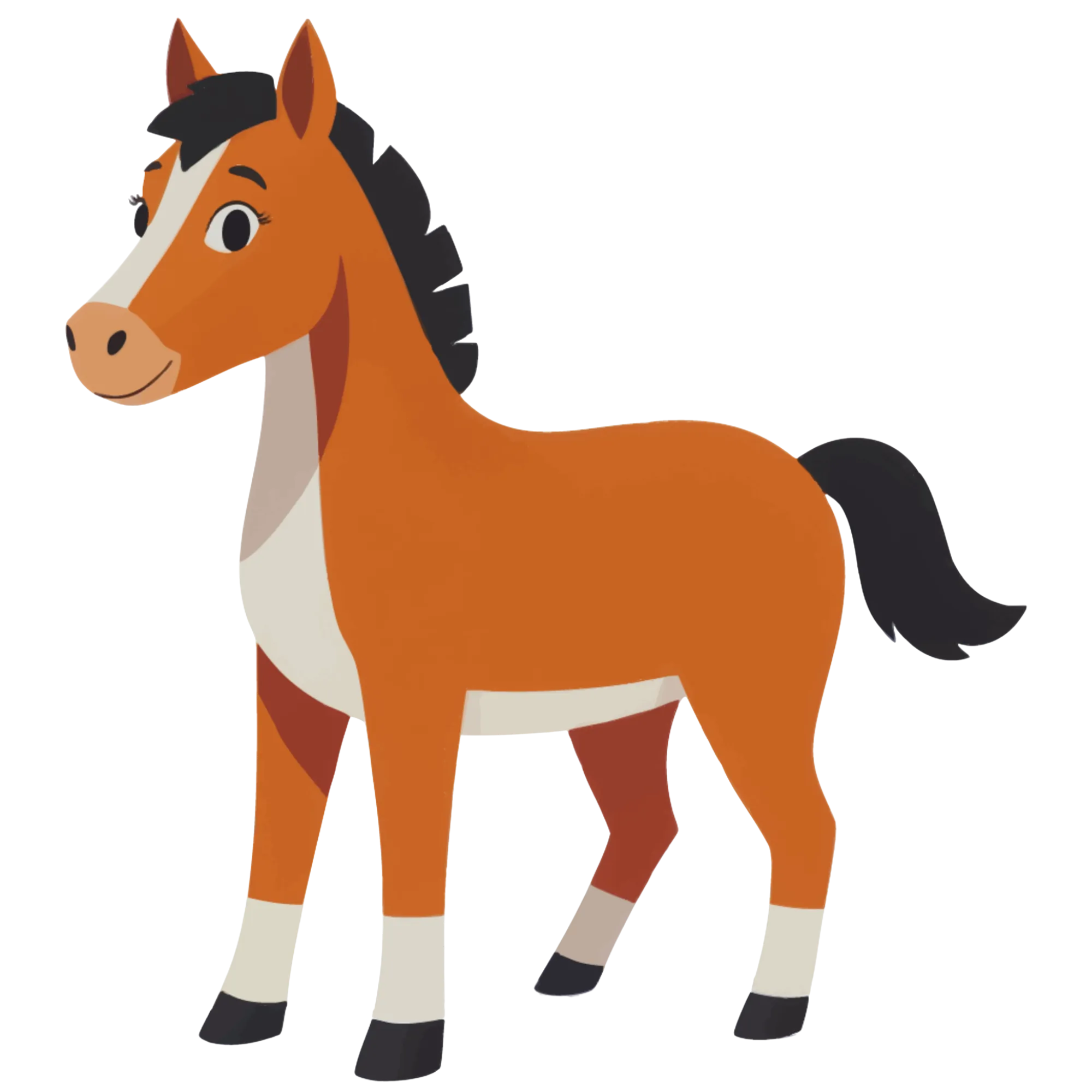
Step 3 -- Generate puzzles: Open the word search generator, switch the language to German, and select your first theme. The generator pulls German vocabulary automatically -- "Hund" (dog), "Katze" (cat), "Pferd" (horse), "Kuh" (cow) for an animals theme. Generate 4 to 5 puzzles per theme for a starter bundle of 20 to 25 puzzles.
Step 4 -- Export and compile: Export each puzzle with its answer key. For Etsy, compile into a PDF bundle. For KDP, format as a complete book manuscript with title page, instructions in German, puzzles, and answer keys.
Step 5 -- Create listings: Write your Etsy listing or KDP product page in German. Use the German keywords and title formats described earlier in this guide. Upload preview images showing the German content clearly.
Step 6 -- Expand: Once your first German word search product is live, add crosswords, math worksheets, and coloring pages in German. Each new product type fills a gap in the German market and cross-sells with your existing products.
Step 7 -- Monitor and iterate: Track which German products sell best. Double down on popular categories and themes. Pay attention to customer messages -- German buyers often leave detailed feedback that helps you improve future products.
7
Competitive Advantage Through 11-Language Support
The LCS generators support 11 languages: English, German, French, Spanish, Portuguese, Italian, Dutch, Swedish, Danish, Norwegian, and Finnish. This multi-language capability creates a structural competitive advantage that single-language sellers cannot match.
Catalog multiplication: Every product you create in English can be regenerated in German (and 9 other languages) with minimal additional effort. A 20-puzzle word search bundle that took 2 hours to create in English takes roughly 30 minutes to regenerate in German -- the generator handles vocabulary, character sets, and filler letters automatically.
Cross-market visibility: Having German products alongside English ones in your Etsy shop signals to German-speaking buyers that you understand their market. They are more likely to browse your full catalog and purchase multiple items.
Bundle opportunities: Create multi-language bundles -- "Word Search Bundle: English + German" -- that appeal to bilingual families, language learners, and international schools. These bundles have virtually no competition on Etsy because most sellers cannot produce authentic multi-language content.
Platform diversification: German products sell on Etsy DE, amazon.de, and smaller German marketplaces. This diversifies your revenue across platforms and reduces dependency on any single marketplace.
Seasonal coverage: German holidays do not perfectly overlap with English-speaking country holidays. Karneval (February), Tag der Deutschen Einheit (October 3), Nikolaustag (December 6), and regional festivals create demand windows that English-only sellers miss entirely.
The key insight is that language support is not just a feature -- it is a business multiplier. Each language you add to your catalog opens an entire new market with its own demand patterns, seasonal cycles, and buyer base. German is one of the most lucrative language markets to enter first, and the LCS generators make entry essentially frictionless.