Tutorial
1
Mapping Activities to Kindergarten Curriculum Standards
Parents and teachers trust workbooks that demonstrate awareness of what kindergarteners actually learn. Mapping your activities to curriculum expectations is not about rigidly following standards documents -- it is about choosing the right activity types at the right difficulty levels.
Number sense activities:
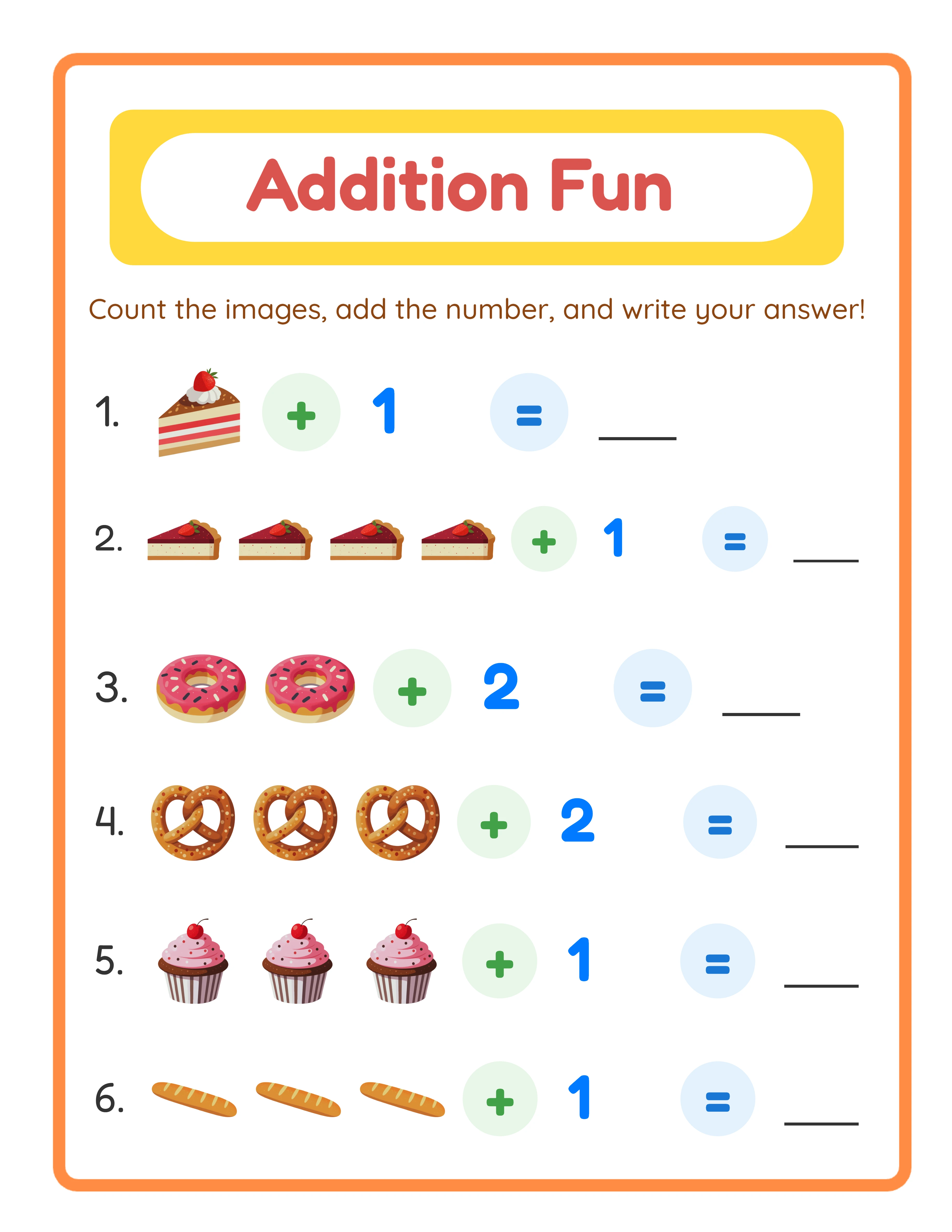
- Counting objects from 1 to 20 (the addition generator creates counting-based math worksheets with themed images)
- Addition within 10 (image-based addition where children count groups of pictures)
- Subtraction within 10 (if available, or frame as "how many are left" counting activities)
- Number recognition and writing (tracing numbers 0 through 20)
- Comparing quantities (more, less, equal using grouped images)
Literacy activities:
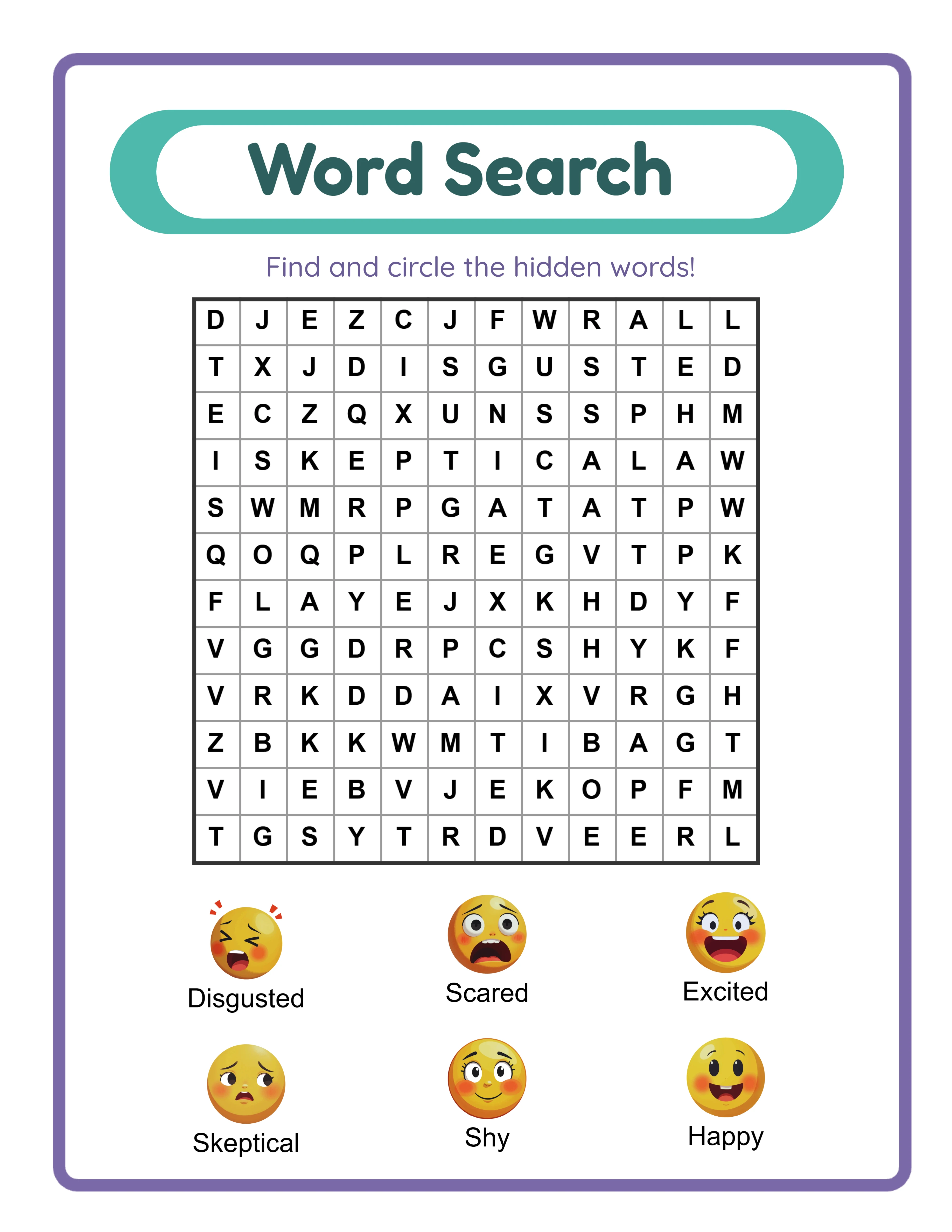
- Letter recognition (word search puzzles with uppercase and lowercase letters embedded in themed vocabulary)
- Beginning sounds (matching images to their starting letter)
- Sight word practice (word search puzzles using common kindergarten sight words: the, and, is, it, can, see, my, we, go, to)
- Vocabulary building (themed word searches introduce new vocabulary through visual context)
Writing activities:
- Uppercase letter tracing (the writing generator creates structured letter formation practice)
- Lowercase letter tracing
- Name writing practice (blank lines with letter size guides)
- Simple word copying
Logical thinking activities:
- Pattern completion (ABC, AABB, ABBC sequences using themed images)
- Sorting by attribute (color, size, shape, category)
- Sequencing (ordering by size, number, or logical progression)
For a 120-page kindergarten workbook, allocate approximately 30% to math, 25% to literacy, 20% to writing, 15% to logical thinking, and 10% to creative activities (coloring). This distribution mirrors how classroom time is typically allocated at the K level.
2
Creating Addition and Math Activities
Math activities are the most searched component of kindergarten workbooks on Amazon. Parents specifically look for "kindergarten math workbook" and "addition practice for kindergarten." Including strong math content in your workbook dramatically improves discoverability.
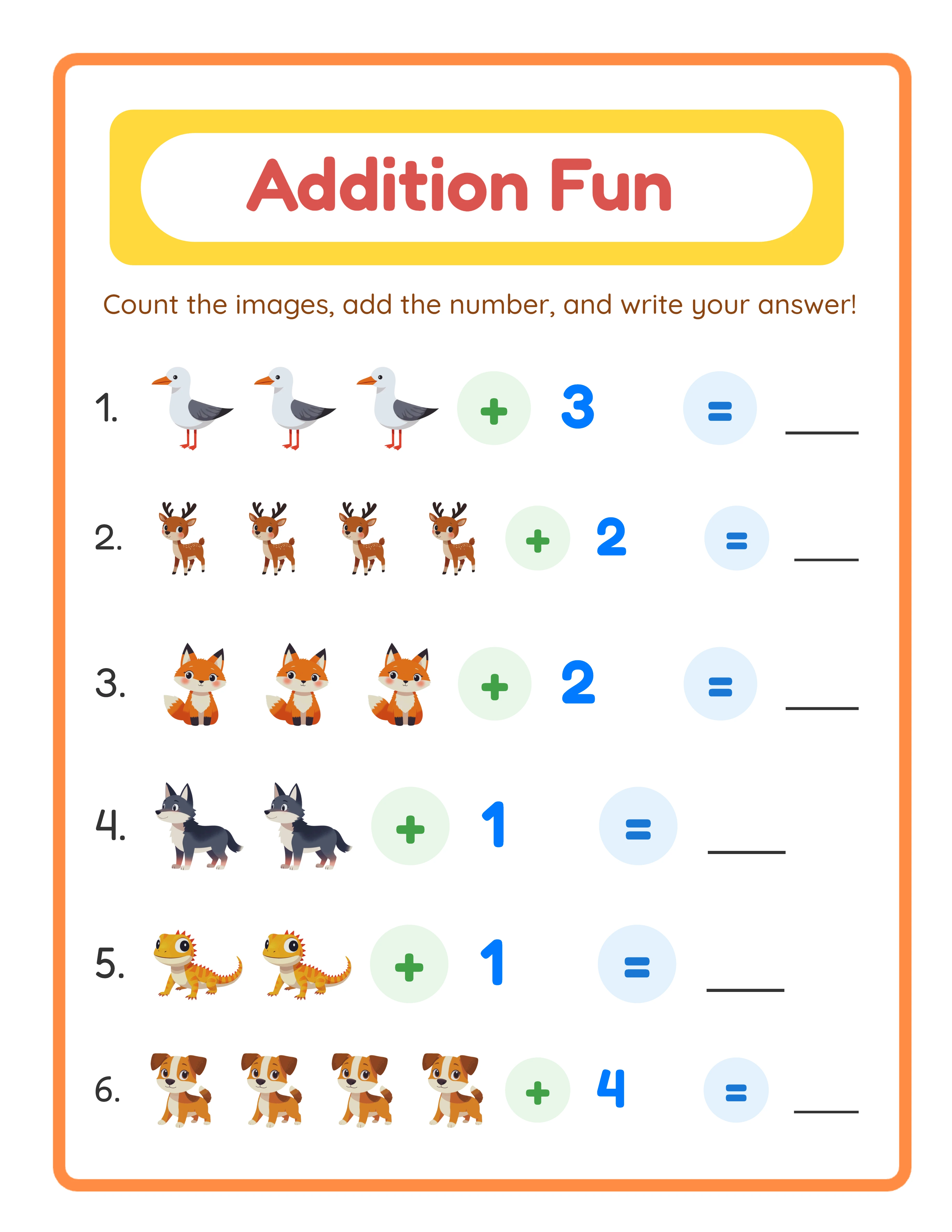
The addition generator creates worksheets where children count images to solve problems. Instead of abstract "3 + 2 = ?", the worksheet shows 3 cats and 2 cats, and the child counts all the cats to find the answer. This concrete, image-based approach matches how kindergarteners learn math.
Math activity progression for a K-level workbook:
Level 1 -- Counting (pages 1-8): Count objects from 1 to 10. Each page shows groups of themed images and asks "How many?" The child counts and writes the number. Start with groups of 1 to 5, then progress to 6 to 10.
Level 2 -- Addition within 5 (pages 9-16): Simple addition using pictures. "2 dogs plus 1 dog equals how many dogs?" Show the images clearly with a plus sign between groups. Include 5 to 6 problems per page.
Level 3 -- Addition within 10 (pages 17-24): More challenging addition still using pictures. "4 cats plus 3 cats equals?" and "6 birds plus 2 birds equals?" Include number sentences below each picture problem so children begin connecting visual counting to written math.
Level 4 -- Addition within 20 (pages 25-30): For advanced kindergarteners. "8 plus 7 equals?" with picture support. These pages challenge children who have mastered basic addition.
Level 5 -- Missing number problems (pages 31-35): "3 + ___ = 5" with picture support. This introduces algebraic thinking at a concrete level. Show 3 cats, a question mark, and 5 cats total.
Generate 30 to 35 math pages using the addition generator with your chosen theme. Export each page as 300 DPI PDF. The visual, image-based format is what makes your workbook stand out from workbooks that use only abstract numbers.
3
Building Word Search Activities for Kindergarteners
Word search puzzles at the kindergarten level serve a different purpose than adult word searches. For kindergarteners, word search activities reinforce letter recognition, build vocabulary, and develop visual scanning skills -- all critical reading readiness competencies.
The word search generator creates puzzles with themed vocabulary pulled from 104 image collections. For kindergarten workbooks, you need to configure the generator for age-appropriate complexity.
Kindergarten word search configuration:
Grid size: 8x8 or 10x10. Larger grids overwhelm kindergarteners. An 8x8 grid with 4 to 6 hidden words provides the right level of challenge.
Word directions: Horizontal and vertical only. Do not enable diagonal or reverse directions for K-level puzzles. Children at this age are still developing left-to-right and top-to-bottom scanning habits.
Word count: 4 to 6 words per puzzle. Each word should be 3 to 5 letters long. Short, familiar words like CAT, DOG, SUN, BIG, RED work well.
Theme selection: Use the same theme as the rest of your workbook. An animal-themed kindergarten workbook has animal word searches. This reinforces vocabulary through repetition across activity types.
Letter case: Uppercase letters in the grid. Kindergarteners typically learn uppercase letters first and recognize them more reliably in grid format.
Word list display: Show the word list with both the word and a picture of the item. This helps pre-readers and early readers identify the words they are searching for.
Generate 15 to 20 word search puzzles with answer keys. Vary the vocabulary by rotating through theme sub-categories (farm animals, ocean animals, jungle animals within the broader animals theme). Place word searches after math sections to provide variety and maintain engagement.
4
Adding Handwriting and Writing Practice
Handwriting practice is the activity type that kindergarten teachers specifically request. A workbook that includes structured letter formation practice appeals to both parents (readiness) and teachers (curriculum supplement).
The writing generator creates handwriting practice sheets with three progressive modes. For kindergarten workbooks, use all three modes in a developmental sequence.
Mode 1 -- Tracing (pages 1-10): Dotted letter outlines that children trace over. Start with straight-line letters (L, T, I, H, E, F) that use simple vertical and horizontal strokes. Progress to curved letters (C, O, S, U) and combination letters (B, D, P, R, G).
Mode 2 -- Guided writing (pages 11-18): A model letter shown at the start of the line, followed by guidelines (top line, middle line, bottom line) where children copy the letter independently. This transitions from tracing to autonomous letter formation.
Mode 3 -- Independent writing (pages 19-24): Only the model letter is shown. Children write the letter multiple times on lined practice space. This builds muscle memory and automatic letter formation.
Letter progression for kindergarten workbooks:
Group 1 -- Easy letters: L, T, I, H, E, F, X (straight lines only)
Group 2 -- Moderate letters: C, O, S, U, V, W, Z (curves and angles)
Group 3 -- Complex letters: B, D, P, R, G, A, M, N, K, Q, J, Y (combinations)
After individual letter practice, include 5 to 8 pages of simple word writing. Children trace and copy 3 to 4 letter words (cat, dog, sun, red, big) using the same themed vocabulary from the word search and math sections.
The 5 font options in the writing generator let you match standard handwriting instruction styles. Select the font that most closely matches your target school system's handwriting curriculum (D'Nealian, Zaner-Bloser, or similar). Mention the handwriting style in your Amazon listing description -- teachers search for specific handwriting methods.
Include 20 to 25 writing practice pages in your workbook.
5
Incorporating Pattern and Logic Activities
Pattern recognition and logical thinking activities round out a complete kindergarten workbook. These activities develop the cognitive skills that underpin both math (number patterns, operations) and reading (letter patterns, phonics rules).
The pattern generator creates "what comes next" sequences using themed images. For kindergarten-level content, you need patterns that are more complex than preschool AB patterns but still achievable without frustration.
Kindergarten pattern progression:
AB patterns with variation (3 pages): Cat, dog, cat, dog, ___. But use different sub-themes within the page. Row 1 might use farm animals, row 2 uses ocean animals, row 3 uses jungle animals. This keeps the pattern type familiar while varying the visual content.
ABC patterns (3 pages): Cat, dog, bird, cat, dog, bird, ___. Three-element patterns require children to track more information. Include 4 rows per page.
AABB patterns (3 pages): Cat, cat, dog, dog, cat, cat, ___. This pattern type is tricky because children may mistakenly think it is an AB pattern. Include image size or color variations to make the repeated elements clearly visible.
Growing patterns (3 pages): One cat, two cats, three cats, ___. This bridges pattern recognition to counting and number sense. Use themed images so the pattern is visual, not numerical.
Shape patterns (2 pages): Circle, square, triangle, circle, square, ___. Use shapes as a bridge between visual patterns and abstract geometric thinking. Fill shapes with themed images to maintain the book's visual theme.
Additional logic activities for kindergarten workbooks:
Odd-one-out (4 pages): Show 4 to 5 themed images where one does not belong. Three farm animals and one vehicle -- which does not belong? This develops categorization and critical thinking.
Sorting (3 pages): Present 8 to 10 mixed images. Children sort them into 2 to 3 categories by circling or drawing lines to category boxes. Animals in one group, vehicles in another, food in a third.
Include 15 to 20 pattern and logic pages. Place them throughout the workbook between math and literacy sections to create cognitive variety.
6
Structuring the Workbook for School-Year Progression
The most effective kindergarten workbooks mirror the school-year progression. Activities at the beginning match early-year skill expectations. Activities at the end match end-of-year expectations. This structure appeals to both parents (who see clear advancement) and teachers (who can assign pages that match their current instructional focus).
School-year workbook structure:
Fall section (pages 5-34, 30 activity pages):
- Counting 1 to 5 with images
- Addition within 5 (picture-based)
- Letter tracing (easy letters: L, T, I, H, E, F)
- 8x8 word search with 4 words (3-letter words)
- AB patterns with themed images
- Simple coloring pages
Winter section (pages 35-64, 30 activity pages):
- Counting 1 to 10 with images
- Addition within 10 (picture-based)
- Letter tracing (moderate letters: C, O, S, U, V, W)
- 8x8 word search with 5 words (3-4 letter words)
- ABC patterns and growing patterns
- Odd-one-out activities
Spring section (pages 65-94, 30 activity pages):
- Counting 1 to 20 with images
- Addition within 20 (picture-based)
- Letter tracing (complex letters: B, D, P, R, G, A, M, N)
- 10x10 word search with 6 words (4-5 letter words)
- Complex patterns (AABB, ABBC) and sorting
- Simple word writing (3-4 letter words)
Summer review section (pages 95-110, 16 activity pages):
- Mixed math review (addition within 20)
- Mixed letter review (full alphabet practice)
- Challenging word searches (6 words, 10x10 grid)
- Complex patterns and logic puzzles
Answer keys (pages 111-120)
Certificate of completion (page 121-122)
Catalog page (pages 123-124)
Total: Approximately 124 pages. This supports a $7.99 price point.
Describe this school-year structure in your Amazon listing. The phrase "follows the kindergarten school-year progression" is a powerful selling point that teachers and education-focused parents respond to.
7
Compiling and Formatting the Kindergarten Manuscript
Kindergarten workbooks have formatting requirements that reflect the needs of 5 to 6-year-old children who are developing both fine motor skills and independent work habits.
Page size: 8.5 x 11 inches is standard for K-level workbooks on KDP. This size provides ample workspace for handwriting practice and math problems.
Margins: Use at least 0.875 inches on the gutter side and 0.5 inches on the outside, top, and bottom. Wider margins give children a natural grip area and prevent content from being lost in the binding.
Writing lines: For handwriting sections, use three-line guides (top, middle, bottom) with the middle line dashed. The spacing between lines should be approximately 0.5 inches for early K practice and 0.375 inches for late K practice. This matches standard primary writing paper dimensions.
Math problem spacing: Each addition problem should occupy at least 2 x 2 inches of space. Children need room to draw counting marks, circle images, and write their answer. Do not crowd more than 6 problems on a page for kindergarteners.
Word search layout: Position the word list below or to the side of the grid, never above it. Include a small themed image next to each word in the list. Grid font size should be at least 16pt for kindergarteners.
Page numbering: Use large, clear page numbers (14pt minimum) in the bottom center or outside corner. Teachers who assign specific pages need children to find them independently.
Section headers: Each section (Fall, Winter, Spring, Summer Review) should begin with a clear section title page. Use large themed images on section title pages to make the workbook visually appealing when parents flip through "Look Inside."
Compile all individual PDFs into one manuscript using PDFsam Basic or similar tools. Verify consistent page dimensions, margins, and orientation throughout. Set KDP interior to "black and white" with "no bleed." Order a proof copy before advertising.