Kindergarten · Math · Unit
Position Words, Size, and Patterns
6 lessonsabout 3 weeks
The unit ends with three more days: a review day, the unit check, and a day to act on what the check showed.
Unit 1 of 8 in the Kindergarten Math Scope and Sequence
What's included in this unit
- 6 lessons in teaching order, each with its objective and a teacher note
- 10 practice pages to print, with an easier and a harder page where available
- 2 classroom tools for the projector
- 3 activities and pages that children do on a screen
- 5 check-up pages to collect
The whole unit in one file
Print every page of the unit at once, with the teacher guide first. The guide has one page per lesson: the objective, what to hand out, and the teacher note.
The unit file, the teacher guide, and saved pages are included with the Teacher plan.
Your PDF is built in your browser, so it always has the newest version of every page.
Lessons
Lesson 1
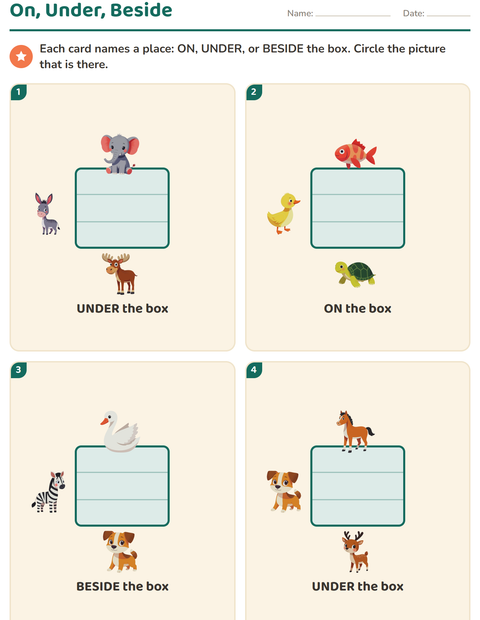
Position words
Children use the words on, under, beside, left, and right to say where something is, and circle the picture in the place that is named.
- StandardCommon Core K.G.A.1Geometry
2 class days
- Day 1Teach: Practice on paper (Core page)
- Day 2Practice and check: More pages from the maker · Practice on screen · Check-up page

Practice on screen
Bramble's Parking Tower — Position Words: Above, Below, Between
Lesson 2
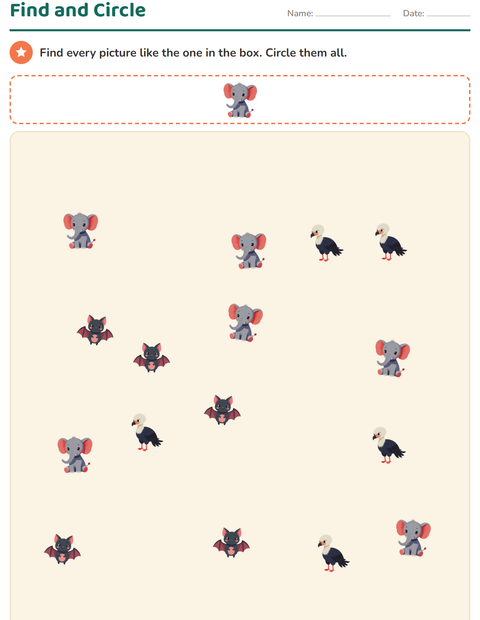
Find every one like it
Children search a busy picture for every picture or shape like the one in the box and circle them all.
2 class days
- Day 1Teach: Practice on paper (Core page)
- Day 2Practice and check: More pages from the maker · Check-up page

Lesson 3
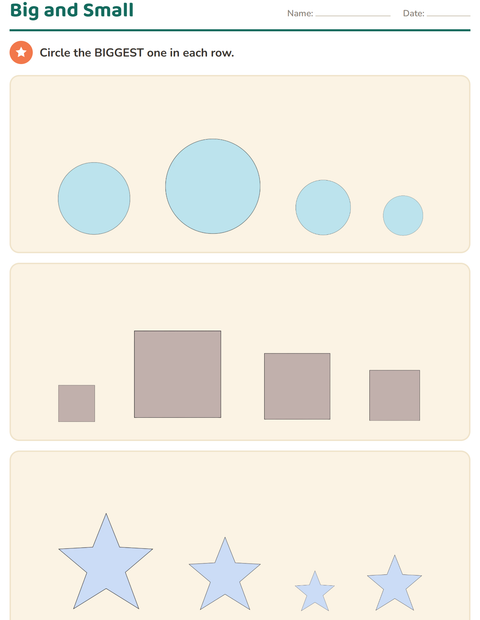
Biggest and tallest
Children compare the pictures in a row and circle the biggest or the tallest one.
- StandardCommon Core K.MD.A.2Measurement and Data
2 class days
- Day 1Teach: Practice on paper (Core page)
- Day 2Practice and check: More pages from the maker · Practice on screen · Check-up page

Practice on screen
Lesson 4
Put them in order by size
Children put three or five pictures in order from smallest to biggest and number them, starting with 1 for the smallest.
- Later gradeCommon Core 1.MD.A.1Measurement and Data
- Goes beyondCommon Core K.MD.A.2Measurement and Data
2 class days
- Day 1Teach: Practice on paper (Core page)
- Day 2Practice and check: More pages from the maker · Practice on screen · Check-up page


Practice on screen
Lesson 5
What can we measure?
Children hold a real object, such as a book, a cup, or a block, and say what can be measured about it: how long it is, how heavy it is, or how much it holds.
- StandardCommon Core K.MD.A.1Measurement and Data
2 class days
- Day 1Teach: Measurement Bench · the routine with the class
- Day 2Practice: the routine with the class
Warm up and teach
What the class does
Start at the length bench of the Measurement Bench. The class says what is being measured there (how long the object is) and what else could be measured about that object (how heavy it is, how much it holds). Then sit in a circle with a basket of real objects. Each pair takes one object and tells two things about it that can be measured: "We can measure how long it is. We can measure how heavy it is." On the second day each pair takes a new object from the basket and tells again what can be measured about it. This lesson has no worksheet.
Lesson 6
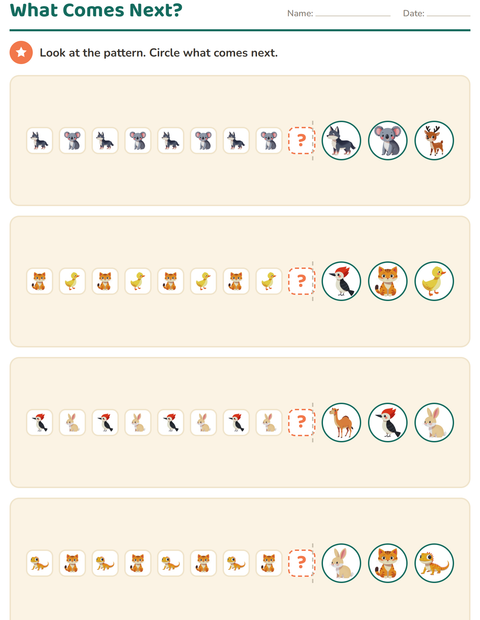
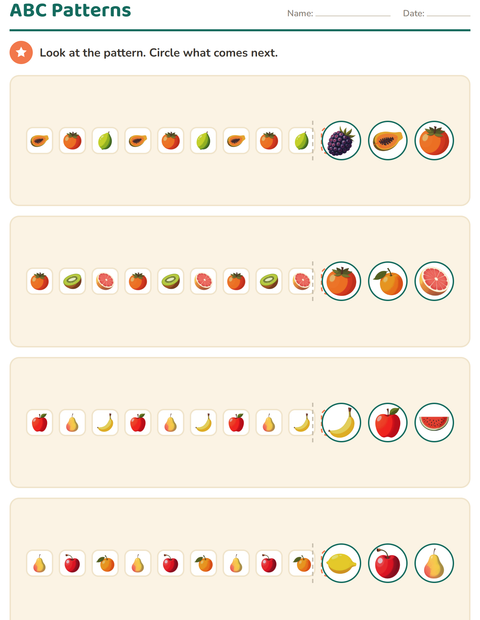
What comes next?
Children read a repeating pattern aloud, find the part that repeats, and circle what comes next.
2 class days
- Day 1Teach: Pattern Bench · Practice on paper (Core page)
- Day 2Practice and check: More pages from the maker · Check-up page
Warm up and teach
Unit check: before and after
Two short paper checks made from this unit's own worksheets. Give Check A before you teach the unit and Check B after it, and you can see what changed. Each part belongs to one lesson.
- Part 1: Lesson 1, Position words (2 tasks)
- Part 2: Lesson 2, Find every one like it (1 task)
- Part 3: Lesson 3, Biggest and tallest (1 task)
- Part 4: Lesson 4, Put them in order by size (1 task)
- Part 5: Lesson 6, What comes next? (1 task)
Not in the check: Lesson 5. Worksheets that cannot be split into single tasks are left out.
Printing a check counts as a download, like any worksheet.
The answer keys and the teacher pages come with the paid Teacher plan.
This is a classroom check of this unit's lessons. It is not a standardized test, and its points are not a grade.