Tutorial
1
Open the Chart Count Worksheet Maker
Navigate to the Chart Count Worksheet Maker and click "Try Free Now" to launch the generator in your browser. The tool loads instantly with a settings sidebar on the left and a dual-tab canvas on the right — one tab for the worksheet, one for the answer key. No account creation, no software download, no installation required.
The dual-tab canvas is a distinguishing feature of this generator. Unlike single-canvas worksheet tools, the Chart Count Maker simultaneously produces both a solver worksheet and a buyer answer key in the same session. You will work primarily on the Worksheet tab during creation, then switch to the Answer Key tab to review the auto-generated solution before exporting both.
Take a moment to familiarize yourself with the sidebar sections: Page Setup for dimensions and decorations, Image Library for selecting your 6 image types, and Text Tools for adding custom titles and instructions. The canvas area supports full drag-and-drop editing with zoom controls ranging from 25% to 300%.
2
Set Page Layout and Background
In the Page Setup section, select your page size. Options include Letter Portrait, Letter Landscape, A4 Portrait, A4 Landscape, Square (1200×1200), and custom dimensions. US Letter is the standard for North American buyers, while A4 serves European and international markets. Creating both versions doubles your market reach with minimal additional effort.
Set a page background color — white is the default for clean, print-friendly worksheets. For digital-use products or premium bundles, a light pastel can add visual warmth.
The generator offers both background themes and border themes from the built-in library, each controlled by an independent opacity slider (0–1, step 0.05). Set a subtle watercolor background at 15–25% opacity to add texture without distracting from the image grid and bar chart. Layer a decorative border at 80–100% opacity for a polished frame. Background and border themes work independently, so you can mix and match to create a professional product look. Consistent styling across a bundle creates a cohesive brand identity that buyers recognize and return to.
3
Choose Your Image Source
The Chart Count Maker offers two distinct workflows for selecting the 6 image types that will appear on your worksheet.
Automatic mode: Use the Worksheet Image Source dropdown to select a theme like Animals, Food, or Vehicles. The app randomly picks 6 images from that collection. This is the fastest workflow for building large bundles — select a theme, generate, repeat. With 104 themed collections containing 3,100+ illustrations, you have enormous variety without any manual selection.
Manual mode: Browse the Image Library by theme or search by keyword, then click exactly 6 images. Selected images appear in a preview strip where you can click to remove and replace individual picks. Manual selection gives you precise control over which image types appear together — useful for creating curriculum-aligned worksheets where specific items matter (farm animals only, ocean creatures only, or specific food groups).
You can also upload custom PNG, JPG, or GIF images using the upload button for subject-specific picture graphs, branded content, or niche themes not covered by the built-in library.
Both modes guarantee exactly 6 image types per worksheet, which is essential for the 6-column bar chart format. The strategic choice between automatic and manual depends on your product: automatic for rapid bundle creation, manual for curated educational products.
4
Generate the Picture Graph Worksheet
Click Generate to create your worksheet. The app performs several operations simultaneously:
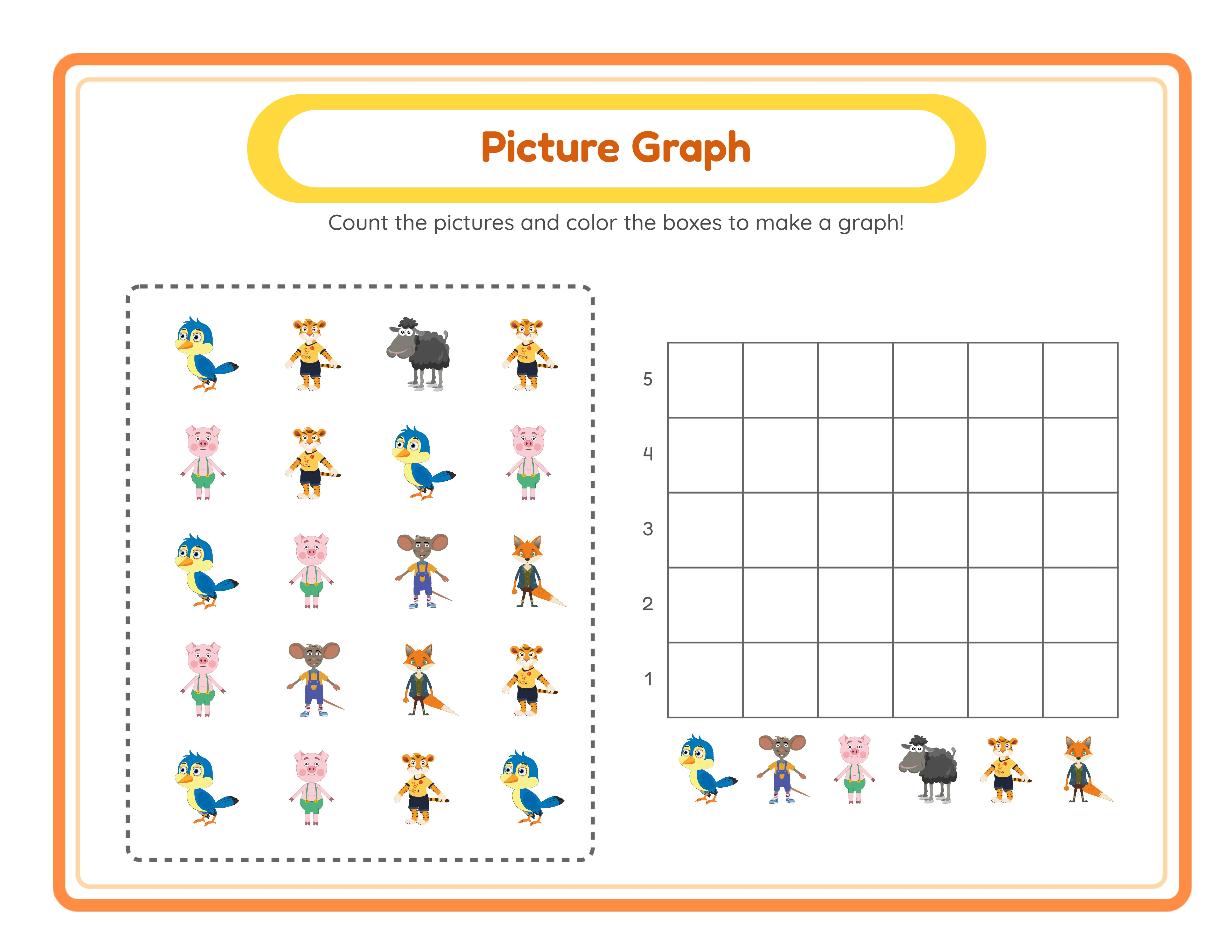
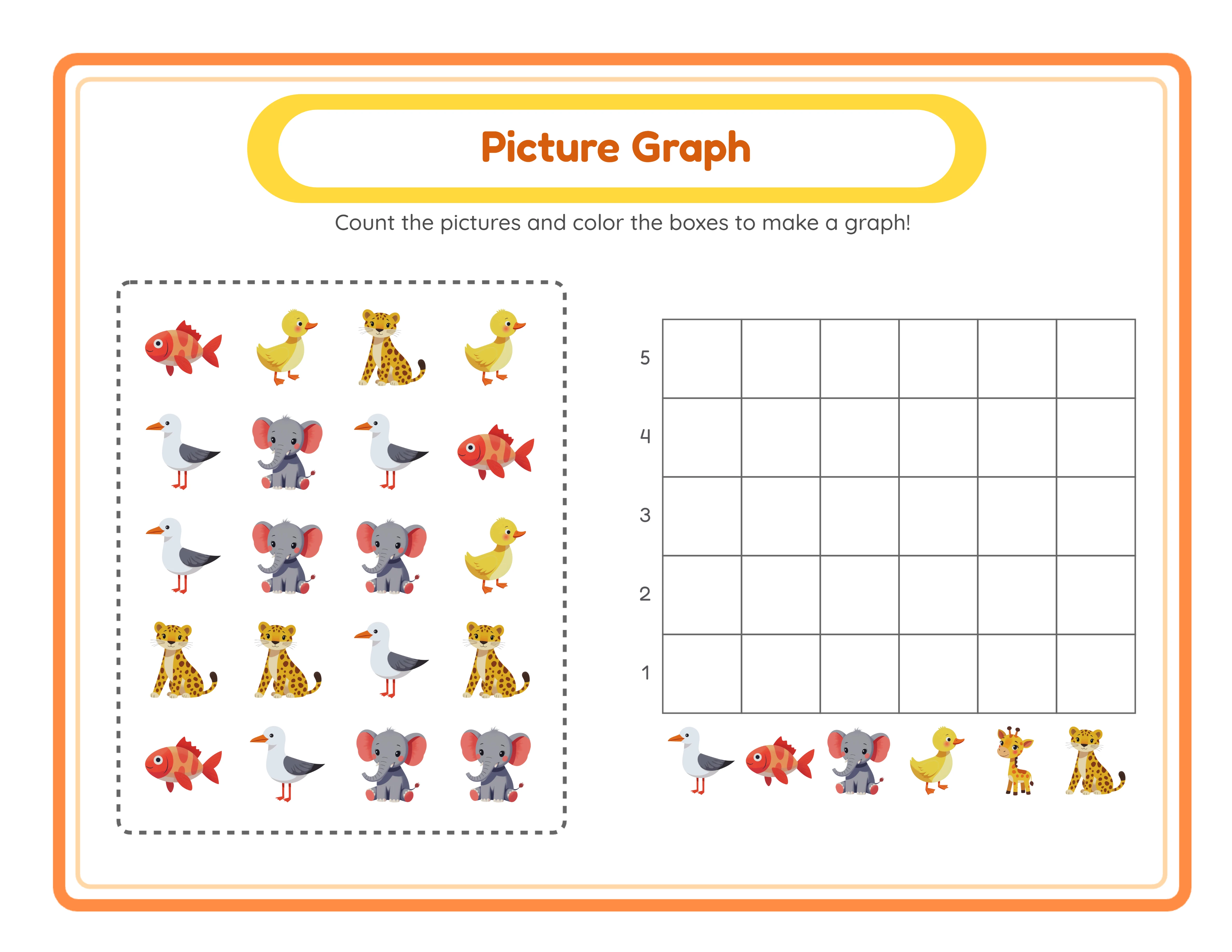
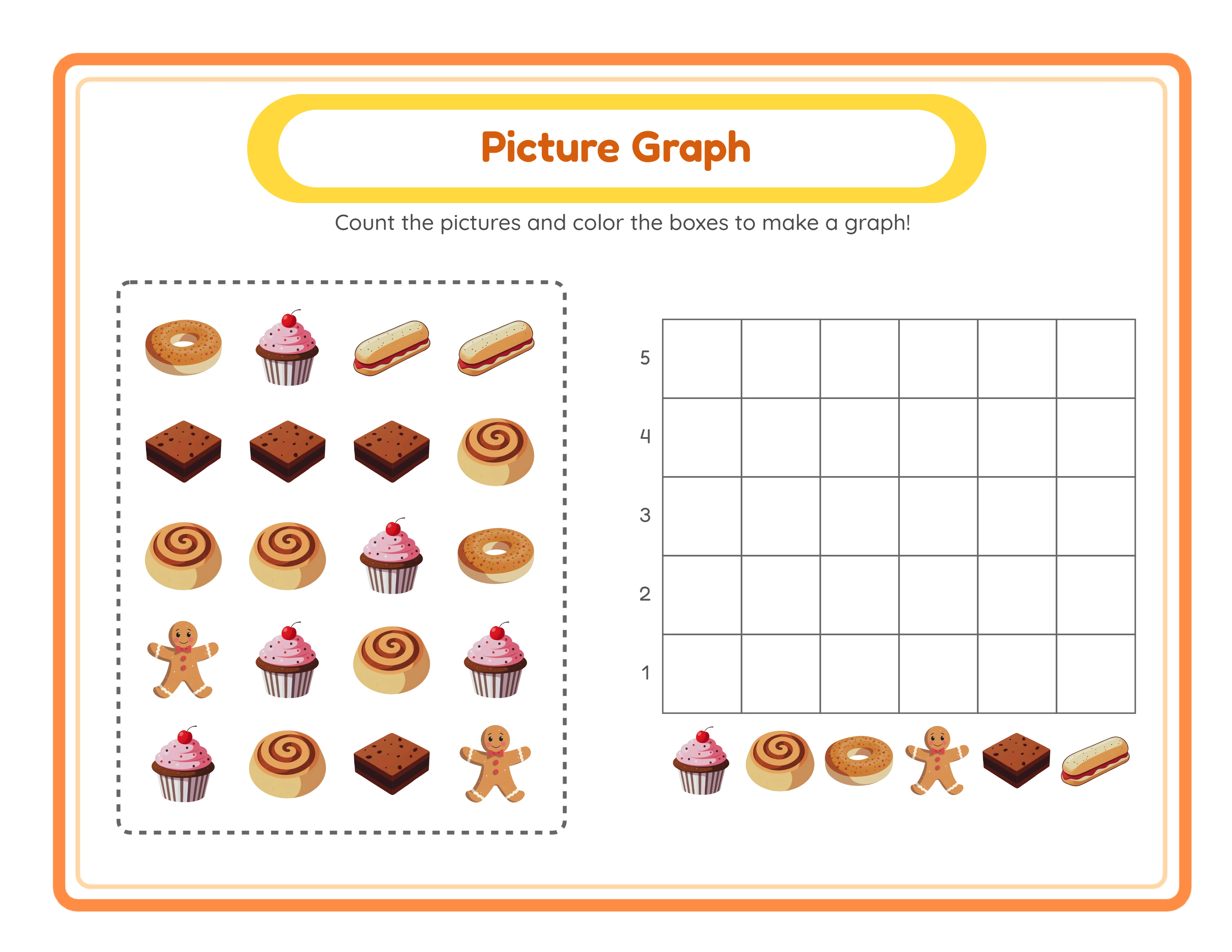
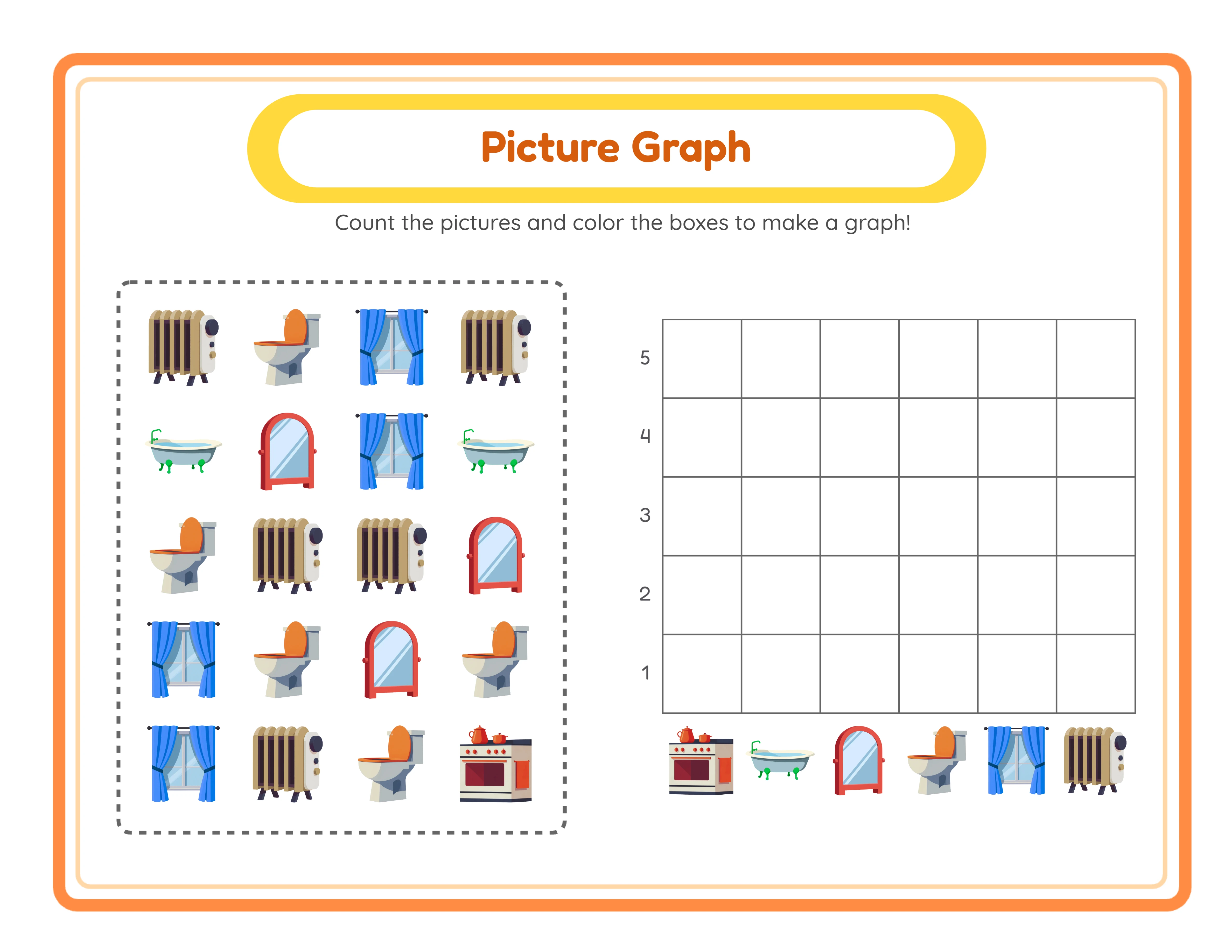
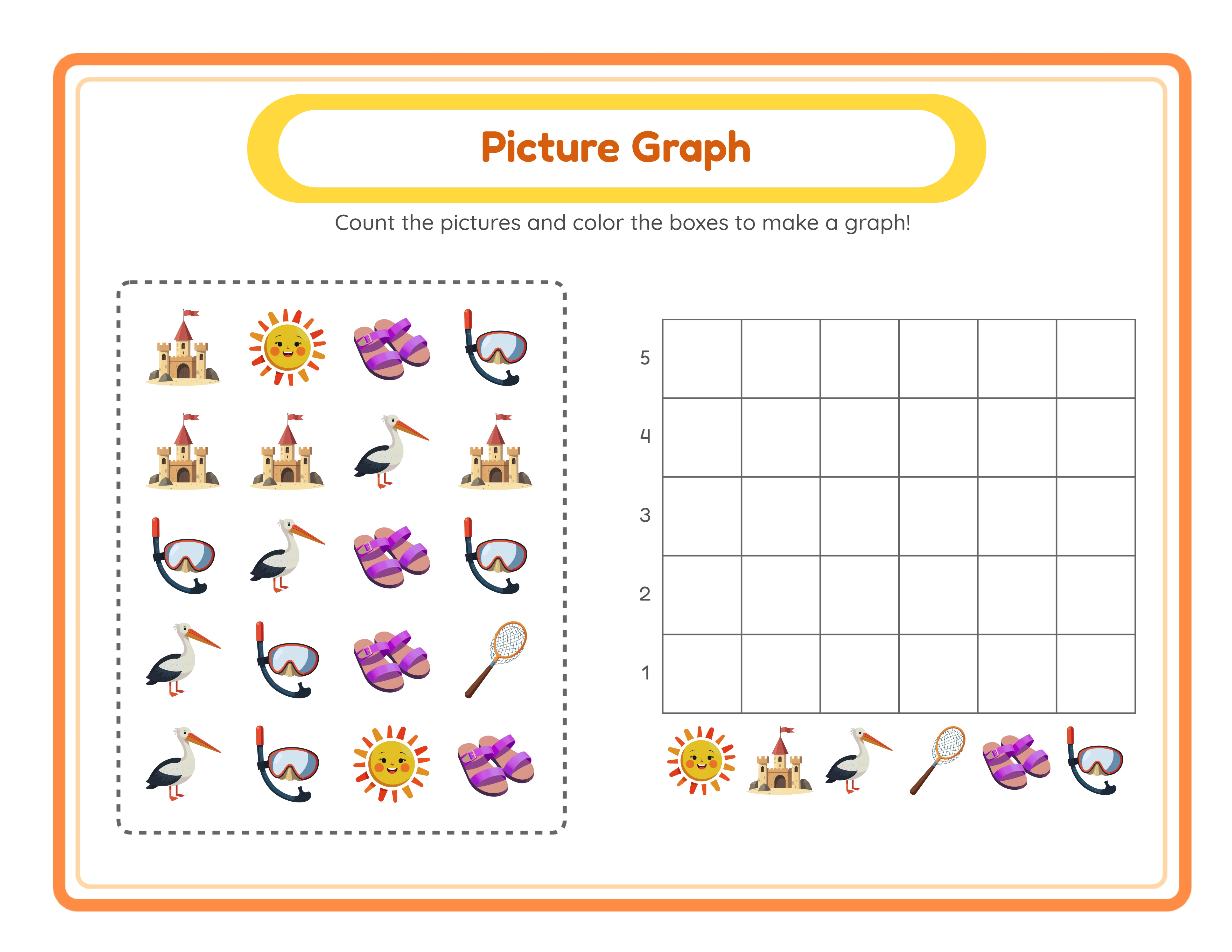
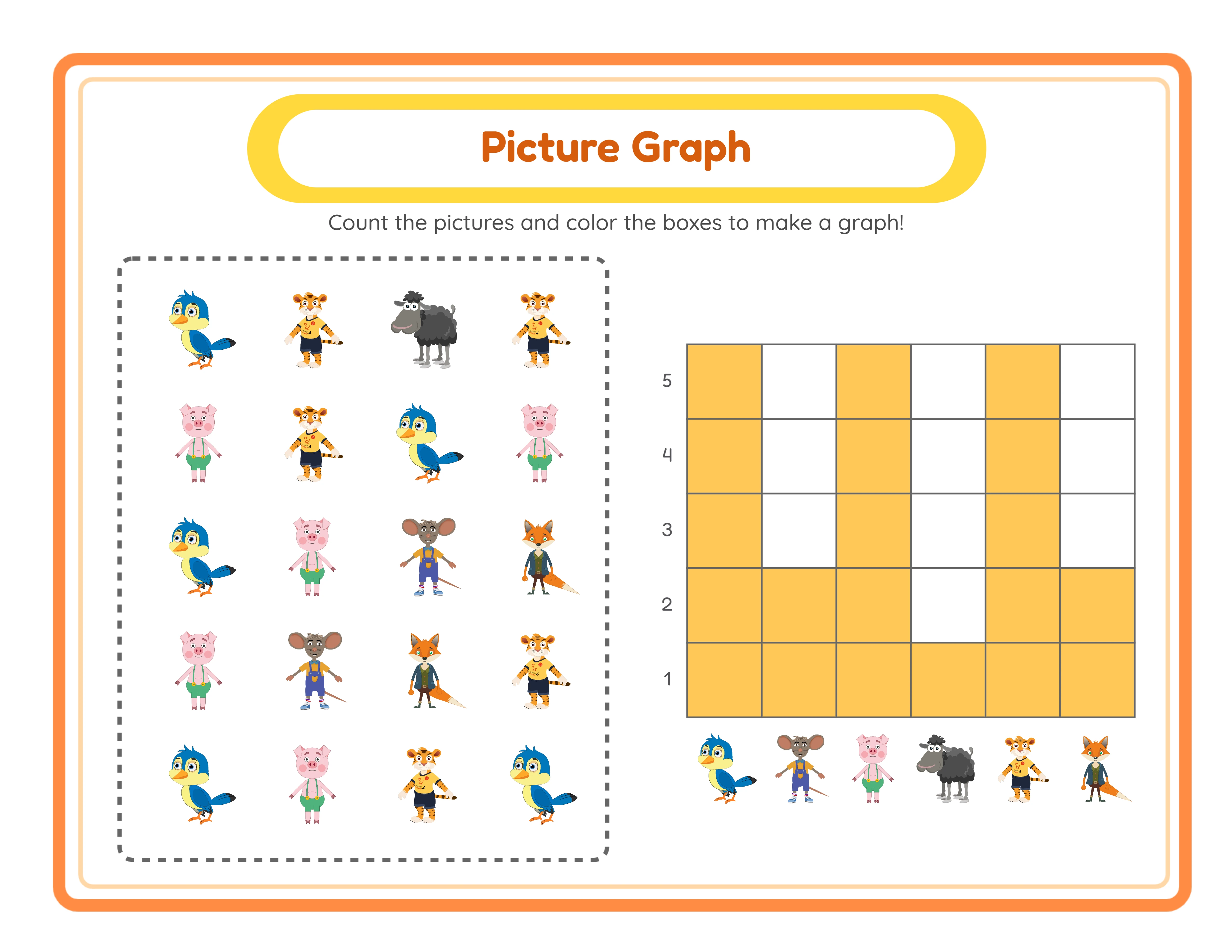
First, it arranges 20 scattered icons from your 6 selected image types in a 4×5 grid with a dashed border at the top of the page. Each image type appears 1–5 times in a random distribution, so every generation produces a unique counting challenge. The scattered arrangement prevents solvers from simply counting rows or columns — they must visually scan and identify each image type individually.
Below the grid, a 6-column × 5-row bar chart appears with columns labeled by each image type and rows numbered 1–5 from bottom to top. Solvers count how many of each image type appear in the grid above, then color or fill the corresponding number of cells in the matching column.
An auto-generated header displays a localized "Picture Graph" title and counting instructions in a styled yellow pill (#FFD93D) with an orange border frame. This header adapts automatically to all 11 supported languages when you switch the UI language.
Examine the generated worksheet carefully. Verify that all 6 image types are clearly distinguishable in the grid. Check that the bar chart labels match the scattered images above. If you want a different random distribution, simply click Generate again — the app produces a completely new arrangement every time.
5
Review the Auto-Generated Answer Key
Click the Answer Key tab next to the Worksheet tab to view the auto-generated solution. The answer key shows the same image grid and bar chart, but the correct cells are filled with yellow (#FFC857) highlighting showing exactly how many of each image type appear in the grid.
The answer key generates simultaneously with the worksheet. There is no separate creation step, no manual counting, and no possibility of error. When you click Generate on the Worksheet tab, the Answer Key tab updates at the same time with the matching solution.
This dual-canvas system is your biggest production advantage. Competing sellers who create graphing worksheets manually must count every image and fill every answer key cell by hand — a tedious process prone to mistakes. The Chart Count Maker eliminates this entirely. You can generate 15–20 unique worksheets per theme session, each with a verified answer key, in the time it would take to manually create and check a single worksheet.
Buyers specifically search for graphing worksheets "with answer key" on every marketplace. Including the answer key with every product is not optional — it is a baseline expectation. The auto-generation feature ensures you never ship a product without one.
6
Add Solver Fields and Customize the Header
Check the Include Name/Date box to add formatted "Name: ____" and "Date: ____" fields to the worksheet (Fredoka 18px #333). This single checkbox transforms a generic printable into a structured group activity. Buyers on Gumroad specifically search for "group-ready" and "print-and-go" resources with solver identification areas built in.
The auto-generated header automatically displays the "Picture Graph" title and counting instructions in whichever UI language is active. Switch between English, German, French, Spanish, Portuguese, Italian, Dutch, Swedish, Danish, Norwegian, and Finnish to generate headers in any of these languages. The worksheet content itself — scattered images and numbered bar chart cells — uses universal visual elements that work identically in every language without modification.
This localization capability creates a unique product opportunity. You can generate the same worksheet with headers in multiple languages and sell language-specific versions on international marketplaces. One creation session produces globally sellable products with zero translation effort beyond switching the UI language.
7
Customize with Text Tools and Canvas Editing
Use the Text Tools panel to add custom titles, labels, or instructions to your worksheet. Seven font choices are available: Lexend Deca, Baloo 2, Nunito, Quicksand, Fredoka, Arial, and Verdana. Adjust text outline width from 0 to 10 with 0.5-step granularity to create readable headings that stand out against any background.
The full Fabric.js canvas supports drag, resize, and rotate operations on every element. Use layer controls to manage stacking order — move elements forward or backward, lock finished elements in place to prevent accidental changes. Zoom from 25% to 300% for precision placement of text and decorative elements.
Undo and redo up to 20 history states with Ctrl+Z and Ctrl+Y. This gives you freedom to experiment with layouts, text placement, and styling without worrying about losing earlier work.
For product creation, consider adding a custom title like "Count and Graph — Farm Animals" or branded footer text with your shop name. Consistent text styling across a bundle (same font, same size, same position) creates a professional product line that buyers recognize as cohesive and trustworthy.
8
Download All Four Files
The Chart Count Maker produces four files per generation session. The Worksheet tab offers worksheet JPEG and worksheet PDF downloads. The Answer Key tab offers answer key JPEG and answer key PDF downloads. All files render at 300 DPI for professional print quality.
Toggle grayscale before downloading for ink-friendly versions ideal for bulk printing and Amazon KDP black-and-white interiors. The grayscale toggle applies to the currently active tab, so you can export a color worksheet with a grayscale answer key or vice versa.
For marketplace listings, export the JPEG versions as listing preview images and the PDF versions as your deliverable product files. Buyers want to see exactly what they are purchasing, and the JPEG preview serves this purpose while the PDF maintains perfect formatting across all devices and printers.
To build a complete product bundle, generate multiple worksheets by clicking Generate repeatedly with the same or different themes. Each click produces a new random distribution of 20 icons, creating a unique counting challenge. Download all four files after each generation, then organize them into themed folders for your product packages.
The free trial with watermark produces fully functional exports with a visible watermark overlay. This lets you evaluate print quality, verify formatting, and create test prints before purchasing a commercial license. The commercial license removes the watermark from all exports, producing clean files ready for sale.
.webp)




.webp)